



Sergio Marchionne: the genius who saved Fiat, conquered Chrysler and lost himself in success
In 18 months Fiat loses Gianni and Umberto Agnelli. The company has no leader and no money. Before he dies, Umberto hands everything to an Italian-Canadian manager nobody knows. In this story I trace how Sergio Marchionne saved a company given up for dead, from the Grande Punto to the Chrysler coup bought without a dollar, and where he went wrong in his last years, repeating Romiti's mistake. At the end, 5 lessons and 2 warnings for anyone running an SME.
We need your consent to play it: YouTube uses cookies that may profile what you watch.
Cookie preferences- Act immediately, cut immediately. When a company is in crisis, time is enemy number one.
- Look for the opportunity in other people's crises. To everyone else Chrysler was a corpse, but Marchionne saw an opportunity in it.
- The brand is the most valuable asset you have. A brand cannot be copied.
- Never forget the product. Customers judge the company by what they buy.
- Don't make the company dependent on you. With no succession plan, the group lost its bearings when he died.
The collapse of Fiat
In 18 months Fiat loses Gianni Agnelli and Umberto Agnelli. The company has no leader and no money. But before he dies Umberto makes one last move: he hands everything to an Italian-Canadian manager nobody knows. His name is Sergio Marchionne.
This is the story of a genius who saved Fiat by conquering Chrysler and in the end devoured himself. We will look at the many positive sides, everything he did for Italian industry, and at the end also the negative side which, in my judgement, led to the current crisis of the Italian car industry.
The context is Italy at the start of the 2000s. The Fiat that Vittorio Ghidella had taken to the top of Europe is a distant memory: after he left in 1988 there was a long decline, with mediocre models and falling market share. Romiti, his successor, chose finance over product and history proved him wrong: Fiat Auto is losing hundreds of millions of euros a year. If you neglect your own business, product development, customer care, brand positioning, to develop unrelated activities, the market will inevitably present the bill.
The GM deal and Fresco's trap
Before Marchionne we have to talk about Paolo Fresco, whom Gianni Agnelli made chairman of Fiat in 1998. Born in Genoa, a primary-school classmate of Paolo Villaggio, nicknamed Mr Globalization, he had made an entirely American career, rising to vice chairman of General Electric. A man of business, of relationships, of deals. And what does he propose to the Avvocato? Selling Fiat Auto. Agnelli replies that it is the right thing to do, but that his grandfather, the founder, would turn in his grave: do it, but only after his death.
Faced with this veto, Fresco looks for a gradual alternative and begins talks with the multinationals. With Mercedes nothing comes of it: they offer 10 billion, Fiat asks for 12, and not even a meeting in New York between Schrempp and the Avvocato is enough. Then comes the bluff, the same one Enzo Ferrari pulled when he brought in Ford's Americans to raise the price with Fiat. Fresco calls General Motors back, then the largest car company in the world, and goes all in: we are closing at 12 billion with the Germans, we sign in 15 days, do you have anything to offer? GM accepts the 12 billion but prefers to start by taking 20%. Fresco asks for guarantees and, with the Mercedes bluff on the other side, gets the clause: at Fiat's request, GM would be obliged to buy the remaining 80%.
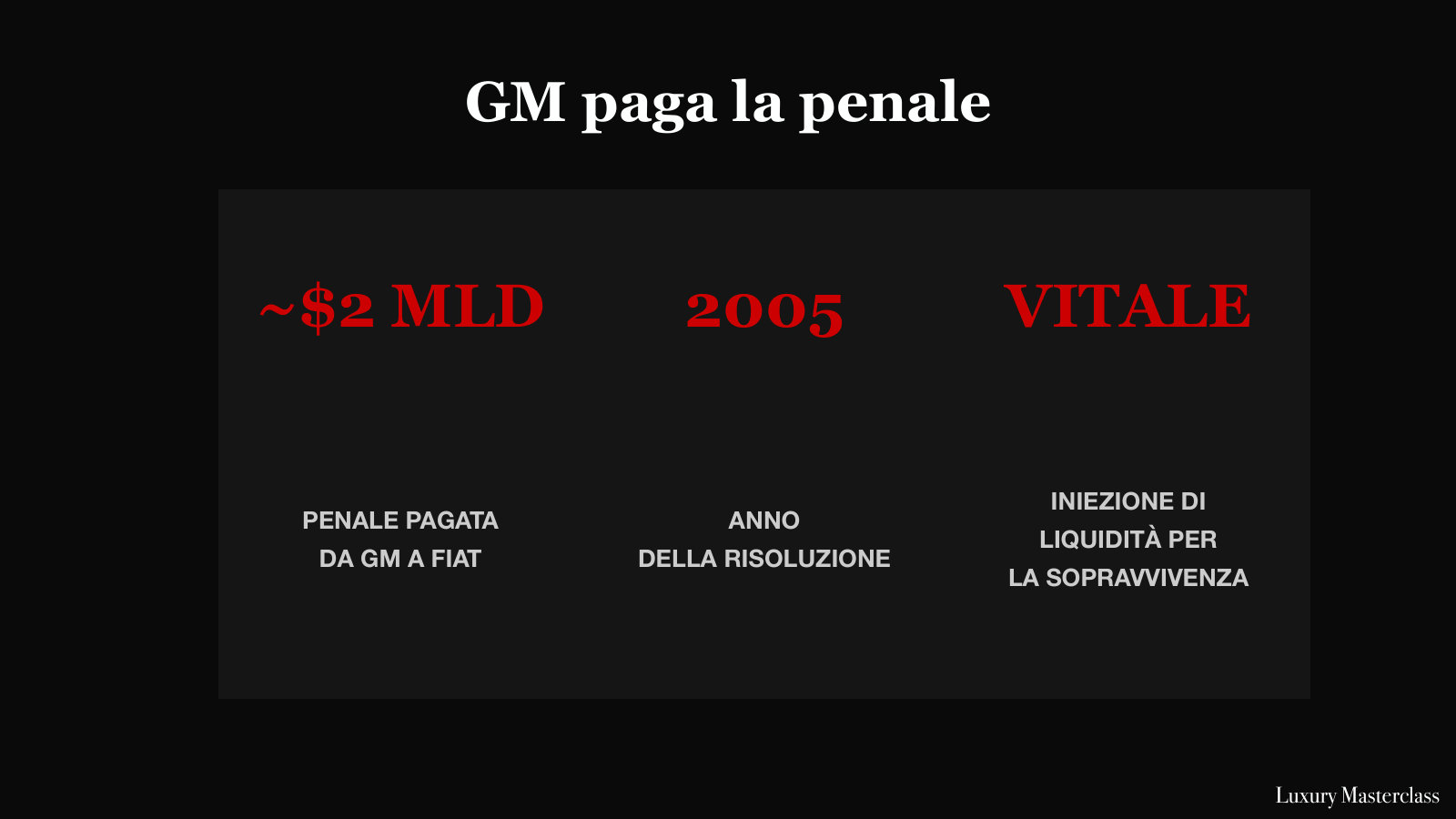
GM takes 20% of Fiat Auto and, by a certain date, must buy the remaining 80% or pay a penalty. The Americans thought they were buying Fiat at a bargain price, but Fiat sinks even lower and the accounts are disastrous: buying it would mean buying a problem. In 2005 GM chooses to pay the penalty, almost $2 billion. A vital injection of cash, which arrives when Marchionne is already in charge. This stroke of genius by Fresco is the foundation stone of Marchionne's Fiat and of Fiat Chrysler: as Ghidella made the Uno, Marchionne will use that money to launch the Grande Punto.
The deaths of the Agnellis and Marchionne's appointment
On 24 January 2003 Gianni Agnelli dies. Fresco, who was the Avvocato's man and not well regarded by Umberto, resigns. Umberto Agnelli takes the helm of Fiat with a single mission: to find the right chief executive. The choice falls on an Italian-Canadian manager unknown to the general public, who doesn't come from cars, doesn't come from Turin, doesn't come from the establishment drawing room. A year later Umberto dies too: within a few months Fiat loses both its reference points. The family is on its knees, the company is on its knees, but Umberto has left a legacy, the appointment of Sergio Marchionne.
Marchionne is an outsider. Born in Chieti in 1952, he emigrated to Canada at 14, took a degree in philosophy, then in law, then an MBA. He is an intellectual and builds a career in finance and consulting. He has never worked in cars. The blue jumper and the cigarettes will make him a unique figure. He doesn't know the rules of the car business? All the better: Umberto wanted an outsider to turn the company upside down. He doesn't come from Turin's drawing rooms, he owes nothing to anyone, he isn't afraid to take unpopular decisions. In June 2004 he becomes CEO of Fiat Auto at 52 and finds himself facing a company losing €5 million a day.
The top team is made up of Luca Cordero di Montezemolo, chairman representing the family, who brings the name, the image and the institutional credibility of the man who had already relaunched Ferrari after the death of the Drake; John Elkann, Gianni Agnelli's grandson, vice chairman; and Marchionne, CEO with carte blanche. Real power, though, is entirely in Marchionne's hands. Two names like that in the same room work for a while, and the relationship with Montezemolo is bound to become complicated.
The turnaround plan: product and speed
Marchionne does what Ghidella did, but even more heavily: Ghidella had grown up in the company and respected the people who had grown up with him; Marchionne is an outsider and comes in with the axe. He removes layers of hierarchy, shortens the chain of command, sets himself up in the factory and talks to everyone. Years later, when he acquires Chrysler, the American programme 60 Minutes will show the top-floor office in the Auburn Hills tower, iconic and empty: Marchionne had installed himself next to the engineering and design offices, because the only way to be saved is by making cars, and the cars are made by the young people. He fires the managers who don't deliver results, promotes those who can, cuts costs mercilessly, renegotiates supplier contracts, ends unfavourable agreements. And above all he relaunches the product.
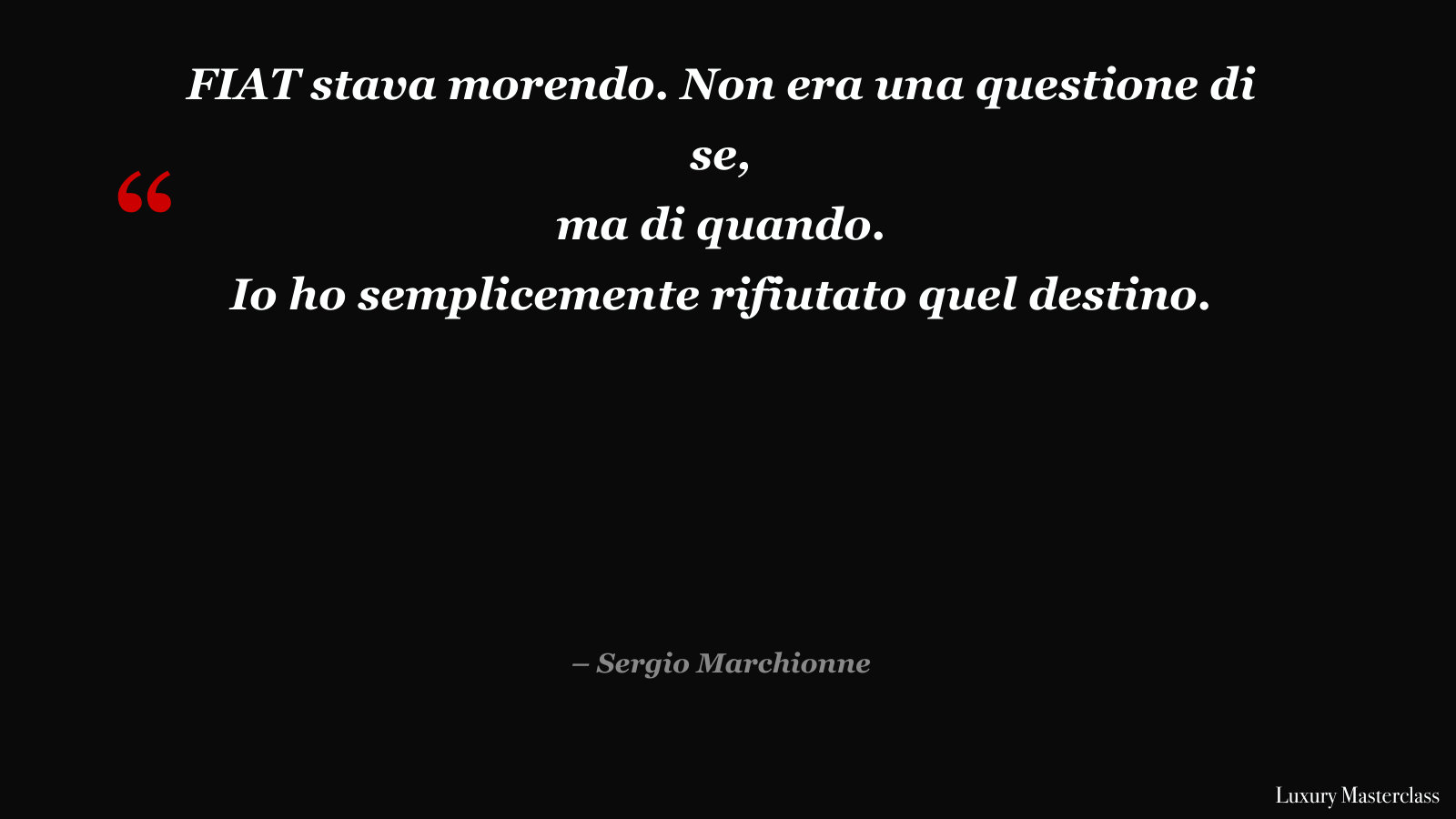
Like Ghidella, he understands that without cars people want to buy there is no future. You can keep doing finance, but the blanket is short: the only finance that counts is the money customers give us in exchange for a product or a service. External finance can be useful, but it must not be the company's core business.
So the first model of the Marchionne era is born, the Grande Punto designed by Giorgetto Giugiaro, perhaps the greatest Italian industrial designer along with Walter de Silva. A modern car that sells, marking Fiat's return to competitiveness in the B segment and showing the market that Fiat can still make cars people want. Built in Melfi and Turin, and later in Brazil and India for local markets, with a launch price in Italy of just over €11,000 for a genuinely beautiful car. And after dark years Fiat's brilliant marketing returns too, the Ghidella school, with the launch advert for the Grande Punto. Three years later comes the record: one million Grande Puntos built in Melfi. It is a liberation. I remember those years, when Fiat risked not paying salaries and Berlusconi summoned the company's top management to Arcore. And I remember that in 2018 the last Punto built had no official photo, just a photo taken on a phone by the people in the factory and posted on Facebook. Companies are made above all of people, and when you build a team that works, an attachment to the product is born that makes the difference.
The 500: the rebirth of an icon
In 2007, two years later, comes the Fiat 500, a project championed by Lapo Elkann, then head of marketing. Lapo was mocked for his personal troubles, but in Fiat's marketing he was a genius, and he should have been surrounded by more structured managers. Fiat lived off the 500 for 20 years, and the credit is his. Not only the 500: all the merchandising tied to the Fiat brand, which until then had been a byword for cheap cars that broke down, and initiatives like the Fiat sweatshirt, which today may seem trivial but became a fashion phenomenon sought after by the most important people in Italy, resold for hundreds of euros in specialist shops. The relaunch of the image culminated in the grand presentation of 2007, entrusted to the same company that staged the opening of the Turin 2006 Olympics. The 500 becomes an icon built in millions: it sells in Europe, begins to win over the United States, and is launched in London in the luxury department stores of Oxford Street. It is a cult object and proof that an Italian brand, when done well, is worth its weight in gold.
Chrysler: the deal of the century
So far we are in classic Fiat Auto territory: Fiat, Alfa Romeo, Lancia. Then comes 2008 and the great crisis, which in Europe we are still paying for now, while the United States has doubled European GDP. In 2008 the subprime mortgage crisis hits the whole of American society: finance, property, income, consumption. I remember customers in the United States who halved their architecture practices from 30 to 10–15 people in a week, shrinking their offices with plasterboard walls.
In this scenario the Chrysler opportunity arises. The smallest of Detroit's Big Three was owned by an investment fund, Cerberus Capital Management, which had bought it at a political price from the Germans at Mercedes, the ones who hadn't done the deal with Fiat and had acquired Chrysler in what turned out to be a bloodbath. But a fund doesn't know how to run a car company: in 18 months Chrysler burns through cash and collapses. The Obama administration rescues it with a bailout, but someone is needed to run it. Marchionne puts himself forward, flying between Turin and the United States to meet White House officials and then Obama, and secures a managed bankruptcy: Chapter 11, our equivalent being the concordato. The New York Times of 1 May 2009 announces on its front page that Chrysler is filing for bankruptcy and that the union and Fiat will take control.
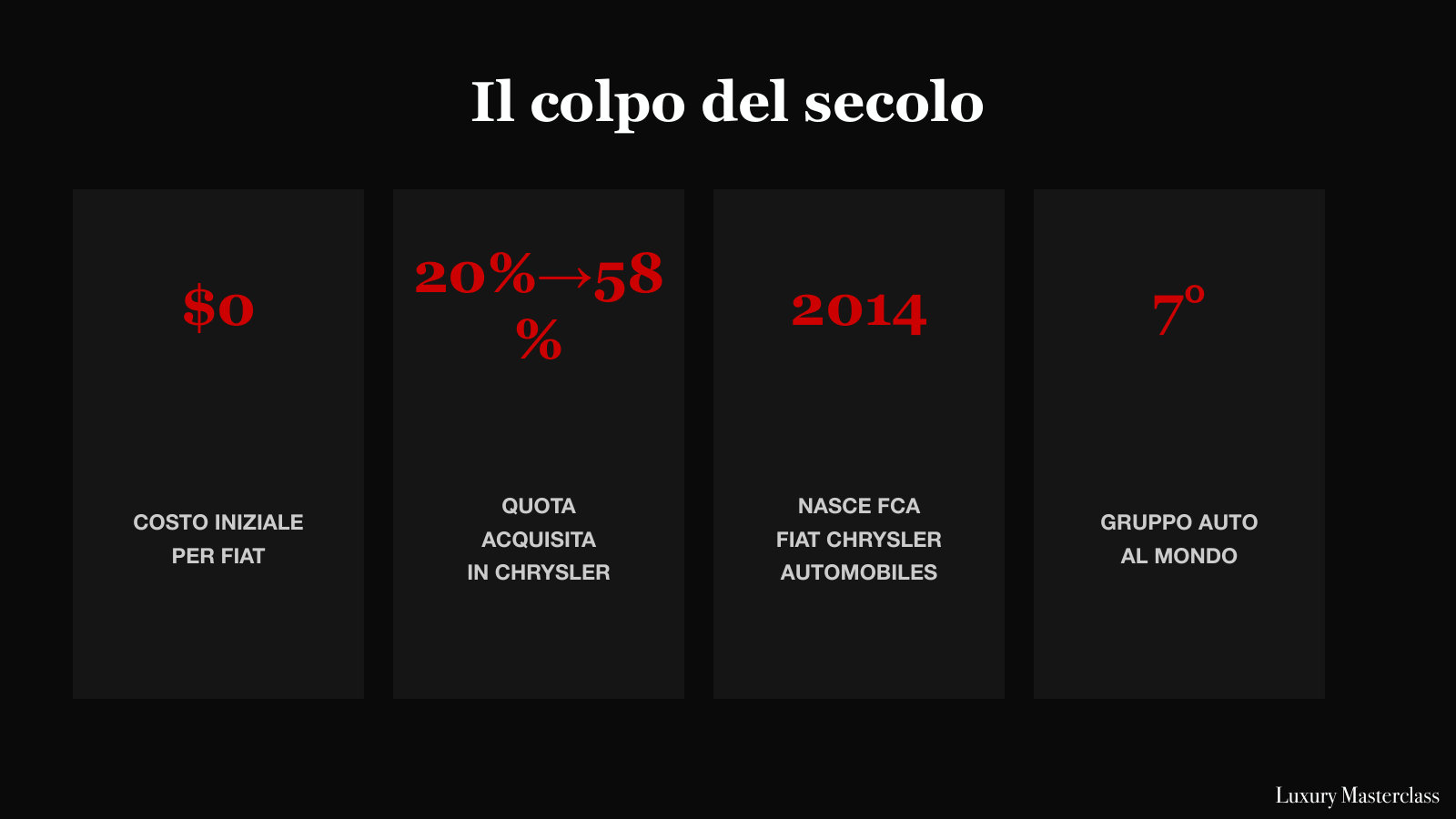
Everyone, above all in Europe, sees a corpse. Marchionne sees an opportunity: the American brands, the production and above all a ready-made distribution network in the most important market in the world. He takes 20% of Chrysler without paying a dollar, with money lent by the US government, in exchange for what Chrysler lacks: technology, platforms, small engines. Washington accepts, and it is a masterstroke. Fiat comes in at 20%, can rise to 35% by meeting operational targets and then beyond 51%, taking control. The numbers of the deal of the century: zero euros out of Fiat's coffers, a stake that grows from 20% to 58%, and the merger of Fiat and Chrysler that creates the seventh-largest car group in the world. Marchionne not only relaunches Chrysler, he repays the government loan early and with interest, a shrewd political move: like Iacocca, he takes the government's money and gives it back. History repeats itself, and Marchionne knows it very well.
2014: FCA is born
In 2014 Fiat Chrysler Automobiles is officially born: registered office in the Netherlands, tax domicile in the United Kingdom, listed in New York. A global group with Fiat, Chrysler, Jeep, Dodge, Ram, Alfa Romeo and Maserati, and Marchionne at the top of it all. The best part of the story begins: the development of the FCA range. In Europe, the relaunch of the upper range with Alfa Romeo, Giulia and Stelvio, and with Maserati, Ghibli and Levante, drawing heavily on the German legacy of the Daimler-Chrysler era. In the United States FCA becomes a money machine: Jeep prints money, Ram grows, the Chrysler 200 and 300, the minivan, the Dodge Challenger and Charger are restyled. The group generates record profits driven by the American market.
And Marchionne discovers the goose that lays the golden eggs. SUVs are exploding at the expense of saloons, and he finds in his portfolio the very synonym of off-roader: Jeep. He understands its potential before anyone else and pushes it globally, with new markets and new models, even building it in Italy, in Melfi, with the Renegade. On its own Jeep is worth more than the whole of Fiat Europe: proof that the right brand, well positioned, generates enormous value. At Fiat at the time people used to say that this month too the salaries had been paid by Jeep and Iveco.
It is the peak: CEO of the seventh-largest car group in the world, chairman of Ferrari after spinning it off and listing it on the stock exchange, chairman of CNH Industrial. An Italian-Canadian manager sitting at the table with the biggest in the world. The numbers are a triumph nobody can dispute: in 2004 Fiat was losing €5 million a day; in 2017 FCA generates more than €110 billion in revenue with accounts in profit. From a company given up for dead to a global empire in 13 years.
The peak and the mistakes: Europe, Montezemolo and Ferrari
On balance the strengths clearly outweigh the flaws, but it is right to talk about the mistakes too, so as not to repeat them in our own companies. At this point in the story something changes, and Romiti's mistake repeats itself: Marchionne stops investing in the Fiat product in Europe. In 2018 he blocks the birth of the new Punto, a car built in more than 9 million units, an icon of the B segment, several times car of the year and several times Europe's best-selling car. It is as if Volkswagen stopped making the Golf. The European range ages, the Punto is not replaced, and the Tipo is a stopgap: a car meant for the Turkish market, built by Tofas, which Altavilla persuades Marchionne to bring to Europe at a low price to fill a gap in the range in the C segment. All the group's profitability comes from North America, from Jeep, Ram and Dodge. Europe becomes a colony.
It is the mistake history should have taught. In 1988 Romiti chose finance over product and sent Fiat into crisis. In 2015 Marchionne chooses North America over Europe: the same mistake. Ghidella knew it: without product there is no future. But success blinds, and Marchionne always wants more. In 2014 he pushes Montezemolo out of the Ferrari chairmanship: two irreconcilable visions, Montezemolo wants exclusivity, Marchionne wants volume. He also becomes CEO of Ferrari. Too many roles, too much concentrated in one man. His interest is to list it on the stock exchange: certainly a financial coup, but was it in the company's interest? In my view, not much. Shareholders are happy because the share price has risen a great deal since the listing, but in the long term this dilutes the Ferrari brand. Montezemolo followed Enzo Ferrari's strategy: build one car fewer than the market asks for, at most 7,000 a year, and beyond that threshold a waiting list of one, two, three years. Marchionne wanted to increase production.
What I call the abandonment of the European product begins. Fiat models are not renewed. Lancia is cut to a single model, the Ypsilon, after the tragic interlude of Chryslers imported into Italy with nothing but a change of badge. Giulia and Stelvio miss their sales targets and become a source of losses, because development cost several billion. The Italian heart of the group empties out; only the name remains. Marchionne's solution is another merger: he tries with General Motors, and is publicly rebuffed first by its chief executive and then by its chairman. The point was clear: to prepare FCA for a marriage with a large group.
Death and legacy
Marchionne dies, in a manner of speaking, on the job. His last public appearance is in June 2018 in Rome, where he hands over Jeeps and Alfa Romeos to the Carabinieri and takes his leave by recalling that his father was a marshal in the force and that in the Carabinieri he found the values of his upbringing: seriousness, honesty, a sense of work, discipline, a spirit of service. The best farewell he could have given of himself. On 25 July 2018 he dies in Zurich from complications after surgery, aged 66, after 15 years of working 18 hours a day in every country in the world. The news is a shock to the car and finance worlds. No succession plan had been prepared.
The legacy is positive but ambivalent. He saved Fiat when everyone had written it off and built a global empire from nothing. But he left an unbalanced group, strong in the United States and weak in Europe, with the design drawers in Turin rather empty, and a leadership vacuum impossible to fill, which is not his fault. Mike Manley takes the helm as interim CEO pending the merger, and John Elkann takes on the search for the ideal partner. FCA's accounts remain excellent, because without development in Europe those costs disappear, and in the United States sales bear him out: the company is in profit with its accounts in order. In 2021 Fiat Chrysler merges with PSA and Stellantis is born, the fourth-largest car group in the world. But that is another story.
The lesson for entrepreneurs: 5 lessons and 2 warnings
1. Act immediately, cut immediately
If things are not going well, don't wait. Marchionne didn't wait: in the first 60 days everything changed. When a company is in crisis, time is enemy number one.
2. Look for the opportunity in other people's crises
To everyone else Chrysler was a corpse, but Marchionne saw an opportunity in it. He bought without money because he offered what nobody else could: technology and management.
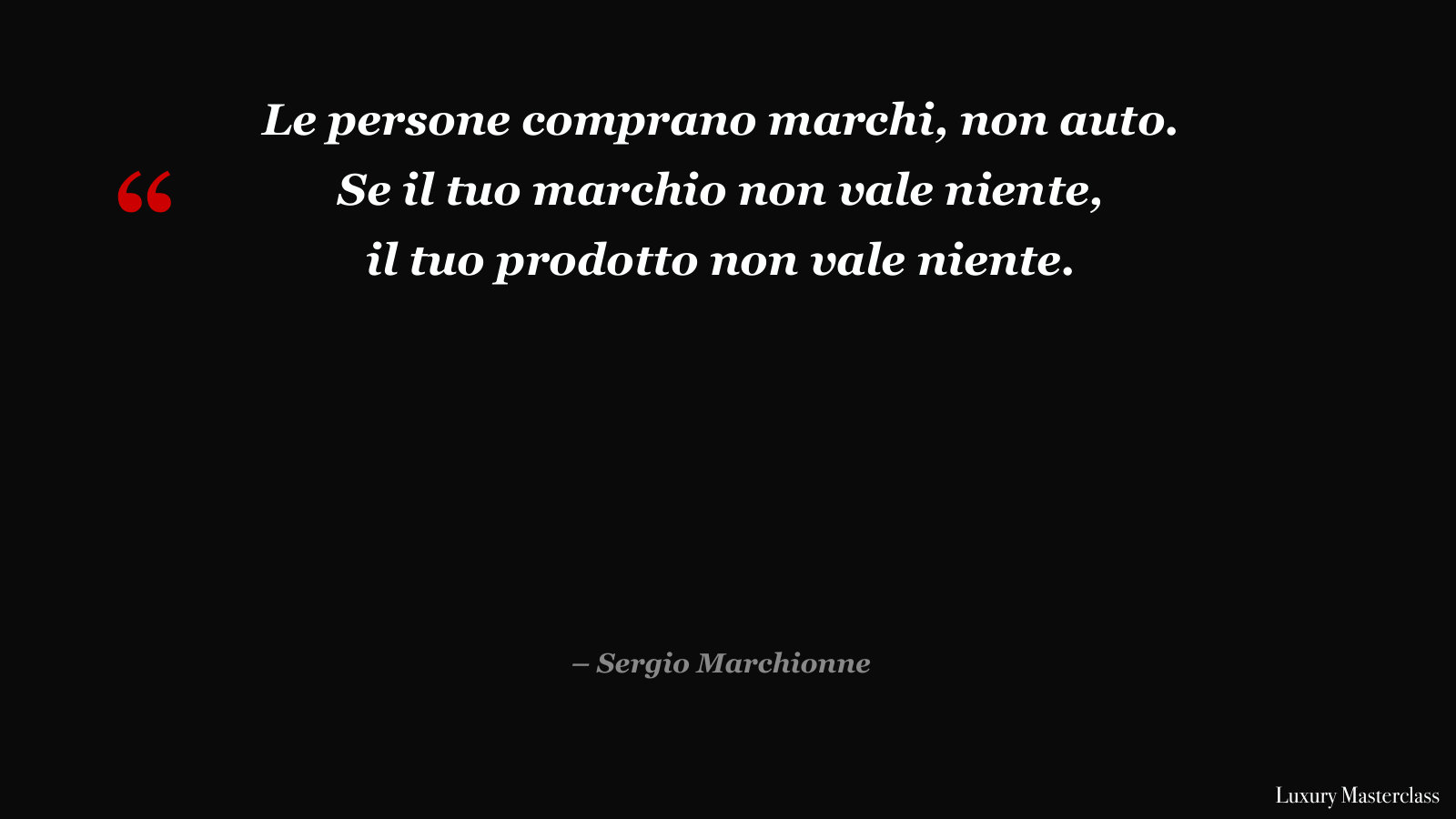
3. The brand is the most valuable asset you have
Fiat 500, Jeep, Ferrari: Marchionne understood the power of brands. With cars he was selling belonging and lifestyle. Invest in your brand, because a brand cannot be copied.
4. Never forget the product
The brand is essential for positioning the company and selling at high prices, but customers judge the company by the product. They give you money in exchange for a product or a service, and you are judged by how you deliver it.
Warning: the same mistake as Romiti
In the end Marchionne made the same mistake as Romiti: he stopped investing in the European product to chase the big merger. Ghidella knew it, Iacocca knew it: the product comes before everything.
5. Don't make the company dependent on you
FCA depended entirely on Marchionne. No succession plan: when he died, the group lost its bearings. The most important lesson for every entrepreneur is to build a company that works even without you. I know it is hard, but you have to start laying the foundations for delegation.
The pros still clearly outweigh the cons. Marchionne did the impossible: he saved Fiat and conquered Chrysler, creating the seventh-largest car group in the world. But his story also has a dark side, the concentration of power and the abandonment of the product development that had made him great.
Frequently asked questions
How did Marchionne buy Chrysler without money?
In 2009 Chrysler was bankrupt and the Obama administration had rescued it with a bailout. Marchionne obtained 20% without paying a dollar, using money lent by the US government, in exchange for technology, platforms and small engines that Chrysler didn't have. The stake later rose to 58% and the loan was repaid early.
What was Paolo Fresco's put clause?
In 2000 General Motors took 20% of Fiat Auto with the obligation, at Fiat's request, to buy the remaining 80% or pay a penalty. With Fiat's accounts collapsing, in 2005 GM chose to pay almost $2 billion: the cash that financed the turnaround.
What was Marchionne's mistake?
In his last years he stopped investing in the European product to chase the big merger: the Punto was not replaced, Lancia was cut to the Ypsilon alone, Europe was treated as a colony. The same mistake Romiti made in 1988. On top of that he concentrated everything on himself with no succession plan.
What can an SME learn from Marchionne?
To act immediately when the company is in crisis, to look for opportunities in other people's crises, to invest in the brand without ever neglecting the product, and to build a company that works even without its founder.
One live webinar a month.
One topic, questions from the business owners who join, answers without sales slides. It's free and in Italian, and it's the simplest way to get to know us.
See the next webinar →