



Who killed the Italian car? From 2 million cars in 1989 to 238,000 in 2025
In 1989 Italy built 2 million cars a year and was the fifth-largest economy in the world. Today it produces 238,000, fewer than in 1956, while Spain, with no national giant, makes 2.38 million. In this video I line up the data on production, energy, wages and industrial policy to answer one question: who killed the Italian car? And what can someone who runs a company, and cannot move it abroad, learn from it.
We need your consent to play it: YouTube uses cookies that may profile what you watch.
Cookie preferences- In 1989 Italy produced 2 million cars a year. In 2025 it produced 238,000, fewer than in 1956.
- The world still wants cars. Global production has gone from 48 to 93 million. Spain, with no national giant, produces 2.38 million.
- The internal causes: after Ghidella, the accounts before the product. Today only one Stellantis car in 10 is made in Italy.
- The external causes: energy at twice the price of Spain and France, a stagnant GDP, the tax wedge, bonuses in place of industrial policy.
- The lesson for business owners: Ferrari produces 10,000 cars and is worth more on the stock market than Stellantis. For a company, margin and value count for more than turnover and volume.
1989: Italy on top of the world

It is 1989. Italy builds 2 million cars a year and is the fifth-largest economy in the world. Industry is booming, savings are growing, people own their homes and there is a second car in the garage. Prosperity belongs to everyone, and the world looks at us with envy. 37 years later those lines are at a standstill: of the 2 million cars, 238,000 remain. This is a story of choices.
The car market is the most transparent and honest thermometer of manufacturing, because the data is available month after month. The aim of this video is to understand how we went from 2 million cars produced in 1989 to 238,000 in 2025, and what someone who runs a company can learn from it.
Let's go back to that year. The five-party coalition is in government, with De Mita as prime minister and then, after the July handover, Andreotti. It is the year of Trapattoni's record-breaking Inter, of Maradona's Napoli winning the UEFA Cup, of Sacchi's Milan winning the European Cup. Italy is preparing for the 1990 World Cup and Pink Floyd play in front of Piazza San Marco.
The fifth-largest economy in the world
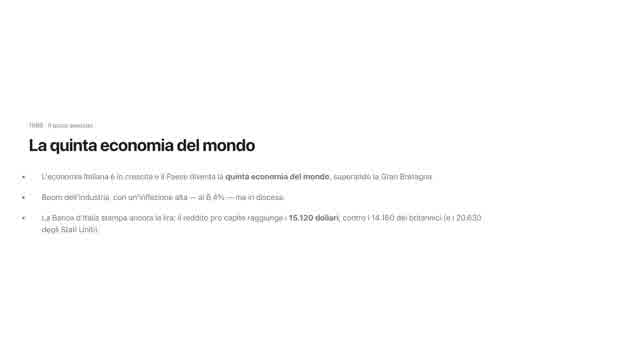
The Italian economy is growing and the country becomes the fifth-largest economy in the world, overtaking Britain, so much so that the British accused us of fiddling the statistics. Inflation is at 6% but falling; Ciampi runs the Bank of Italy, which still prints the lira. The most significant figure, beyond GDP, is per capita income: 15,120 dollars for an Italian against 14,160 for a Briton and 20,630 for an American. A 27% gap with the United States, which, given the size of the two countries, is an extraordinary result. We will see shortly how it has evolved.
The 1980s are the decade of headlong growth: exports soar, the Milan stock exchange multiplies its value, Made in Italy conquers the planet. Armani and Versace dress the world, Ferrari makes it dream, Italian design and furniture set the style. Italian families are the biggest savers in the world. A second car, a home of your own, the seaside and the mountains for everyone. The middle class is at its peak, and the car is the symbol of all this.
Where 2 million cars were made
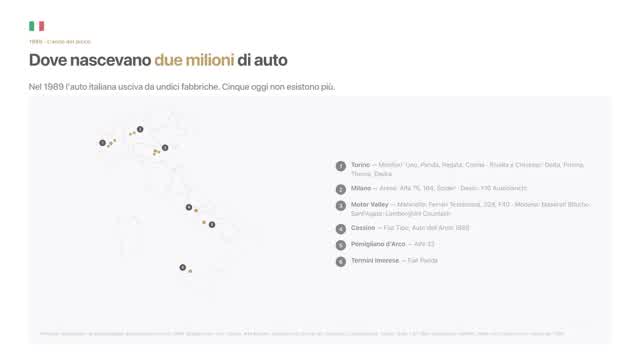
In 1989 the plants are running at full capacity, day and night, from north to south. In Italy Fiat produces the Uno, the Panda, the Tipo, the Ritmo, the Regata and the Croma, with the Uno and the Panda sweeping up sales and international awards. Lancia holds the slightly premium segment with the Y10, the Delta that triumphs in the world rally championship, the Prisma, the Dedra and the Thema. Alfa Romeo, the group's sports brand, produces the 33, the 75, the 90, later replaced by the 164, and the Spider. And the Motor Valley teaches the world a lesson with Ferrari, Lamborghini and Maserati.
There were 11 factories. Mirafiori in Turin for the Uno, Panda, Regata and Croma. Rivalta and Chivasso for the Delta, Prisma, Thema and Dedra. In Lombardy, Arese, where there is now a shopping centre, for the Alfa 75, 164 and Spider, and Desio, a few kilometres from where I am recording this video, for the Y10. Cassino, ultra-innovative at the time with the world's first robotised lines, where the 1989 car of the year, the Tipo, was born. Pomigliano d'Arco for the Alfa 33. And in Sicily, Termini Imerese for the Panda. Production spread across Piedmont, Lombardy, Emilia, Campania, Lazio and Sicily.
What is left: Italy in 2026
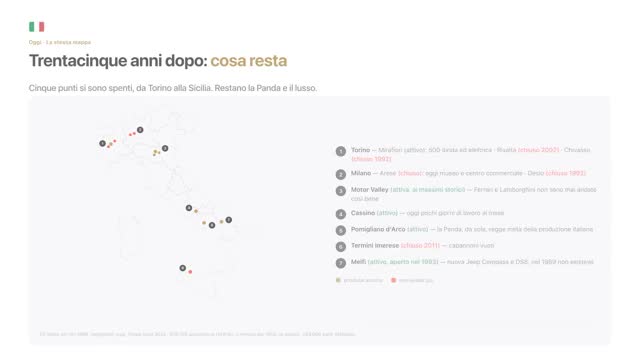
36 years later we have hit rock bottom: Italy produces 310,000 cars against 2 million in 1989, and the data shows no sign of recovery. Mirafiori works in fits and starts with the electric and hybrid 500; the hybrid version, introduced last year after years of failed sales of the electric one, is now suspended. Rivalta was closed in 2002, Chivasso in 1992, Arese houses a museum and a shopping centre, Desio has been closed since 1992 and the site is derelict. Cassino, the Alfa Romeo and Maserati Grecale factory, works a few dozen days a year because the product has not been updated. Termini Imerese has been closed since 2011, its sheds empty. In the Motor Valley, on the other hand, Ferrari and Lamborghini have never done so well and are at peak production. Pomigliano is the only plant running at full capacity, and Melfi, which did not exist in 1989, now produces the new Jeep Compass, the DS 8 and soon the Lancia Gamma: niche models, and I don't think they can keep a plant of that size going on their own.
The dramatic figure is that Italy produces fewer cars than it made in 1956. There was a small recovery in 2015, above 600,000 cars, in the Marchionne era. Then the decline to today's 300,000. There are three questions: what are the causes? Is it the same across Europe? Does the world no longer want cars?
The world still wants cars
The answer to the third question is no. Global production went from 10 million in 1950 to 48 million in 1990, up to a peak of 97 million before Covid and 93 million today. The world is hungry for cars. Since the 2000s the headlong growth has been Chinese, while Europe, the United States and Japan are declining or flat, but none of them has suffered what Italy has suffered. In 1990, when we were producing 2 million cars, China produced half a million. Today we produce 300,000 and China 34.5 million. And from being a maker of cheap cars, when the Germans opened factories with Chinese partners to produce the Volkswagen Santana, that is, the 1970s Passat, China has reached a medium-high level of quality and technology. It learned, it innovated, and now it is starting to export.
Europe compared
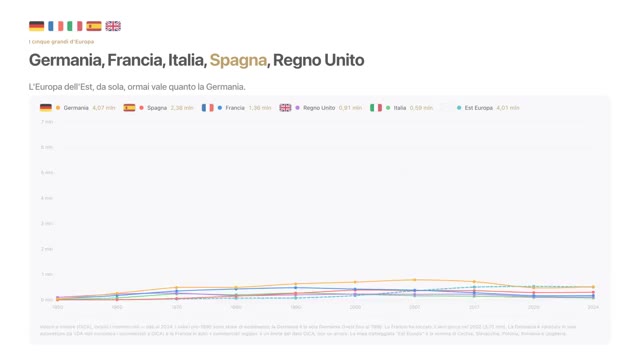
In Europe Italy is bottom of the table: it was the third or fourth-largest producer, today it is at its lowest. England followed the same pattern, and so did France. The exceptions are Spain, which I will come to shortly, and the Eastern European countries, which thanks to low labour costs now produce as much as Germany put together. And the Germans aren't laughing: in 2006 Germany produced 6.2 million cars, today 4 million, because it no longer exports as before to the United States, because of tariffs, and to China, which now prefers local production under Chinese brands. Today's news is that Volkswagen will close more plants in Germany.
The chart that hurts most is Italy against Spain. In 1990 Spain caught up with us at 2 million cars. From then on Italy has been in continuous decline, while Spain reached 2.38 million without a national car giant behind it, apart from Seat, once a Fiat brand and now Volkswagen. The Spanish, and above all their governments, offered companies a business-oriented ecosystem, with low energy costs and more flexible rules than ours.
Shares and markets
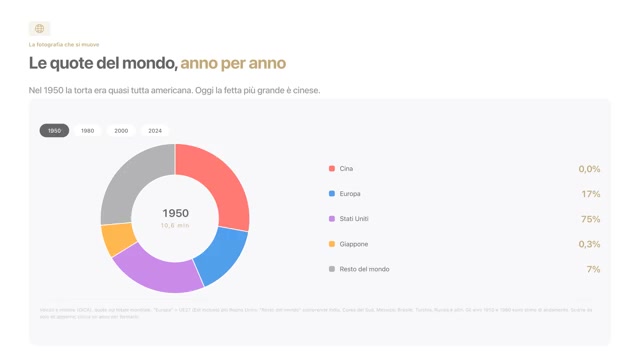
In 1950 the pie of global production was American, with Europe second. In the 1980s the Japanese giant wakes up. In 2000 the first Chinese slice appears, at 4%. In 2024 that slice is 34% and China is the largest car producer in the world; Europe produces 14 million cars, 15%, Japan 8 million, the United States 10 million. The same goes for registrations: China is not only the largest producer but also the largest market, with 34% of global registrations, against 16% for Europe and 17% for the United States.
The internal causes: after Ghidella, darkness
Why did Italian production collapse? In my view there are two families of causes. The first is internal to Fiat, later FCA, now Stellantis. The second is the ecosystem the Italian state offers manufacturing companies, and the absence of industrial policy.
On the internal side, the golden years bear the signature of engineer Vittorio Ghidella, chief executive of Fiat Auto and architect of the boom of the Uno, Croma and Tipo. There are two videos on this channel about it, one on Ghidella and one on Marchionne. After Ghidella, darkness: Romiti wins the showdown and puts finance ahead of the product. Cantarella runs Fiat from 1996 to 2002 with investments the market does not reward, such as the Lancia K and the second-series Delta. Then a string of chief executives with the company in deep crisis, Galateri di Genova and Morchio, until Sergio Marchionne, who literally saves Fiat, restores its finances and, with the Chrysler merger, creates FCA, leading it until his death. After him Mike Manley steers the group while cutting investment to zero, especially in Italy, up to the merger with PSA that creates Stellantis. And at Stellantis along comes Tavares, to whom I have devoted a separate video, because it was not a positive experience.
Where Stellantis produces
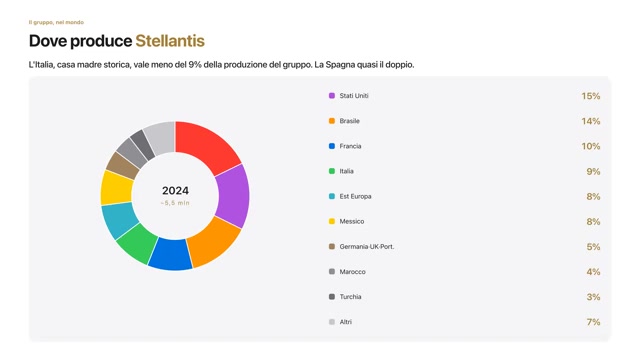
Today Fiat is called Stellantis: the fourth-largest car group in the world, with Exor, that is, the Agnelli family, as its largest shareholder. The group produces all over the world: Brazil accounts for 14% of production, France 10%, and Spain, surprisingly, is the leading production country with 18%. Italy is at 9%. Of every 10 Stellantis cars, one is made in Italy.
The external causes: a country that stopped growing
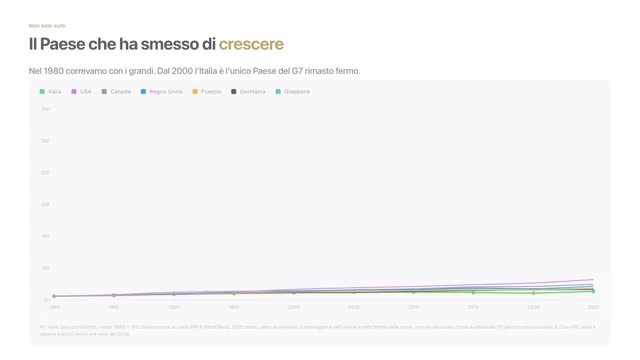
Compared with the 1980s the Italian context is dramatic: a declining economy, no industrial policy, an insane energy cost for manufacturers, stagnant salaries and a state with an appetite for taxes on labour. In 1980 we were running with the big ones; since 2000 Italy is the only G7 country that has stood still. After the 2008 financial crisis the United States was off at a gallop again, while we went through a second, all-Italian crisis: the Monti government's austerity went through taxes on property and industrial buildings, through the super-tax on large-engined cars, which drove those cars out to the rest of Europe and impoverished dealers and mechanics, and through the tax on boats. We never recovered from that.
The energy problem
If Italy had the same economic and political conditions as Spain, Stellantis could easily come back and invest here. If it doesn't, the reason is the cost of energy for manufacturing, which makes it impossible to be competitive in the mass market, which is Fiat's territory. The new Fiats, the Grande Panda and the derivatives we will see in a few months, are and will be produced in Spain, Serbia and Morocco to be imported into Italy. Italy has become a country of registrations: 1.6 million cars a year.
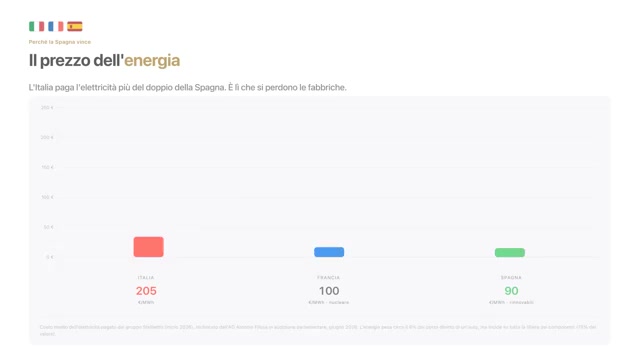
Italy pays more than twice as much as Spain for electricity: €205 per megawatt hour against €100 in France, which bet everything on nuclear, and €90 in Spain, which has a mix of renewables and nuclear. We have no nuclear and renewables have not been developed. Anyone with a factory, offices or a showroom knows that paying twice as much as France and Spain for their bills weighs on the income statement at year end by tens or hundreds of thousands or millions of euros, depending on size.
No industrial policy
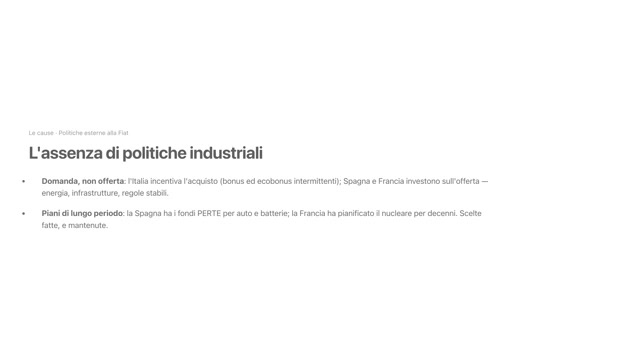
In recent years Italy has chosen purchase incentives with intermittent bonuses: the shutters bonus, the mosquito nets bonus, the taps bonus, the furniture bonus, the facades bonus, the superbonus. Bonus after bonus drugs the market. Then the bonus ends and the market falls. Those who managed to ride that wave did well, but it is like doping: like Ben Johnson in Seoul in 1988, who won the 100 metres and was disqualified. Politicians make extremely short-term moves to pick up a few points of approval.
The way forward is to scrap this policy and invest in supply: energy, infrastructure, stable rules, and above all lowering taxes on labour, which have reached insane levels. And to plan for the long term, as the winners do: Spain has the PERTE funds for cars and batteries, France planned nuclear power over decades. Choices made and kept.
Tax wedge and wages
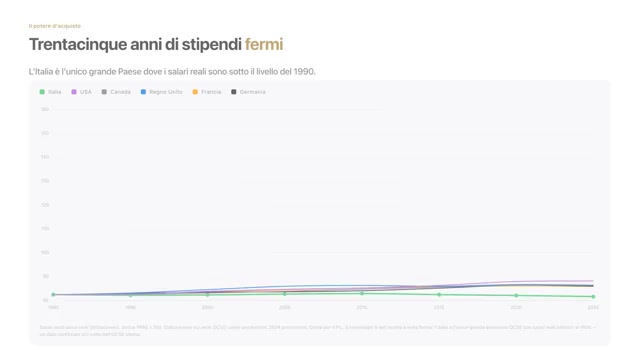
Italians' purchasing power has collapsed: stagnant salaries and double-digit inflation from 2020 to today. For office salaries, take-home pay is less than half of what the employee costs the company, among the worst in Europe. Three examples. With a gross salary of €60,000 the company spends €82,000 and the worker receives €37,200. With a gross salary of €40,000 the company spends €55,200 and the worker receives €27,400. With a gross salary of €30,000 the company spends €41,400 and the worker receives €22,400. With this level of taxation it is hard for the economy to restart.
Average wages adjusted for inflation, based on OECD series, show that Italy is the only major economy with real wages below 1990, a figure the OECD has confirmed several times. While the world races ahead and wages keep pace, Italy is the only G7 country going the other way. And here I go back to 1989: back then an Italian earned 73% of what an American earned. Today the gap is 52%, and that seems an optimistic estimate to me.
Europe's choices
The European Union didn't help. With the ban on combustion engines from 2035, European manufacturers, German, French, Italian and Spanish, found themselves at a crossroads: stop developing traditional engines and invest in battery cars and plug-in hybrids, which the market did not take up and left sitting at the dealers. Today electric's share is around 15-20%, with development costs far higher than the rest. The result: double development costs, plummeting profits, loss-making companies and a market open to Chinese manufacturers. But for Italian production this cannot be an alibi, because the rules in Europe are the same for everyone. The winners are the countries able to attract investment, even without car giants behind them. And Italy is in the back row.
The BYD phenomenon
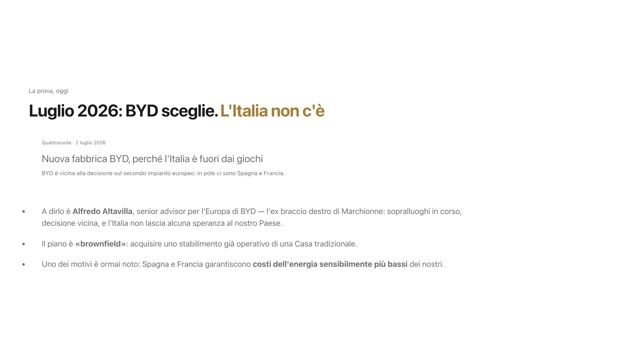
July 2026, that is, today: BYD, one of the most important Chinese makers of electric, hybrid and combustion cars, is choosing where to open its European factory. At the head of BYD Europe is Alfredo Altavilla, who was Marchionne's number two and left Fiat when FCA was handed to Manley. He was the one who told the Chinese that to reap results in Europe you have to make cars that suit European consumers' taste. The first car born under these rules, the BYD Atto 2, is the third most registered car in Italy in June 2026.
Beyond sales there is production. The Chinese have seen that the European market responds well and they are willing to invest: BYD and Leapmotor, whose European distribution is controlled by Stellantis, want to build factories in Europe, with workers and supply chains. The countries under consideration are three: Italy, France and Spain. Italy is out of the game; in my view they will go to Spain, acquiring plants already operated by a traditional manufacturer, because Spain and France guarantee lower energy costs. Nobody is a benefactor: you invest where the ratio between manufacturing quality and overall business costs is best. And we are the last in Europe to guarantee it, to international and domestic investors alike.
Who exports, who imports
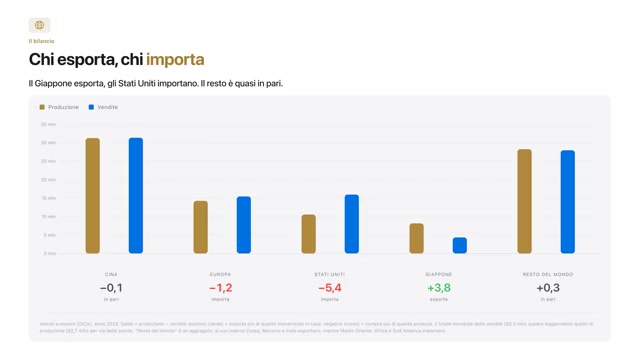
China, whose advance we all fear, has an enormous domestic market that its production mainly serves: production and sales are practically level. The Xiaomi SU7, the electric car that looks like a Porsche, is not sold in Europe because all production for the coming years has already been absorbed by Chinese consumers. The shrewdest companies open European subsidiaries, like MG, Omoda and Jaecoo, or Leapmotor, and the next step will be to open production in Europe as the Koreans and Japanese did.
Europe is in deficit and imports 1.2 million more cars than it produces. The United States imports 5.4 million more, including from Mexico and Canada. Japan is the great exporter, with 3.8 million cars. The dramatic figure is Italy's: in 2025 we produced 238,000 cars, excluding light commercial vehicles such as Iveco's, and we registered 1,530,000. The balance is in total deficit.
The verdict
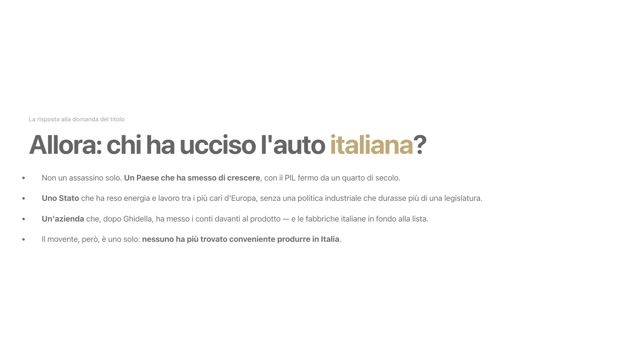
Who killed the Italian car? There is no butler, as in Agatha Christie's novels. There is a country that stopped growing, with a GDP flat for a quarter of a century. A state that made energy and labour among the most expensive in Europe, with no industrial policy that lasted longer than one parliament. And a company that after Ghidella put the accounts ahead of the product, with its Italian factories at the bottom of the list. The motive, and it is an ugly thing to say, is that nobody found it worthwhile to produce in Italy any more.
For Stellantis this is solved by opening production in Morocco, Serbia and Spain and selling the cars in Italy. For us small business owners it is harder, because we cannot move our business. That is why there are videos on this channel explaining how to sell to a higher tier of clients to keep an acceptable margin.
The 20 best-selling cars in June 2026
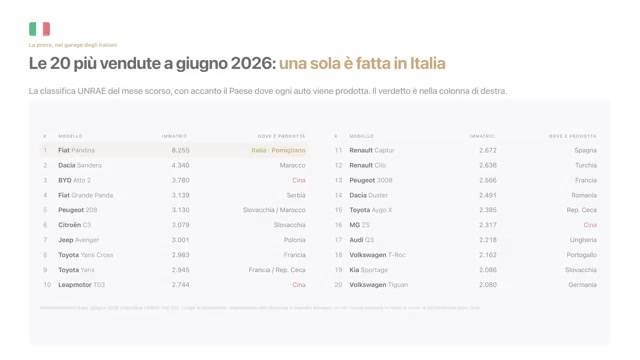
In black and white. Of the 20 best-selling cars in Italy in June 2026, only one is produced in Italy: the Fiat Pandina from Pomigliano, 8,255 registrations in a month, a car Italians are in love with. Second is the Dacia Sandero, produced in Morocco or Romania. Third is the BYD Atto 2, the compact plug-in hybrid SUV designed for Europe, which costs at least €30,000: the Chinese car is no longer the cheapest of all. And here is a practical example: in the same segment Stellantis produces the Alfa Junior, the Jeep Avenger and the Fiat 600, and none of them has a plug-in hybrid version. The consumer who wants one, or the company given incentives to buy one, has no choice but to go to the Chinese manufacturer.
Then the Fiat Grande Panda, produced in Serbia. Peugeot 208 in Slovakia and Morocco, Citroën C3 in Slovakia, Jeep Avenger in Poland, Toyota Yaris in France and the Czech Republic, Leapmotor T03 in China, Renault in Spain and Turkey, Dacia in Romania, MG ZS in China, Audi Q3 in Hungary, Volkswagen T-Roc in Portugal, Kia in Slovakia, Volkswagen Tiguan in Germany. Of 20 cars, one is produced in Italy, three in China and the rest in Europe, but not here.
The Serbia case
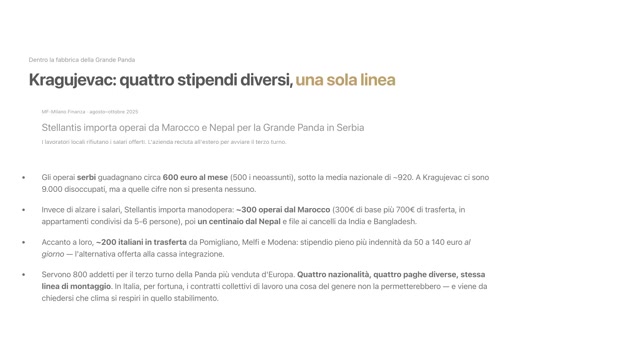
The most emblematic case is the Grande Panda, which could perfectly well have been made in Italy and which Stellantis decided to produce in Serbia, in the 500L plant. According to an investigation by Milano Finanza in autumn 2025, Serbian workers earn about €600 a month, below the national average of €920. In Kragujevac there are 9,000 unemployed, but at those figures nobody turns up. Rather than raise wages, Stellantis imported labour: 300 workers from Morocco, about a hundred from Nepal, queues at the gates from India and Bangladesh, and 200 Italians on secondment from Pomigliano, Melfi and Modena on full salary plus a daily allowance, as an alternative to state-funded lay-offs. 800 staff for the third shift of Europe's best-selling Panda: four nationalities, four different pay rates on the same assembly line.
I say this as a business owner: fortunately this does not exist in Italy, because we have collective labour agreements. Paying different salaries according to nationality is unthinkable in countries with advanced labour law. And you wonder what the atmosphere is like in that plant, and what quality ends up in the product.
Can we restart? The four levers
In my view we can restart if we all row in the same direction, and all four of these things have to happen.
- Rome has to realise that there is a manufacturing problem and adopt industrial policies as Spain did.
- Lower the cost of energy with a mix of nuclear and renewables, bringing it level with Spain, together with reforms of company law.
- Lower the tax wedge, to put more money in workers' pockets and get them spending more.
- Management, inside the company, that believes in Italian manufacturing when faced with policies that favour investment.
The alibi has to be removed: if the cost of energy is brought level with Spain and France, I am not saying with Serbia, Stellantis's management has no more excuses for not investing in our country again.
The lesson for business owners
Against these figures there are two companies that chose value, with a historic brand behind them: Ferrari and Lamborghini have never had a period of splendour and production like these years. Ferrari produces around ten thousand cars a year and is worth more on the stock market than Stellantis, which produces millions and is the fourth-largest manufacturer in the world.
It applies to a country and it applies to your company: go for margin before turnover and value before volume. Never aim for the lowest price. Look for value by building or repositioning your brand at the high end of the market, offering a product and a brand of value instead of a mass product.
Will we go back to producing 2 million cars? I don't know, and the signs are not positive. At the very least the four things I mentioned have to be done. The sources for this video: OICA, ACEA, ANFIA and UNRAE for production and registrations; Stellantis and the unions, in particular CISL, for production and employment; the World Bank, the International Monetary Fund and the OECD for GDP and wages; the parliamentary hearing of the new chief executive Antonio Filosa and Quattroruote for Stellantis; Milano Finanza for the investigation into the Serbian plant.
Frequently asked questions
How many cars does Italy produce today compared with 1989?
In 1989 Italy produced 2 million cars, its all-time peak. In 2025 it produced 238,000, excluding light commercial vehicles: fewer than in 1956. In the same year it registered 1,530,000.
Why does Spain produce more cars than Italy?
In 1990 Spain caught up with Italy at 2 million cars, and today it produces 2.38 million without a national car giant. Spanish governments offered companies a business-oriented ecosystem: energy at €90 per megawatt hour against Italy's €205, flexible rules and long-term plans for cars and batteries.
How much does Italy weigh in Stellantis's production?
About 9%: one in 10 Stellantis cars is made in Italy. Spain is the leading production country with 18%, followed by Brazil with 14% and France with 10%.
What can an SME learn from this story?
That in the mass market the lowest costs win, and a small Italian company can neither compete on that ground nor move abroad. Ferrari produces around ten thousand cars and is worth more on the stock market than Stellantis: the way forward is margin before turnover and a brand positioned at the high end.
One live webinar a month.
One topic, questions from the business owners who join, answers without sales slides. It's free and in Italian, and it's the simplest way to get to know us.
See the next webinar →