



The 7 commandments of luxury brands: how to sell at high prices
The rules of traditional marketing don't work at the high end. In this one-hour lesson I explain who high-spending customers are, why an Italian SME should position itself at the top of the market, and the seven non-negotiable rules I follow to build a brand that sells at above-average prices.
We need your consent to play it: YouTube uses cookies that may profile what you watch.
Cookie preferences- Advertising is not for selling. It is for making people fall in love with the brand. The sale comes later, when the customer is the one asking.
- You are not the one selling: the customer decides to buy. The sales network stays, but it becomes consultative.
- The brand must not be a single-product brand. Several products, organised into collections, to cover premium and luxury without damaging the image.
- The price of a luxury product is always relative, never absolute. What counts is the gap against the mass-market product in the same segment.
- Creativity is the key to success. An ugly campaign doesn't work with any algorithm; a beautiful one works even without tracking.
- The consumer price must seem higher than it is. The exact opposite of the mass market.
- Your brand must draw on the values of Made in Italy. Above all if your ambition is to sell abroad.
Why the rules of traditional marketing don't work at the high end
This is probably the most important lesson I have recorded, because it introduces a new discipline: the method for creating a luxury brand. And it is the only way to offer the market products or services that cost more than the competitors' average, take in more and, at the end of the year, generate more profit.
But to do it you have to take a step back. The traditional rules of marketing cannot be applied to luxury brands. They are no use to the Italian entrepreneur who wants to create a brand at the high end of the market. If you want to sell to high-spending customers, you have to forget everything that holds for mainstream businesses and brands.
They are two completely different sports. It is the difference between Formula 1 and football. Put the Formula 1 world champion on the pitch in a Serie A match and he would be the worst player there. Put the man of the match from the last round in a Formula 1 car and he probably couldn't even get it into first gear and out of the pits.
Be careful: the rules of traditional marketing work perfectly well for the mass market and for the mid-market and upper mid-market, which rely on promotions, coupons and direct-response marketing. But for the small percentage of entrepreneurs who want to sell to high-spending customers, you have to change register completely.
I am speaking to a niche of entrepreneurs and professionals who have every right to aim for the top of the market, because we are sitting on a treasure called Made in Italy.
Why an Italian SME should position itself at the top of the market
Whether it is repositioning an existing brand, rare but possible, or creating one from scratch, there are three reasons, and they are linked:
- Selling at high prices to high-spending customers.
- Selling these customers high-end products or services through a brand positioned in the premium or luxury segment.
- As a result, having higher margins during the year and higher profits at the end of the financial year.
We have understood why. But who buys?
Who buys: the seven social classes
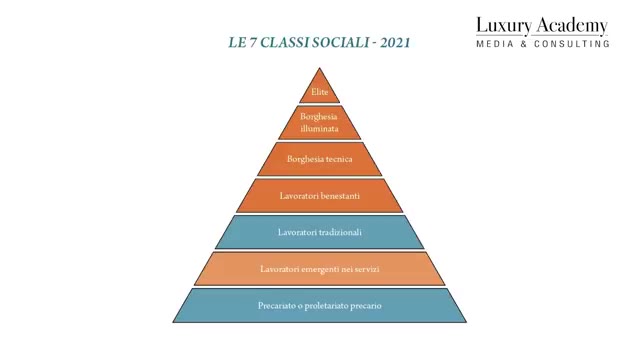
Western societies, let's take the G7 countries for convenience, are consumer societies. The historical division into aristocracy, bourgeoisie and working class is outdated. From my analysis, today's society is made up of seven classes, from the bottom up:
- Precariat, or precarious proletariat: people not fully integrated into the labour market, or who rely on benefits.
- Emerging service workers: the new economy, often young freelancers with a VAT number in professions that didn't exist ten years ago.
- Traditional workers: people who work in an office, a company, a factory.
- Affluent workers: those who have managed to build a career.
- Technical bourgeoisie: those at an important stage of their career.
- Enlightened bourgeoisie: adds important social and cultural elements.
- Elite: the top, the sum of the three pillars.
The three dimensions that define a class
A person belongs to a social class according to where three dimensions intersect:
- Economic, divided into wealth (what has been accumulated: cash, property, valuables) and income (annual earnings).
- Social: the quality of the inner circle, meaning the people you spend time with and talk to every day.
- Cultural: social activities, cultural activities, qualifications.
To be at the top, a high income or great wealth is not enough: you need the other two dimensions as well. In my course on how to sell to the high end these classes are analysed in detail; here the summary is enough to understand the second part.
Who we sell to: five classes out of seven
Potential buyers of premium and luxury products belong to five classes. It starts with emerging service workers, because people in emerging jobs want to stand out from the crowd and choose brands that cost more than others, status symbols in their own niche. Then affluent workers, the technical bourgeoisie, the enlightened bourgeoisie, up to the elite.
Italy is a rich country
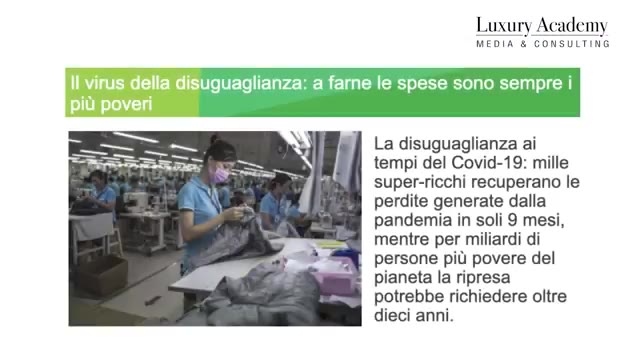
In 2020 we were put in the freezer for months. Today Italy is among the fastest-growing European nations, thanks in part to European funds and, above all, to the people who work and spend in our country every day. But within this recovery there are two opposite reactions: the top of the pyramid has increased its wealth, the bottom is struggling.
An entrepreneur, by definition, puts a product or service on the market in exchange for money. So you have to sell to people who are doing well, who have more money in their pockets than a year ago. Not to people who can't make it to the end of the month and pay by credit card, going into debt.
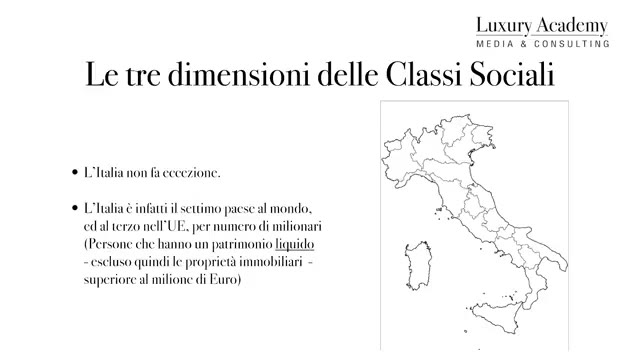
And Italy is no exception; quite the opposite. It is seventh in the world and third in the European Union for net number of millionaires: around one and a half million people with liquid wealth above €1 million, excluding property. Behind giants such as the United States, China and Japan, a few places from Germany and France, which have much larger populations, and ahead of Canada, Australia and Switzerland. In terms of individuals, there are about twice as many millionaires in Italy as in Switzerland.
All this is to say that what I teach can be applied straight away, on the Italian market too. The ideal is to start from Italy and then sell abroad, as I do with my kitchen and bathroom company. And you don't need to sell only to millionaires: people with wealth of thirty, forty, fifty thousand euros, or an income a few hundred euros above average, also buy high-end. Different reasoning kicks in, a different sensitivity in how they spend.
The cash cushion
Why sell to high-spending customers? To build a cash cushion inside the company. Solid company accounts let you bear the high costs of doing business in Italy, energy, transport, the tax burden, and survive the unexpected. In 2020 the companies that kept going were those with significant cash put aside. That cash comes from higher profit, and higher profit comes from a high-priced product sold to this kind of customer.
Luxury goods are the only sector in which you can make luxury margins.
Bernard Arnault, chairman of LVMH, quoted in the video
These are the words of the richest man in Europe, head of the largest luxury goods company in the world. The only legal and effective way to sell to high-spending customers is to create a brand positioned in the premium or luxury segment. And this is where the seven commandments come in.
They are called commandments because they are not up for discussion. Before studying them you have to set aside what you know, or think you know, about this subject. There is only one way to sell to high-spending people, and that is to follow them.
1. Advertising is not for selling
It may sound crazy, but in a luxury brand the role of advertising, online and offline, is a different one. With the main tools of content marketing, photos, video and copy, the aim is to turn a potential customer who doesn't know our brand into a fan. In the first phase, the fans don't need to be customers too.
The example is Ferrari, the most important Made in Italy company in the world: a huge fan base and a very limited number of customers, because the cars start at €200,000. The fan base grows around the brand, Formula 1, the poster a child sticks on the bedroom wall. The fans don't need to become customers straight away. Ideally, of course, they do become customers later, and from customers they become testimonials and ambassadors: I write about this in the article on how to create ambassador customers.
You do it through videos, photos and texts designed to arouse positive emotions that lead the potential customer to fall in love with the brand. Only after this phase do you propose a sale or an appointment. You don't put a direct-response copy, a shocking image or a funny video in front of a stranger on Facebook with the aim of converting them straight away. At the high end it doesn't work: potential customers reject the product and ignore you. And the cause is the message, wrong for that customer.
It is always the customer who asks for the product, and the company never forces the sale. Every time a company communicates in an aggressive tone, on social media or in person with salespeople who have to close to meet a budget, the sale is dirty: you sell at a discount, stretching payment terms, losing money instead of making it.
The brand funnel: how to use social media at the high end
Social media can be used in a way consistent with this mission, by building step-by-step campaigns linked to one another, on Facebook, Instagram, YouTube and Google. You need a system, made of several linked ads, copy and videos.
- Step 1, awareness. The only aim is to make the company known. No action requested, no sale, not even a half-hearted lead capture. The potential customer has to start falling in love with the product through photos, videos and copy designed for the high end. No direct-response copy, no shock photos, no funny or pseudo-educational videos with the entrepreneur's face filling the screen: short videos, photos and moving texts in which we explain who we are, why we do it and what we offer, with the creative side predominant.
- Step 2, lead generation. Only to those who interacted significantly in step 1 do we propose an exchange: a catalogue, a project in digital format, exclusive videos, a webinar. I advise going lightly: name and email, not the phone number. We are still in a lukewarm phase. From here an automated email sequence starts, which in this scheme has an excellent response rate.
- Step 3, sale. Only to those who have shown they love the brand and taken an action do we propose more direct-response copy, always elegant, and a less emotional, more concrete video about the benefits. Here you sell the product, invite people to the showroom or a trade fair, or carry out a consultative sale, by video call or in person.
Each step has its own copy, its own photos, its own video and its own pages. Only the chaining of all this leads a target customer to ask: “Can I book an appointment to see this model, with these finishes? Can you tell me how much it costs?” From strangers to people in love, to people in love who ask for the product. This is the level of customer we have to aim for.
2. You are not the one selling: the customer decides to buy
It is the logical consequence of the first. The customer is inclined to buy before even speaking to a salesperson. The sales network remains essential, but selling turns into consultative selling. Be careful: if the salesperson is unprepared or arrogant, even a customer in love with the brand won't buy from them.
A kitchen, a major investment, inevitably requires consultation, often many times, before the bank transfer. But it also applies to a pair of shoes. On via Montenapoleone, at Valentino or Tod's, the sales staff are marketing experts lent to sales, trained by multinationals. An €800 pair of shoes is sold through consultation: the person walks in already in love, the sales assistant has them try models and finishes, works out the budget and steers them towards the highest product within that budget. She maximises the person's spending capacity and the maison's takings.
With a sound brand funnel, enquiries arrive every day. In my company they arrive daily, 75 per cent from abroad: people who have studied our models, read the documentation, identified the collection, and who write to book an appointment, attaching the floor plan of their kitchen. That is the clean contact the seven rules have to bring into the company.
3. The brand must not be a single-product brand
Several products under the same brand, yes, but organised into collections. Collections stop the company from looking like a single-product business and let it reach different market bands within the high end: some collections in the premium segment, others in luxury.
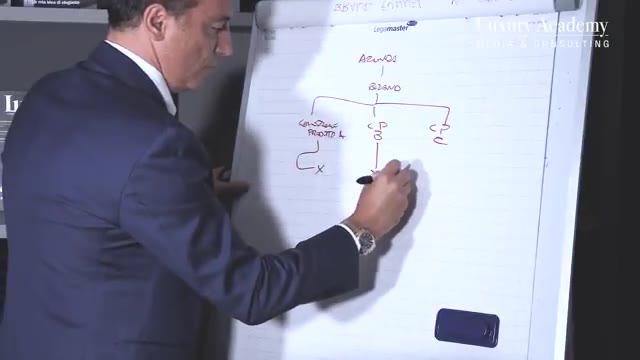
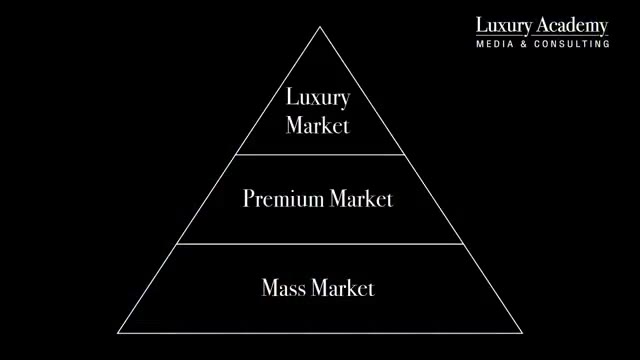
The scheme is this: company, brand, and below it collections A, B and C, where B costs 5 per cent less than A and C 15 per cent less. From the top of the range you come down towards premium, brushing the upper mid-market, and then concentrate on the top end. It is what we do, with five bathroom collections and five kitchen collections, and it is what most high-end companies do.
The best example is Rolex, a company that never misses a shot in marketing. Several collections, with different prices within them: a steel Datejust costs €6,750 retail, a Daytona in a different material about €40,000. Same company, same product, same brand recognised by everyone as a luxury object, completely different prices. Because they are organised into collections: you take different market bands without damaging the brand's image.
4. The price of a luxury product is always relative, never absolute
The price of a high-end product is relative to the percentage increase over a mass-market product in the same segment. What counts is the gap: between mass market and premium, and between premium and luxury.
Take the C segment of cars, the best-selling in Europe, always dominated by mid-market manufacturers: Fiat Tipo, Hyundai, Peugeot 308, with an average entry price of around €19,000. About sixteen years ago the German manufacturers, first Audi, then Mercedes, finally BMW, decided to enter it. Many cried scandal: the risk was damaging the brand image built up over the years. It didn't happen, because the Audi A3, BMW 1 Series and Mercedes A-Class kept a significant price gap: about €28,600 on average, €10,000 more, 47 per cent more than the mass market.
With that extra 47 per cent the customer is also buying to show their inner circle that they have made it, that they have bought an aspirational good. These are psychological mechanisms I go into in the Luxury Masterclass, my most advanced course. Here the principle is enough: there is no absolute price for luxury. A Gucci wallet costs €400, one in the same leather on Amazon costs €40. A €17 product is a luxury product if the competitor costs €3.50.
5. Creativity is the key to success
Apple's new rules with iOS 14 and 15 were described as the death of social media managers and media buyers. They did little to us. Because an ugly campaign is ugly even with every remarketing pixel switched on, and a beautiful campaign, which makes people fall in love in the first step, keeps working even when you can no longer track everything. Yes, it is harder; yes, you have to study how to communicate. But a beautiful campaign with creativity serving the brand has ten times the chances of an ugly one, which didn't work before either.
When you promote a high-end brand, art direction, the style the company imposes on itself and its products, becomes central. The exact same product, communicated on different channels, can become a success or a flop depending on how the brand communicates it. I deal with art direction in my book, Direct from Milano, in the part devoted to the study of luxury brands, with cases of success and cases of failure.
6. The consumer price must seem higher than it is
Here too the rules of the mass market are turned upside down; there you advertise the entry price and run promotions and discounts to bring in as many people as possible. At the high end the game is the opposite: a brand funnel that makes the potential customer perceive that the product they want costs more than the price they actually pay.
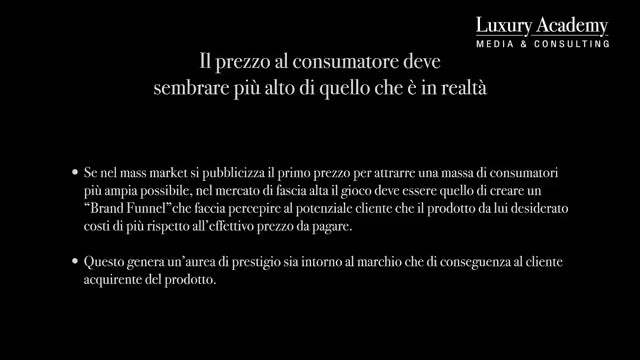
It is a harder, more sophisticated game, but in the long term it brings tangible benefits to the income statement. And, at a second level, it creates an aura of prestige around the brand and, as a result, around the people who buy it.
7. Your brand must draw on the values of Made in Italy
Among Italians we take it for granted, and when we sell things to each other it counts for little. But the moment we have the ambition, and I urge everyone to have it, to sell abroad, Made in Italy is an asset to bet on. Many successful brands carry the idea of Made in Italy in their logo, with the name of the country, of certain regions or of certain iconic cities. Some cities and regions can be used and others can't.
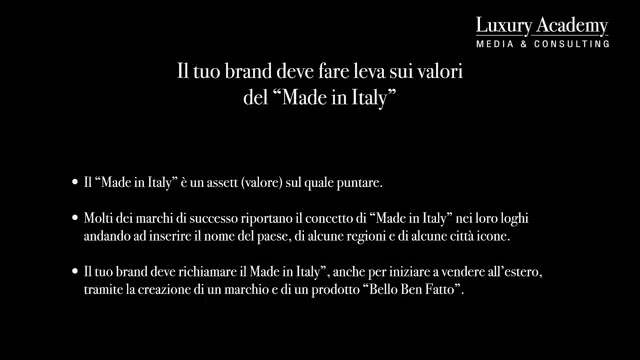
Your brand must evoke Made in Italy in order to start selling abroad, too, through a brand and a product that is beautiful and well made: a video and a blog article are devoted to the subject.
Conclusion: where to start
Apply these seven rules to your company straight away, starting with those that feel closest and easiest, then moving on to the more complex ones. Marketing to sell at high prices to high-spending customers is a sophisticated game that pays off in the medium and long term, but which, if well implemented, brings major benefits to margins and profits.
I firmly believe the future of Italian business is to create, or convert, companies for the high end of the market, selling in Italy and abroad a product that is beautiful and well made, costs more than average, and for which the market recognises that surplus. The only honest way to do it is to build a premium or luxury brand. That is what the seven rules are for.
Frequently asked questions
Do the seven rules apply to services as well as products?
Yes. In the video I talk about products and services in the same way: a strategy consultancy, a professional practice or a hospitality business follow the same logic as a physical product. Only the form of the consultative sale changes.
Do you need a big advertising budget to apply the first commandment?
No. The step-by-step brand funnel was designed precisely for SMEs with limited budgets: you speak to people who don't know you with emotional content and invest in lead generation and sales only on those who have already shown interest. The creativity and consistency of the content matter more than the spend.
Can a €20 product be a luxury product?
Yes, if its price is clearly higher than that of the mass-market product in the same segment. The fourth commandment says the price of luxury is relative: what counts is the gap against the reference competitor, not the absolute figure.
Which commandment should you start with?
The one closest to your own situation. For many SMEs the first practical step is the third, organising the offer into collections, and the fourth, measuring your price gap against the mass market in your segment.
One live webinar a month.
One topic, questions from the business owners who join, answers without sales slides. It's free and in Italian, and it's the simplest way to get to know us.
See the next webinar →