



Plan everything: the flowchart for deciding whether to act or not
A list of goals with actions attached leads you to get it wrong more than half the time. In this chapter of the 7 rules for winning in business I present the flowchart I use for every decision, at RiFRA and to create the Luxury Masterclass: three paid authoritative sources, three scenarios, a synthesis of pros and cons. Then the strategies: accept the risk, hide your intentions, drop the shyness, and the process broken down into project, time and people, observed from above.
We need your consent to play it: YouTube uses cookies that may profile what you watch.
Cookie preferences- Between goal and action there is a missing step: gathering information from authoritative sources, paying for it, developing scenarios, weighing pros and cons. Only then do you decide whether to act or not.
- From three sources you develop three scenarios, and you synthesise them. If the pros win, you do it; if the cons win, you don't.
- Accept the risk of failing before you start, hide your intentions during the analysis, then drop the shyness.
- Every process is made of project, time and people. The calendar is built backwards from the launch date.
- Look at the process from above, as if from a plane, and listen only to the feedback of those who pay.
What is missing between goal and action
In an entrepreneur's life you have to plan everything, or as much as possible. Traditional teaching on results says: I set myself a goal, I take actions, I get results. But between the goal and the actions there is a missing step: accessing information from authoritative sources and experts in the sector, paying them, reworking it into an analysis that develops a scenario, and weighing the pros and cons of that scenario before taking action. Before attaching actions to a list of goals you need intelligence work, the analysis, the scenario, the pros and cons on a scale, and only after the go-ahead do you take action.
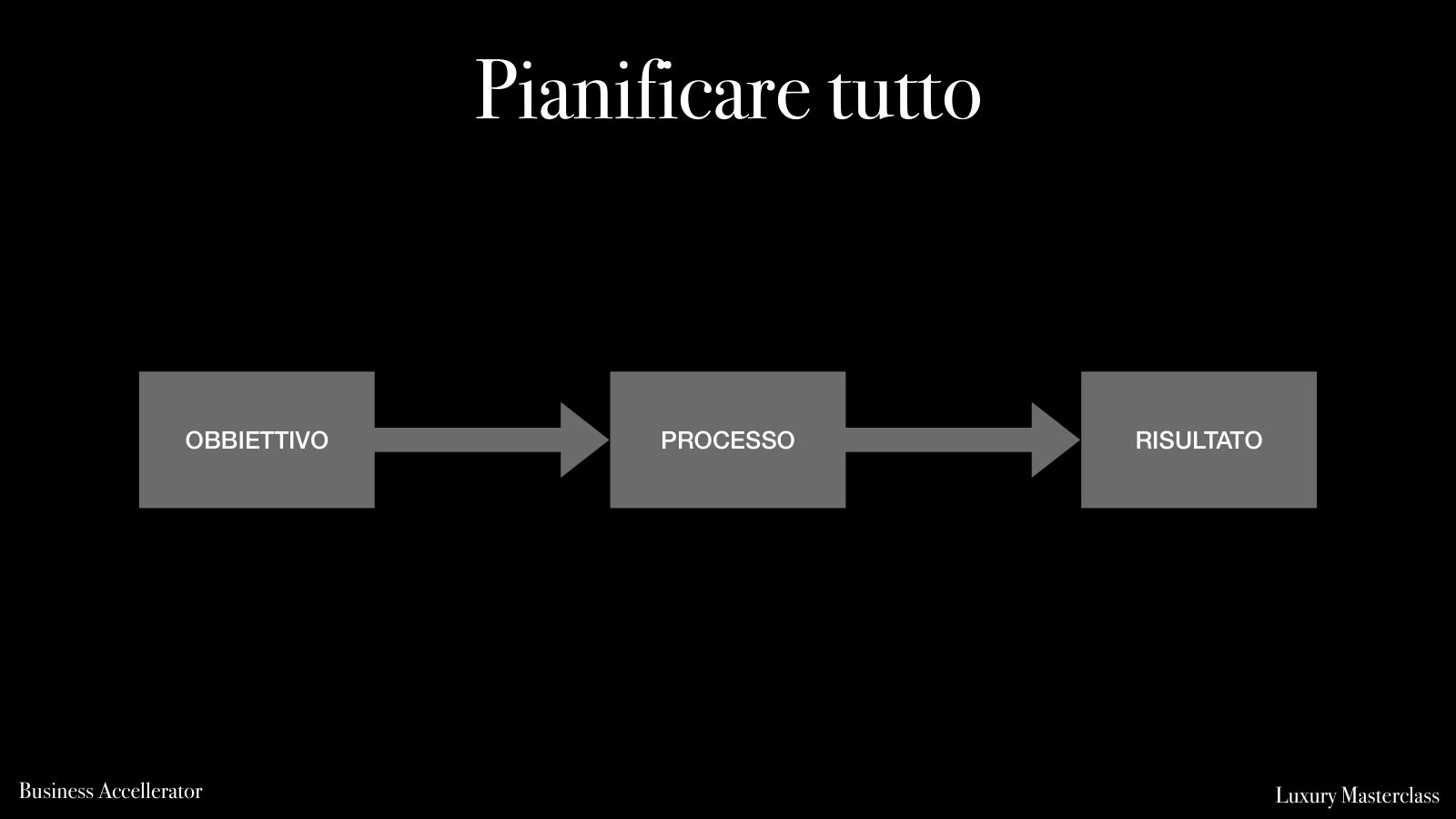
The planning flowchart
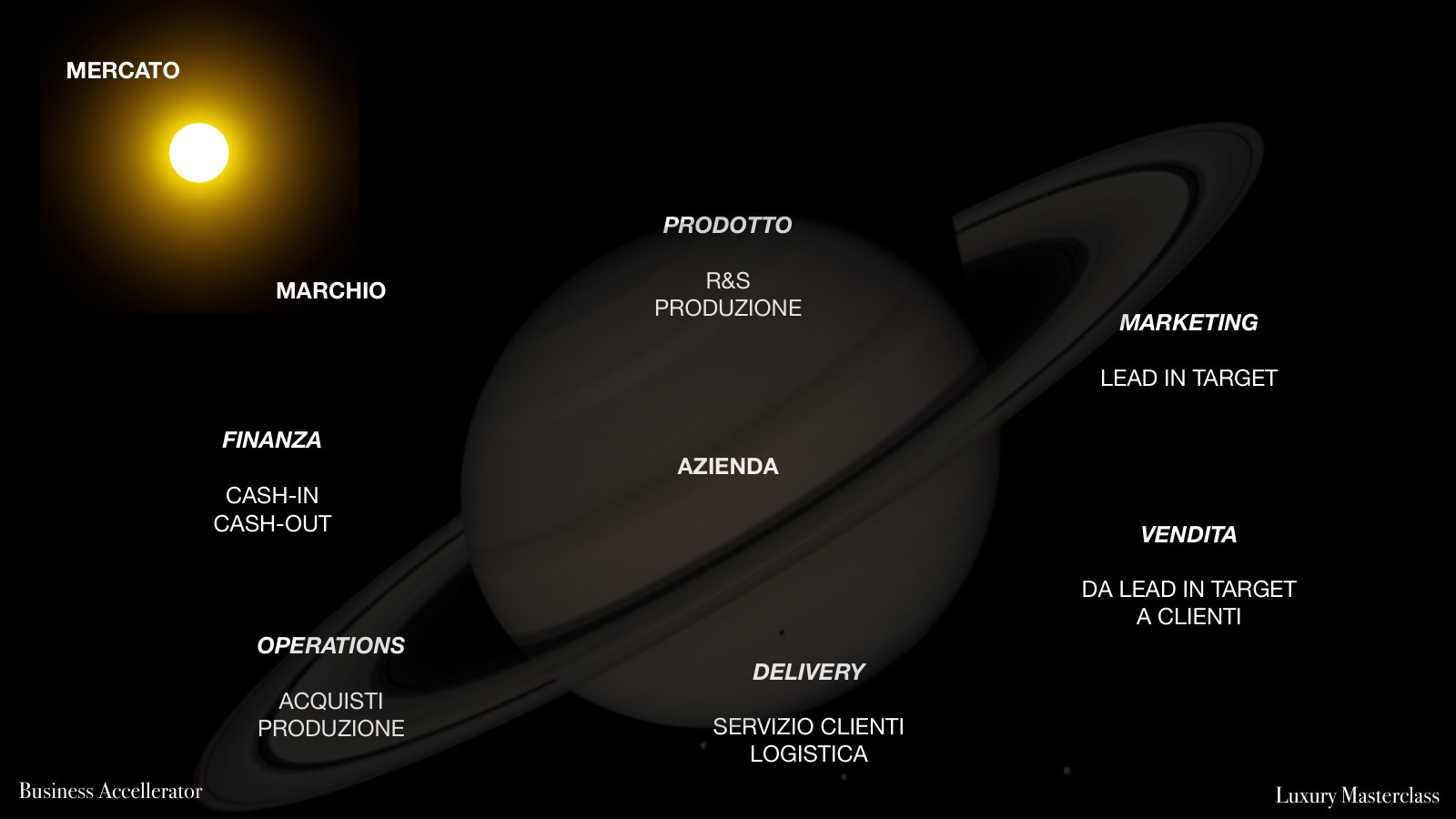
I created a planning flowchart, presented exclusively in this module, for the world of business. The company is a planet warmed by the sun, which is its reference market, and various parts revolve around it: the product, with research and development and production; marketing; sales, which turns target leads into clients; delivery; operations, purchasing and production; finance, cash in and cash out; and, close to the sun, the brand, which determines the market segment and the price of the products. The flowchart applies to any business function, and it is what I use to decide whether to take action or not. I used it at RiFRA to create new products and to create the Luxury Masterclass.
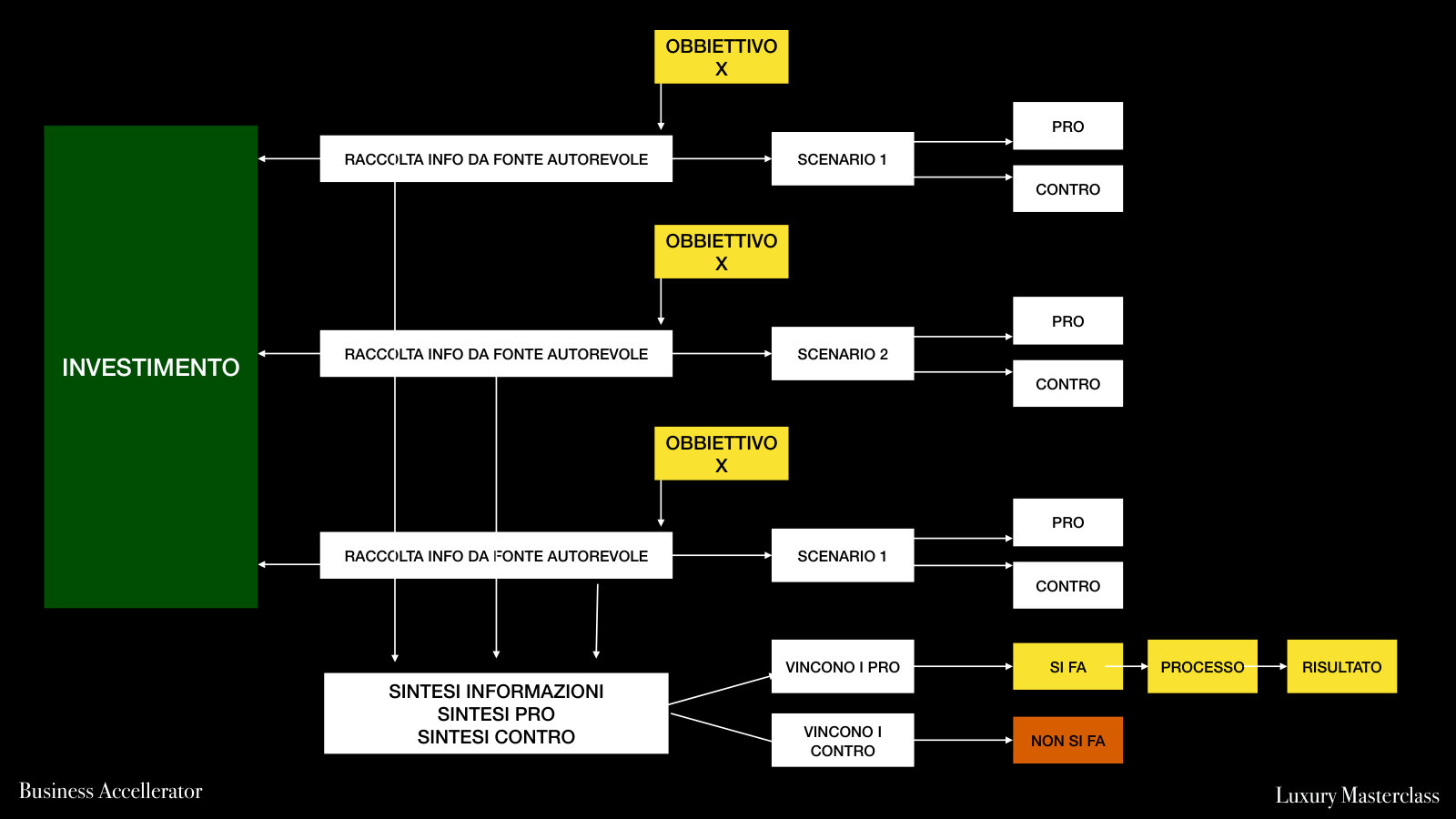
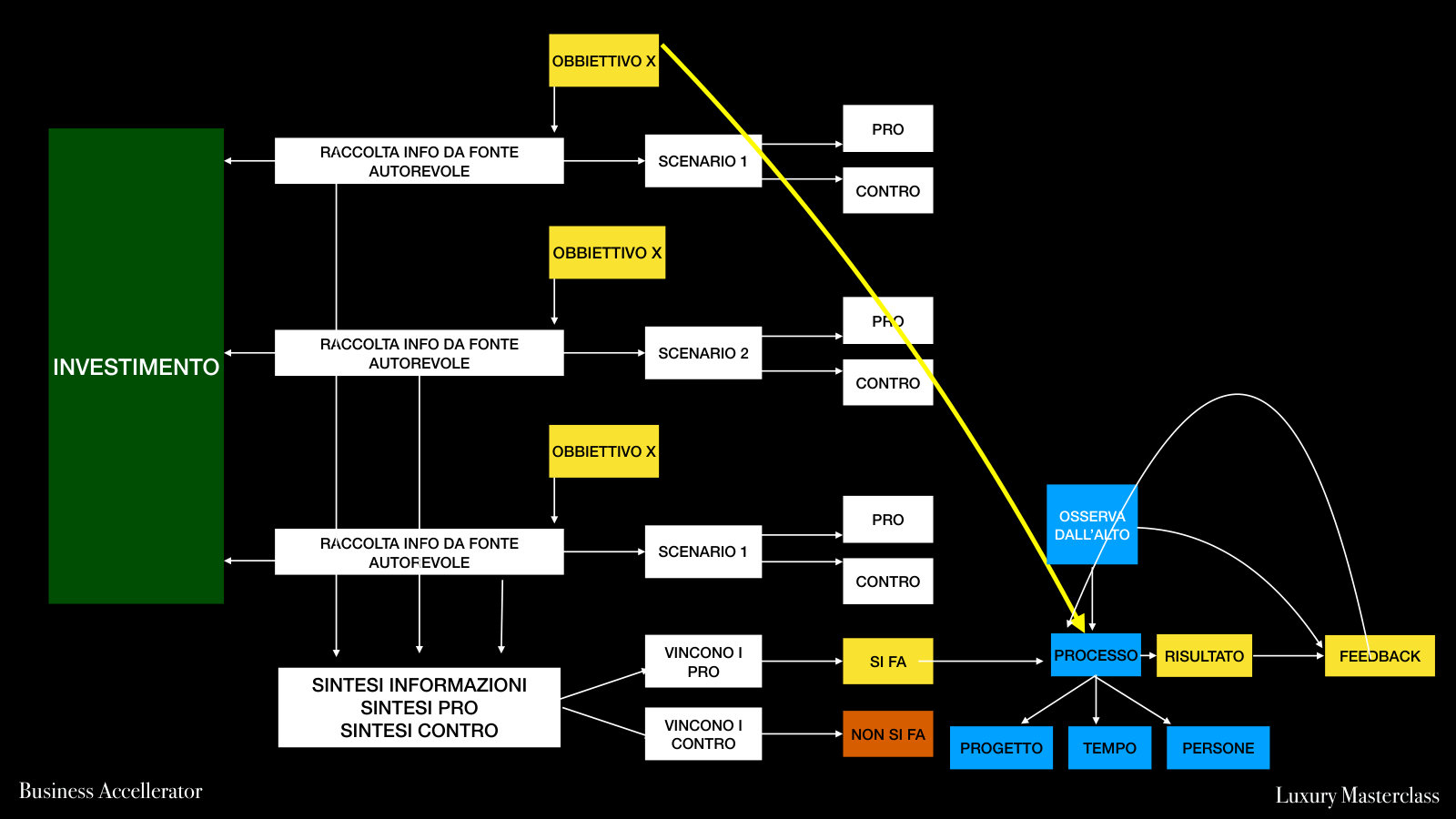
I set myself a goal: a new product, this course, entering a new market. I plan an investment to gather information from an authoritative source, for example through a consultancy, and at the end I develop a scenario with its pros and cons. For the same goal I go to a second authoritative source: the information will be different, because people are different, and the scenario will be different too, with other pros and cons. With a third source I get a third scenario and a third analysis. At that point I synthesise the pros and cons from all the sources. If the pros win, you do it: there is a process, the action, and you get results. If the cons win, you don't do it. First I allocate a budget to study the matter, and the sum of the analyses decides. This is where I understand whether things will go well or badly. If I skip this phase and only make a list of goals with actions, half of the things, maybe more than half, will go badly, and I commit to actions that with the flowchart I would have known to avoid, wasting energy, time and money. This course was born exactly like this: three authoritative sources, one analysis for each, and the synthesis decided.
Planning strategies
Accept the risk of failing
To get the most out of it you have to plan everything, considering the difficulties and consequences of the choice. Only when you have a clear view of the consequences you will pay if the operation goes badly, and you are willing to accept them, do you move to action. When I decided to do this course I put myself in this frame of mind: if it doesn't go well, what am I risking? A bad image, burning financial resources and time without reaching the goal. I accepted a small chance of failure and went ahead. If you are not willing to take the risk, it is better to stop before the action, if the consequences in terms of personal and company reputation or financial risk are too high.
Hide your intentions
Let's think in military strategy terms: before the action and during the analysis you have to keep people in the dark about what is coming. Anyone who doesn't know your goals cannot work on an alternative project and is forced to play defence. It applies in business as in life: never reveal your goals before the action phase, before you have accepted paying the price of the consequences. On Facebook you see millions of people announcing phantasmagorical companies, goals and courses that then come to nothing. You have to do the exact opposite: keep quiet, hide your intentions and talk about things only when everything has been planned.
Drop the shyness
Once you have decided to act, applying the flowchart and taking action only when you are willing to accept the consequences means you are sure of the line to hold, without doubts and uncertainties. It may seem strange, but most business leaders are introverts: think of Bill Gates, Elon Musk and, among Italians, Giorgio Armani, the Ferrero dynasty, John Elkann. It is normal to have doubts before launching a new business, but once it is planned you have to drop the shyness. The flowchart is there so you decide on logical grounds.
The process: project, time, people
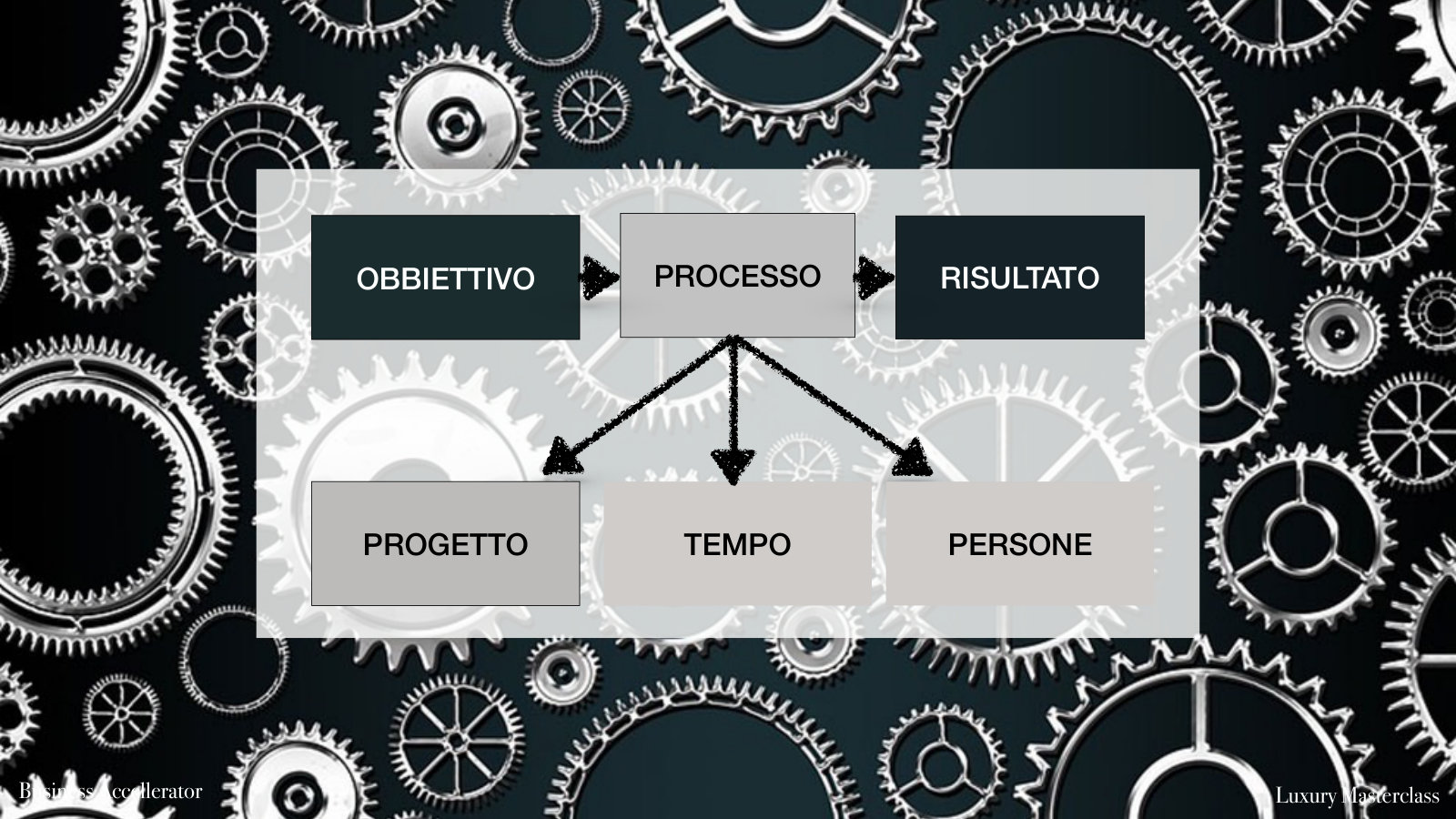
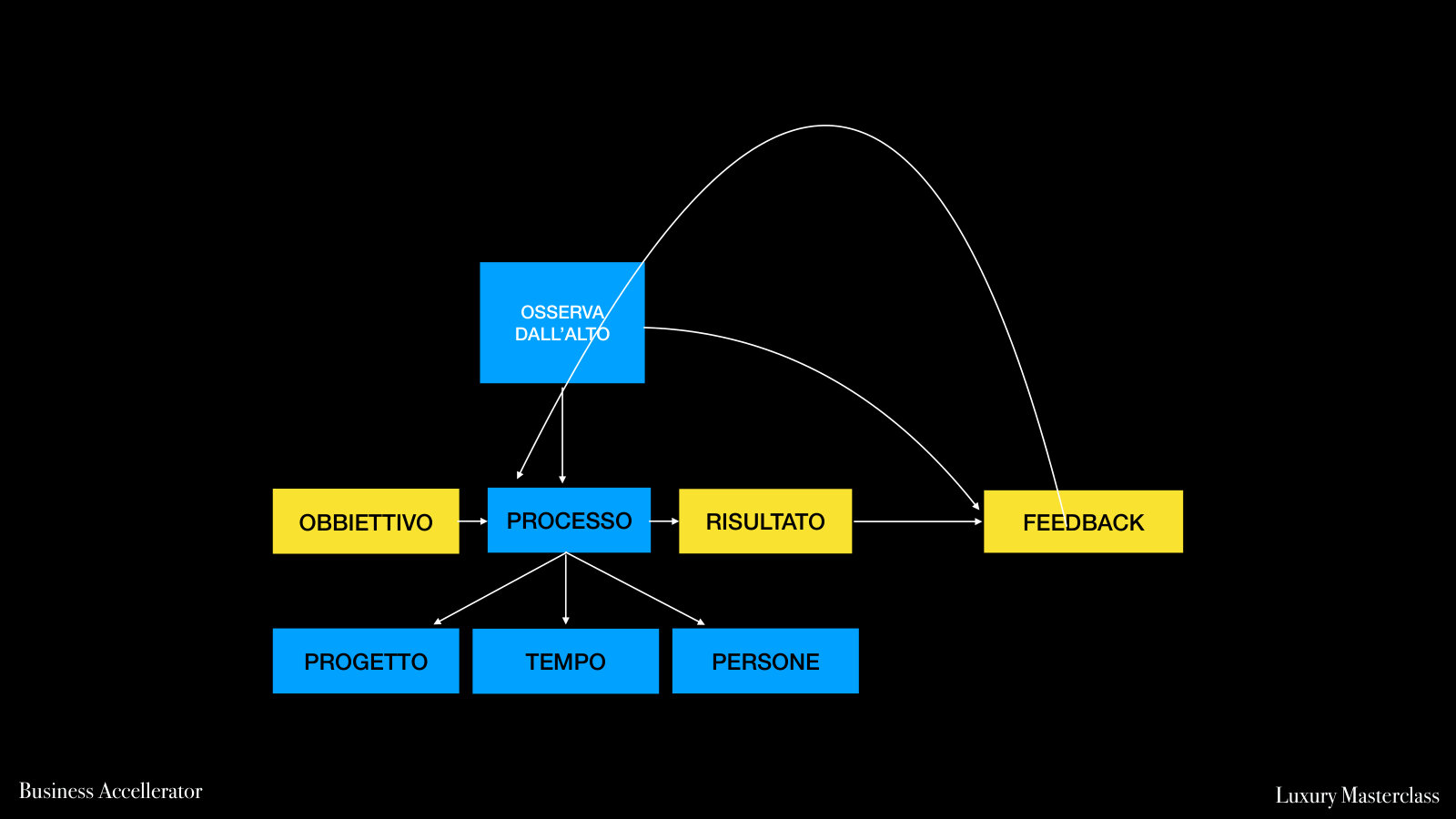
I have decided to make the new product or attack the new market: how do I break down what lies between the goal and the result, that is, the process? Every process is made of three elements. The project: the things that have to be done to reach the result, to be entered, quite simply, in an Excel file. For a video course: the slides, the videos, the marketing campaigns, the audio and video materials, the budget. For a bathroom cabinet: the design, the materials to buy, the market to win, the target clients, the price. Time: every company project has to have fixed timings, and the calendar is built starting from the end. If the cabinet has to be launched at the Salone del Mobile in April, I have a deadline, 16 April, and I work backwards to understand when to start on it, hypothetically in January. The calendar is created once the launch date has been decided, without the classic "let's start and see what happens". People: who makes the prototype, the market research, the photos, the research and development, the marketing, the campaigns, who communicates with clients. People also manage the project and the timings.
Look at the process from above
The most important thing the entrepreneur has to do is observe the process from above, like a plane approaching a city, as if from 5,000 metres up. You have to distinguish your role as designer of the project from your role as an operator in the process. At the beginning you will be an operator, and we will see this in the marketing module when we talk about how to create a media company inside the company, but you have to remember that you are the designer of the process. Take your thinking and your feedback to a higher level: move from seeing yourself in the first person to the third person. I have to imagine myself in my office with my team as if there were a camera on the ceiling, to judge my work and the team's objectively. Put the feedback on results into an overall scheme and repeat until you get the result you want.
The only feedback that counts
Accepting the market's feedback doesn't mean letting yourself be swayed by fear of other people's opinions. Never be afraid of what others think: it is the number one thing to avoid in professional and personal life. The only feedback that counts in a company is the market's, that is, money in exchange for your product or service. The opinions of those who are not clients and never will be count for nothing. Your mind has to ignore the voices of those who will never give you a euro and listen to those who have bought: improve product and service on the basis of paying clients. A classic example is haters on Facebook: if I advertise one of my products and negative comments come in from people who will never buy, I delete the comment and ban the user, because I should not care in the slightest about those people. The people to listen to are the clients, who show you with their money that they appreciated your product. There is no better democracy in the world than the market, because the client votes with their money. Listen to clients and ban, from the page and from your life, anyone who speaks badly of you and your products without being a client.
The complete scheme, with the process between goal and result, the project, time, people, you observing from above and listening to the market's feedback, placed inside the planning flowchart, can be downloaded from the exercises module. Print it, make it yours, and every time you make a decision on products and services to launch, study it: the chances of your product being a success will increase considerably.
Frequently asked questions
How does the planning flowchart work?
Once a goal is set, you invest a budget to gather information from three different authoritative sources, develop a scenario with pros and cons from each, and the synthesis of the three decides: if the pros win, you take action; if the cons win, you don't do it.
Why not announce your projects before you start?
Because anyone who doesn't know your goals cannot work on an alternative and is forced to play defence. You reveal your intentions only when everything has been planned and you have accepted the price of a possible failure.
How do you build a project calendar?
Backwards from the launch date: if the product has to be presented at the Salone del Mobile in April, you start from the deadline and work back to when to start on it. Never start and then see what happens.
Which feedback should you take into account?
Only the market's, meaning that of paying clients. The opinions of those who are not and never will be clients, including haters on social media, count for nothing: the client votes with their money.
One live webinar a month.
One topic, questions from the business owners who join, answers without sales slides. It's free and in Italian, and it's the simplest way to get to know us.
See the next webinar →