



Why sell at the high end: margin, distribution and company value
At the high end you sell with a high margin on every unit and the company is valued on luxury multiples: an SME with 10 million in turnover can be worth 16. In this hour-long lesson, recorded in May 2020 at the height of the pandemic as the opening of the programme on the 7 rules for winning in business, I explain why margin has to beat turnover, how the crisis pushed the market from an hourglass to a cocktail glass, why whoever controls distribution controls the business, with Tesla and Volkswagen, and how to calculate what a high-end brand is worth.
We need your consent to play it: YouTube uses cookies that may profile what you watch.
Cookie preferences- At the high end you sell with a high margin on every unit and the company is valued on luxury multiples, not on those of unbranded manufacturing.
- The paradigm changes: margin beats turnover. Every order, every contract has to bring margin to the income statement.
- The hourglass market has become a cocktail glass: the entry-price segment grows, the mid-market shrinks, the high end holds or grows.
- Whoever controls distribution controls the business. Get closer to the end client, collect payment before you produce and deliver.
- Company value is EBITDA times the sector multiple minus debt. In luxury, value often exceeds turnover: Cova sold for €32.8 million, Sant Ambroeus valued at €20 million on €3 million of revenue.
The 7 rules for winning in business at a high level
This is the first module of the Luxury Masterclass, dedicated to the general rules for winning in business at a high level. There are seven rules. The first is why you should sell at the high end of the market, set in the historical moment when the course was recorded, May 2020, at the height of the pandemic. The other six are a mental journey, a mindset the business owner needs to win in a market that is no longer that of the 1970s and 1980s, when you only had to produce and things sold themselves: your reputation precedes you; plan everything; mental isolation; self-discipline; leadership skills; negotiation skills, because we negotiate every day with clients, suppliers and employees. Today the most important thing is the right mindset, one that leads you to create and carry out the things we will see in the masterclass.
Why sell at the high end
Because at the high end you can sell with a high margin on every unit of product. In 2020 this was more necessary than ever to make up for the turnover lost during the months of closure: two or three months of halted production, with shops, showrooms and restaurants closed, can't be recovered within the year. A high-end brand allows two things. First, working on margins: offsetting the fall in turnover by selling fewer products but at a higher price, or at any rate a higher margin. Second, a high company valuation, based on the multiples of the premium and luxury sector, which follow completely different logic from those of an unbranded manufacturing company.
The context: May 2020
The New York Times, on the day American workers' benefit claims exploded, showed that the great recession of 2007-2009 was nothing by comparison: back then there had been a general decline, not the closure of every business at the same moment. The following week claims had gone from over 3 to 6.6 million, and CNBC was forecasting 47 million unemployed with a peak of 32%, because in the United States there is no furlough scheme like Italy's cassa integrazione and no comparable benefits. I was and am convinced that, thanks to the rules of the American labour market, those losses would be reabsorbed very quickly. In Italy, La Repubblica copied the New York Times graphic: 7 million people on cassa integrazione, something never seen even in 2007-2009. JP Morgan forecast a 10% fall in the first quarter and 6% in the second half of the year, with a V-shaped recovery thanks to the Fed's stimulus.
In short, this crisis, in impact and scale, was not comparable to that of 2009-2011 but to that of 1929. A great upheaval with two effects: on one side, existing companies adapting to the new world, with new fortunes, new companies and new dynasties of entrepreneurs; on the other, the closure of those who do nothing to adapt. The problem, beyond the loss of turnover, is failing to adapt the business model.
The lesson of 1929
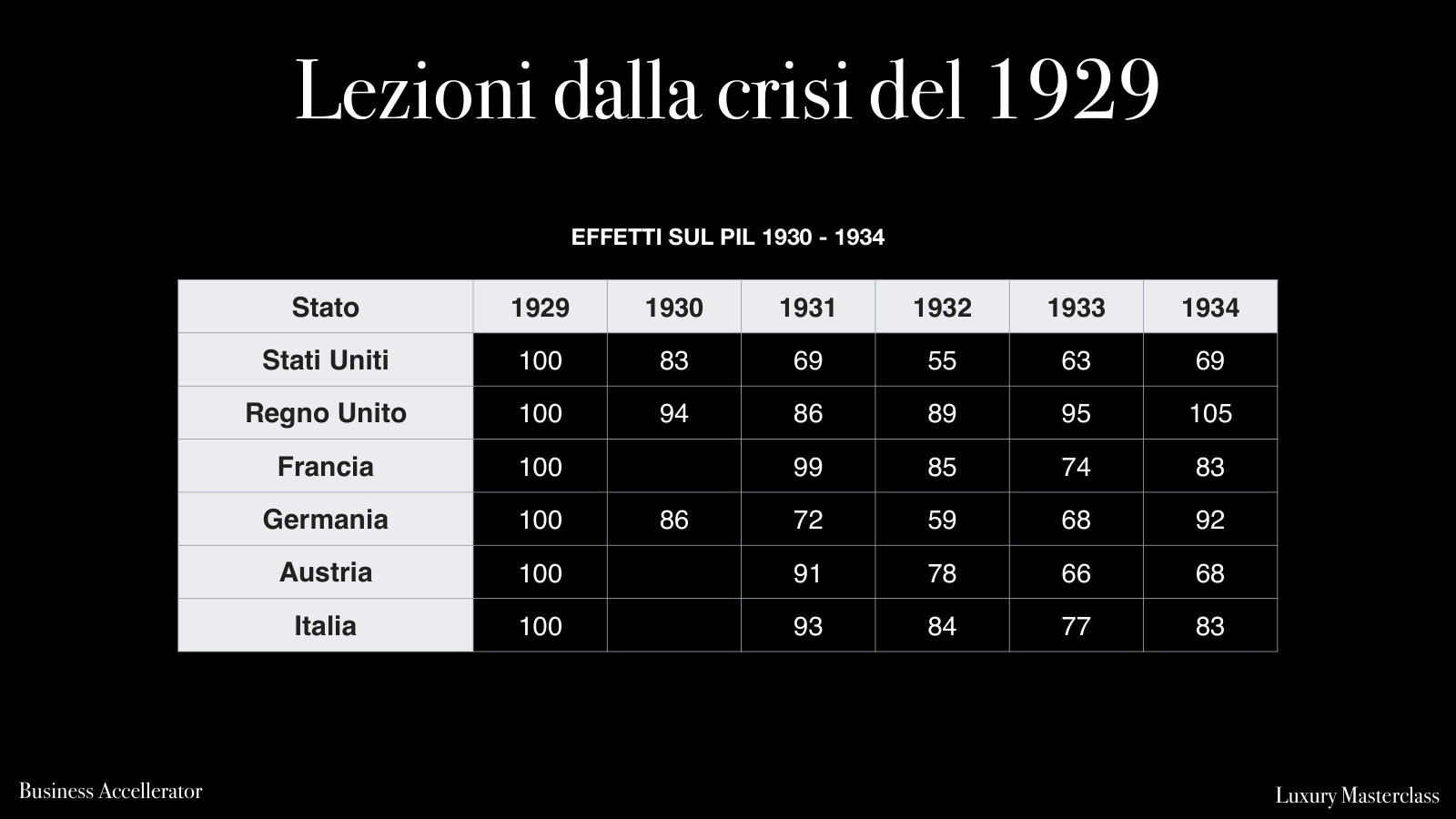
We study history to understand the present and plan the future. I researched the GDP of the main economies of the time, with 1929 set at 100, over the following five years. In the United States, where the crisis began: minus 17% in 1930, minus 31% in 1931, minus 45% in 1932, then a slow climb to minus 37% and minus 31% in 1934. The market shrank by at least 30% for years. In Europe the crisis was felt less, but it was felt: Germany lost 14%, then 28%, then 41%, 32%, recovering to minus 8% in 1934; Italy went from 100 to 93, to 84, to 77, closing 1934 at 83, still 17% below 1929. The Bank of Italy was forecasting GDP for 2020 between minus 13% and minus 16%, never seen since 1929. It means there is less work for everyone, and that is why you have to learn to sell on margin: a high margin lets you withstand the loss of turnover, and perhaps even do better.
From the turnover paradigm to the margin paradigm
The measure of success is doing the right amount of work at high prices. Ferrari in the Montezemolo era made no more than 7,000 cars a year, clients waited on a list and the list price was beyond comparison with any other car maker. You have to change paradigm: from 2020 onwards turnover is no longer what matters, I don't care if it is down 2 or down 3. What has to matter is the margin on every single product sold. Every product has to contribute to the company's margin: selling a product at a loss or at break-even to win a client must no longer exist. The new world changes the rules of the game.
Crises create empires
Companies, empires, dynasties and new millionaires are born during crises. In 1930 George Jenkins founded Publix Supermarkets in Florida with five employees: today it has 172,000 employees and $32 billion in annual turnover. In 1934, in the middle of the crisis, O.D. and Ruth McKee bought a bakery in Chattanooga: today McKee, with its five brands, is still controlled by the family and according to Forbes is worth $1.4 billion. In 1938 in Oregon Paul Lamfrom founded Columbia Sportswear, specialising in jackets made with breathable, waterproof fabrics: today it is listed on the Nasdaq, has a turnover of over 2 billion a year and is worth about 4 billion. And Charles Darrow, laid off in 1929 because of the crisis, after a year of study and betting on himself launched Monopoly and became the first millionaire game designer in history. A great crisis always brings great opportunities and lets new companies grow.
The Italian scenario
Confindustria was forecasting a 10% fall in GDP over the half-year, a deficit at 5%, debt at 147%, unemployment at 11%, and the updates were worse. A wartime scenario, combined with the fact that Italy is the G7 country with the lowest rating for debt sustainability, the highest business costs and one of the most punishing and complex tax systems in the world. From the 1990s to 2011 Italy had an excellent rating, in the A class; from 2012 to 2019 it collapsed to BBB minus, two steps from junk status. Germany, our biggest manufacturing competitor, never moved from triple A: it borrows at very low rates and, with half our debt, has made almost unlimited liquidity available to its companies compared with the Italian situation. Here, in the middle of the crisis, the government postponed companies' social security contributions from 14 to 20 March: a four-day extension.
It was predictable that after Covid the tax burden on companies and citizens would rise: the state needs money and gives nothing away. Newspapers were interviewing ministers calling for the citizens' income to be extended through a wealth tax, and the VAT increase had only been postponed. We have to prepare not only for a fall in turnover but for a higher tax burden, and the only thing that can save us is to position the brand and create products at the high end, selling at high prices.
What do we have to do as business owners? Look reality in the face, especially in bad times. Understanding and confronting the negatives leads to decisions based on data analysis. You have to be analytical: emotion at zero, numbers driving the business process and the thought process. And don't stay anchored to the way you have sold until now: this crisis accelerated by ten years a process already under way since the explosion of the internet, social media and the smartphone, disintermediation, the end consumer and the brand moving closer together.
From hourglass to cocktail glass
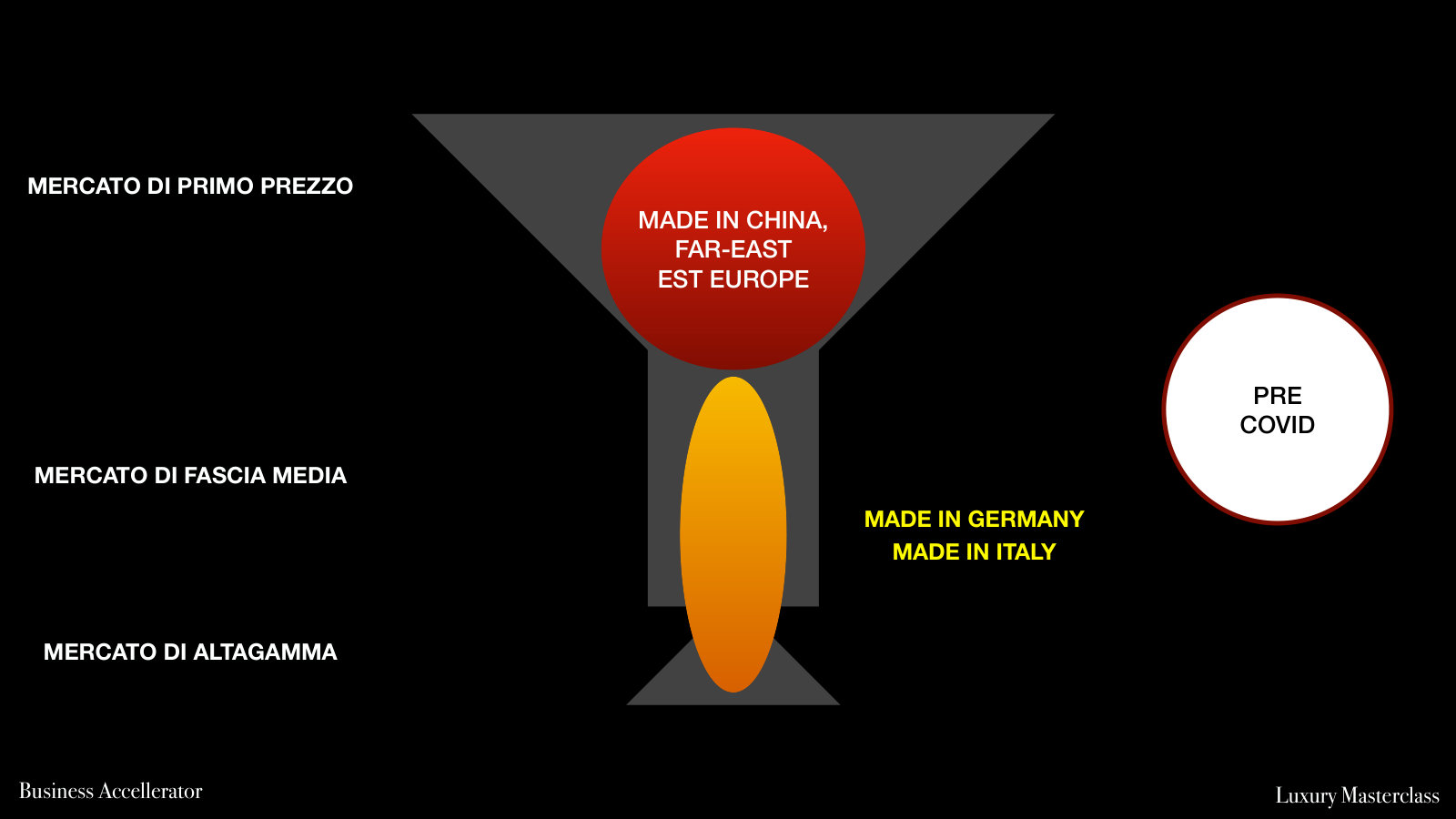
Before the crisis the market was shaped like an hourglass. At the bottom, the entry-price market, the lowest price the consumer can find, dominated by Made in China, the Far East and Eastern Europe: to produce cheaply and stay profitable you have to go where labour is cheap and there are fewer rules, as car makers do when they produce in Serbia, Poland or the Czech Republic. Then the mid-market and the high end, dominated by German and Italian manufacturers: the mid-market with a strong focus on value for money, the high end where you sell a dream, an aspirational product, a personal repositioning.
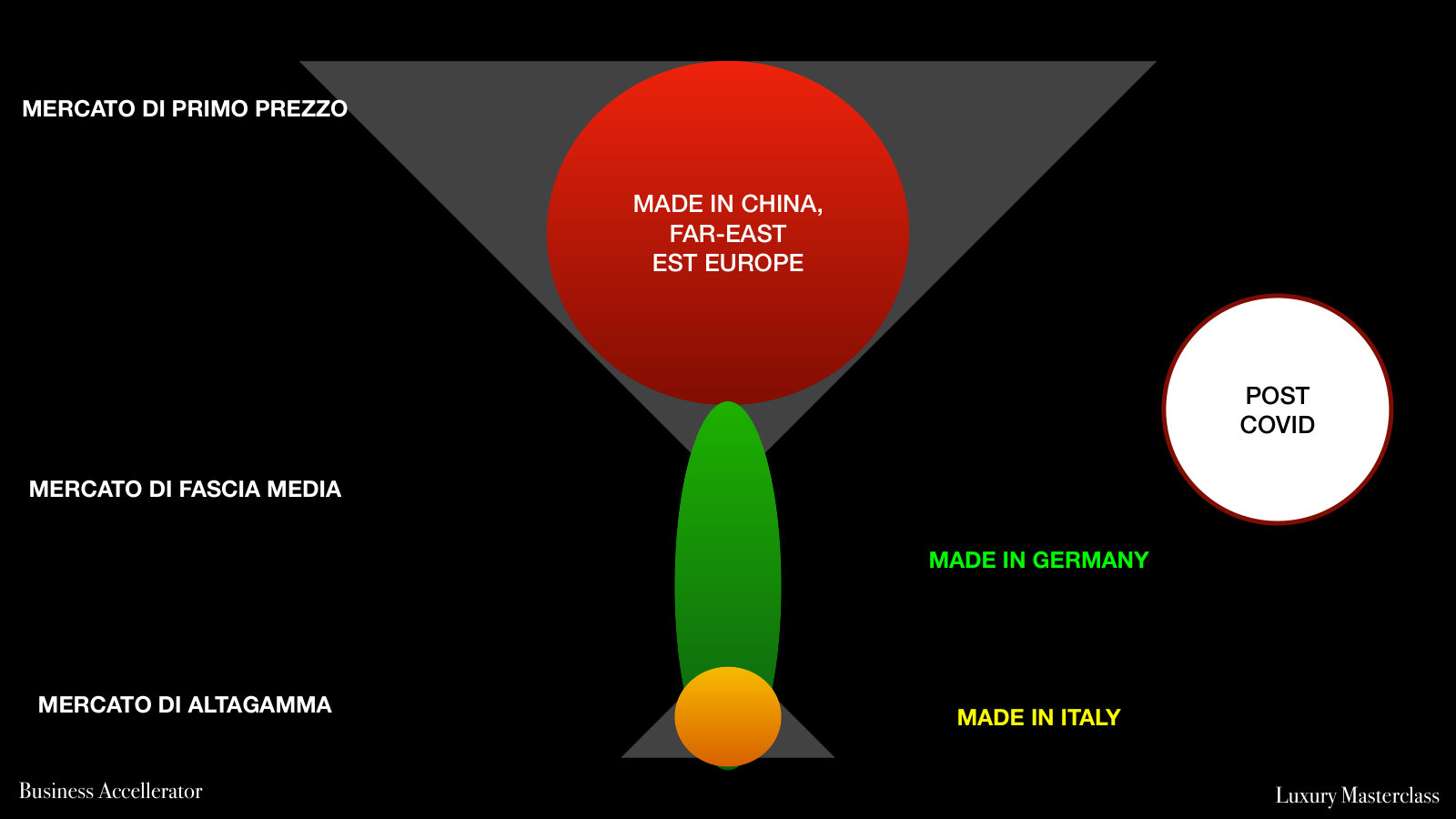
After the crisis the hourglass turned into a cocktail glass. With less money in circulation, the entry-price market grows; the mid-market shrinks; the high-end consumer stays stable or increases, because they don't only have income from work but also income from assets, or they start a new company that will bring them new profits. There will always be a high-end market, and it is the one that will never go into crisis. The one that goes into crisis is the mid-market: the German companies that sell there will hold up thanks to the sustainability of German debt; Italian companies, to stay on their feet, will have to focus on the high end.
Leaner companies, cash and distribution
Companies will have to become lighter, analysing and cutting unproductive fixed costs to maximise cash, which will be the deciding factor: the post-Covid period will last years, like the 1929 crisis. The challenge, as well as in branding, marketing and sales, lies in controlling and cutting costs. Cash generation will also have to drive decisions on branding, marketing and above all distribution. The fall in turnover will have to be offset by higher margins and by the distribution model; in many cases the business model will have to be revised. The chain of commerce will shorten considerably: people will weigh their money before spending it and the first to suffer will be the intermediaries between the product and the end market.
The cash cycle depends on the channel
Selling to the consumer, B2C; selling to a dealer who resells to the consumer, B2B2C; selling to another company, B2B: these are different distribution models and they bring different incoming cash cycles. If I sell directly to the end consumer I eliminate the risk of non-payment, because the consumer pays before receiving the product. If I sell to a company or a distributor I have to allow for a risk of non-payment that can have devastating consequences, with bank receipts at 30, 60, 90, 120 days. Today it is no longer possible to act as a zero-interest bank for your clients with payments deferred until after delivery. You don't have to overturn everything overnight with clients who have always paid on time, but if you have clients who struggle to pay, start asking yourself questions about your distribution model, which affects your cash.
Whoever controls distribution controls the business
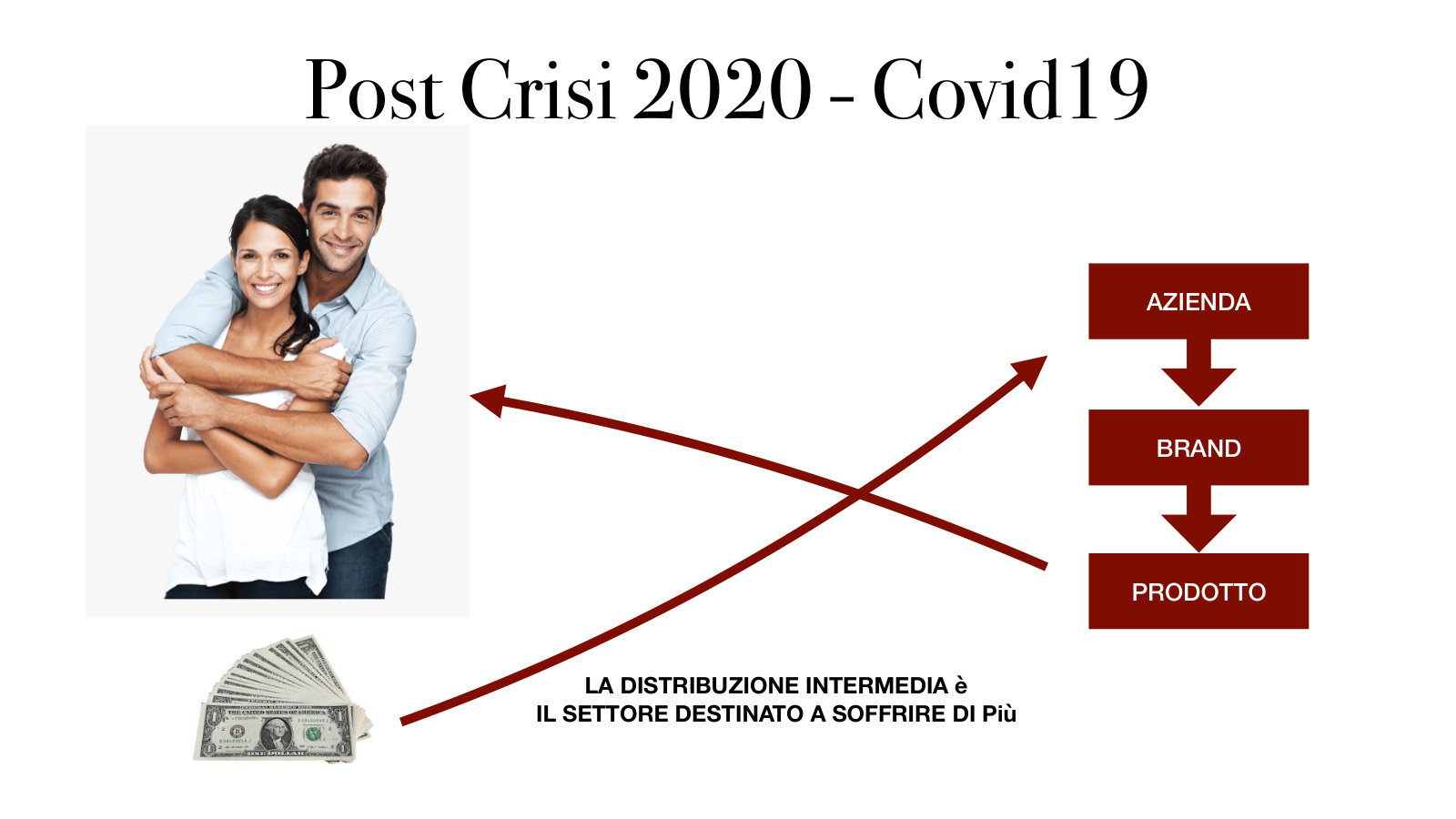
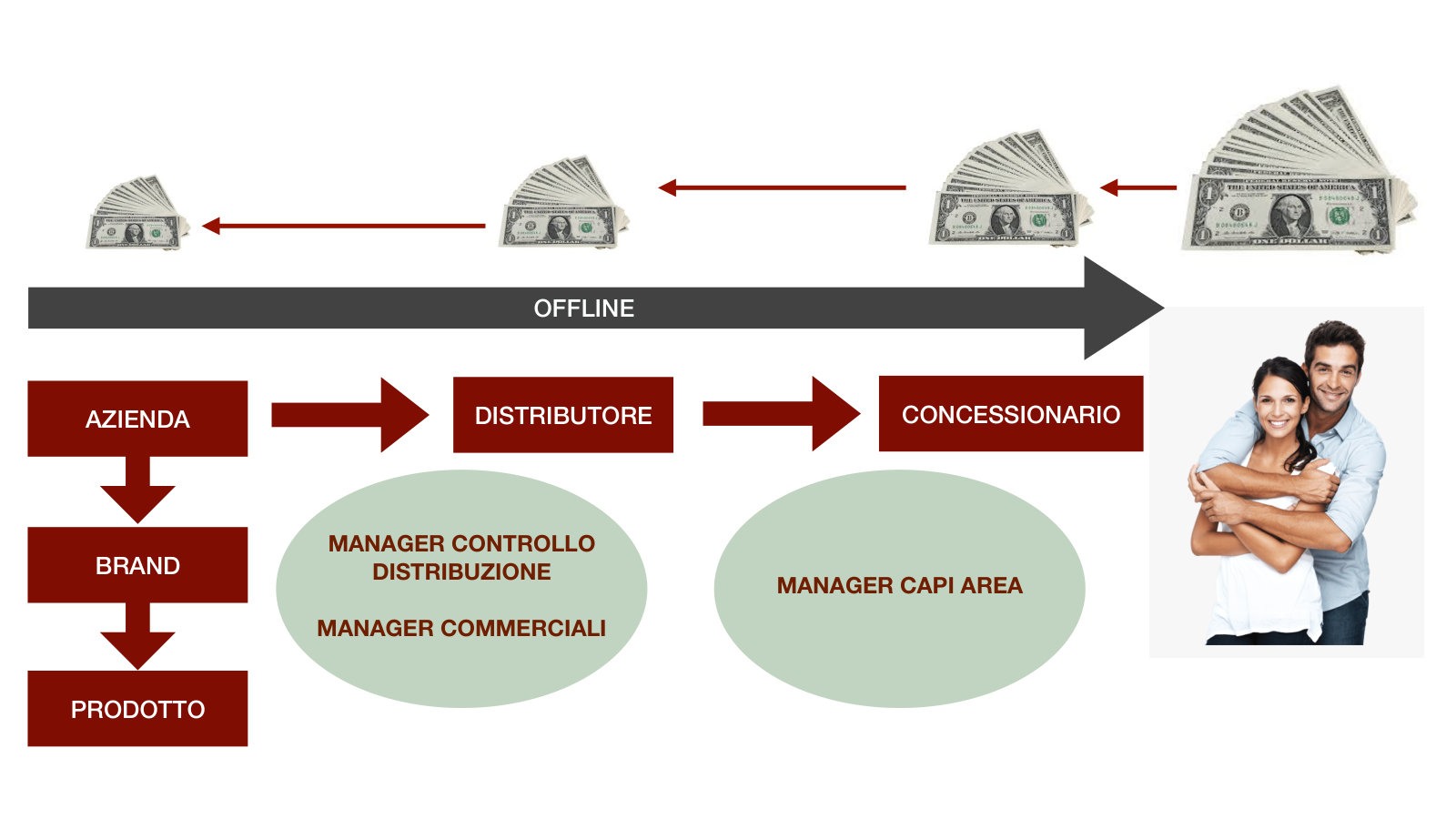
The simplest model: a company develops a high-end brand and product, sells it at a high price because the client recognises its superior value, and sells it directly to the end consumer, who gives their money in return. What is missing? Intermediate distribution, the sector set to suffer most. Il Sole 24 Ore counted over 1,400 car dealerships at risk of default and 120,000 jobs involved, after months of standstill and zero registrations.
Take cars, a market that is easy to analyse because the data comes out every month. A car maker develops brands with products at different prices for different consumers, has a structure of sales managers and area managers, and a network of dealers who are not offshoots of the manufacturer but local entrepreneurs. The couple walks into the dealership, buys the car, pays, and step by step that wad of cash gets thinner until half of it reaches the manufacturer's pocket, with deferred payment on top.
Tesla
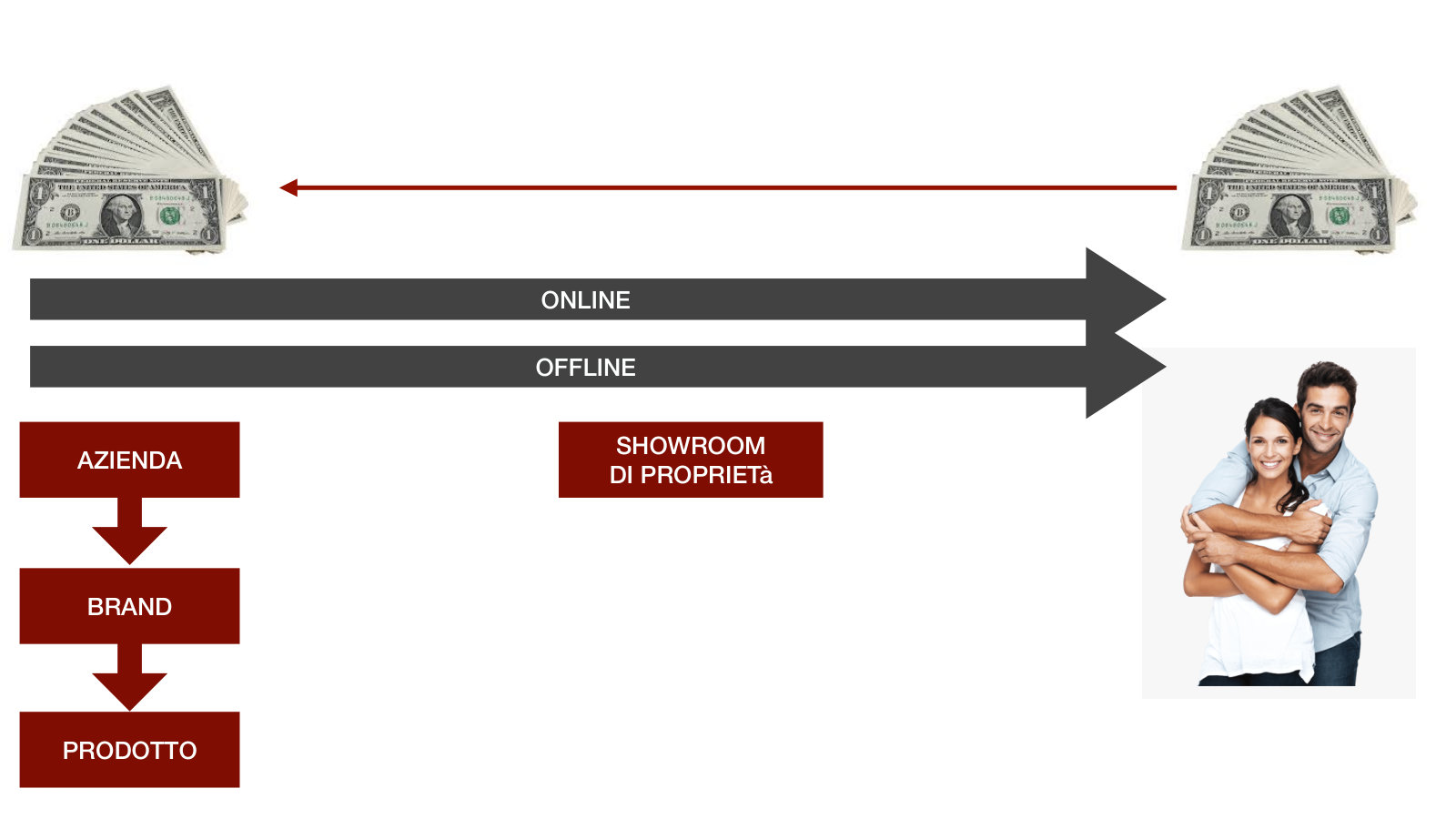
As in every revolutionary phase, a new player has arrived and is changing the rules: Tesla. It has no dealers; it has its own showrooms run by employees who display the product but don't sell, because the consumer does the buying online on the website. Musk, who is a hundred years ahead, chose to suffer in the short term, not to tie himself to distributors who would have given him an immediate sales boom, and to build a network of single-brand showrooms at his own cost, which he could afford thanks to the funds that believed in the company. Result: the couple pays $100,000 and Tesla receives $100,000, not 50,000, by credit card or bank transfer. Zero collection risk, zero margin lost in the distribution chain.
In March 2020 the Chinese market collapsed by 40% because of the lockdown; in the same month Tesla had the best month in its history, with 10,000 registrations in China and 88,400 cars sold worldwide in the first quarter. Why was only Tesla growing while everyone else was losing ground? Because of the business model: with dealerships closed, anyone who wanted a Tesla stayed at home, configured it and bought it online, which the other manufacturers couldn't do, because between them and the market there is a network of distributors acting as a filter. Whoever controls distribution controls their own business: they set the selling price and the clients are theirs, not another sales company's. A year earlier, when Musk announced he was closing showrooms, criticism erupted on Facebook: people will never buy cars online, you need to see the product. Major analysts also declared the model unsustainable. Musk did exactly the opposite and the results have proved him right.
Volkswagen
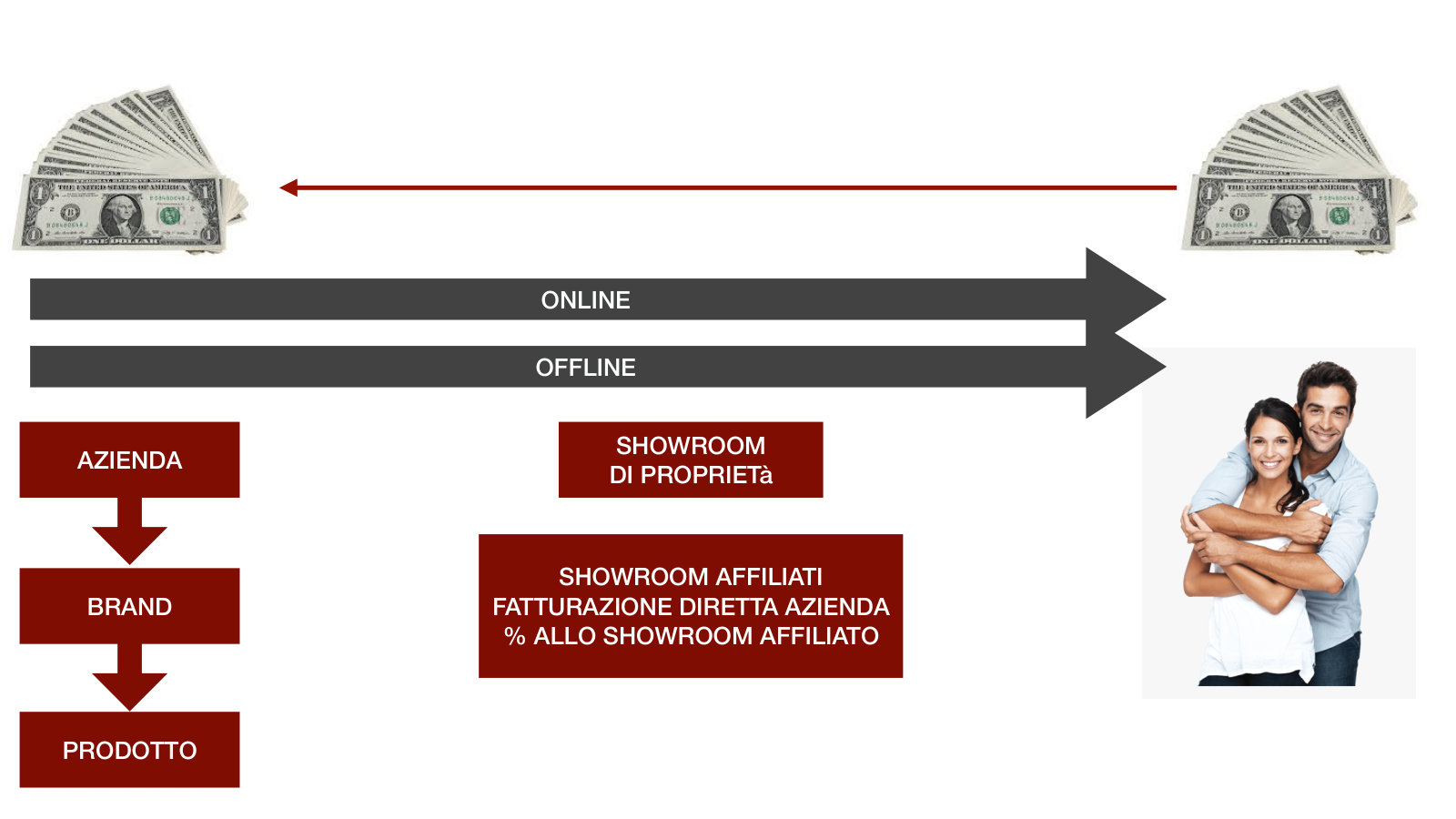
Volkswagen has set out on a path similar to Tesla's, with the added difficulty of having a very powerful sales network that it must not destroy. Here lies the key to making direct sales coexist with an existing network. Under a historic agreement with the association of Volkswagen and Audi dealers in Germany, from 1 April 2020 the 2,400 dealers no longer buy electric cars to resell them: the contract is signed directly by the manufacturer, and the dealers receive a commission for advising and assisting the client, paid even if the purchase happens online. The client configures the car, asks for a test drive, selects the dealership, receives the offer, buys and collects the car. Compared with Tesla there is one extra box: the manufacturer receives 95 or 93 instead of 100, eliminates the collection risk, and the affiliated showrooms earn a commission. But note: the client's data passes from the dealer to the manufacturer, which will be able to use it to build audiences and do marketing. Volkswagen is deliberately starting with electric cars, a small share of its volumes: it is a first step, and it takes courage on both sides. In Italy, incidentally, there was a pioneer: John Elkann, who 20-25 years ago, with the Ciao portal, was the first to propose direct online sales of the customisable Fiat Barchetta. It wasn't a successful experiment, but he believed in the model even before Musk.
The RiFRA case: three channels
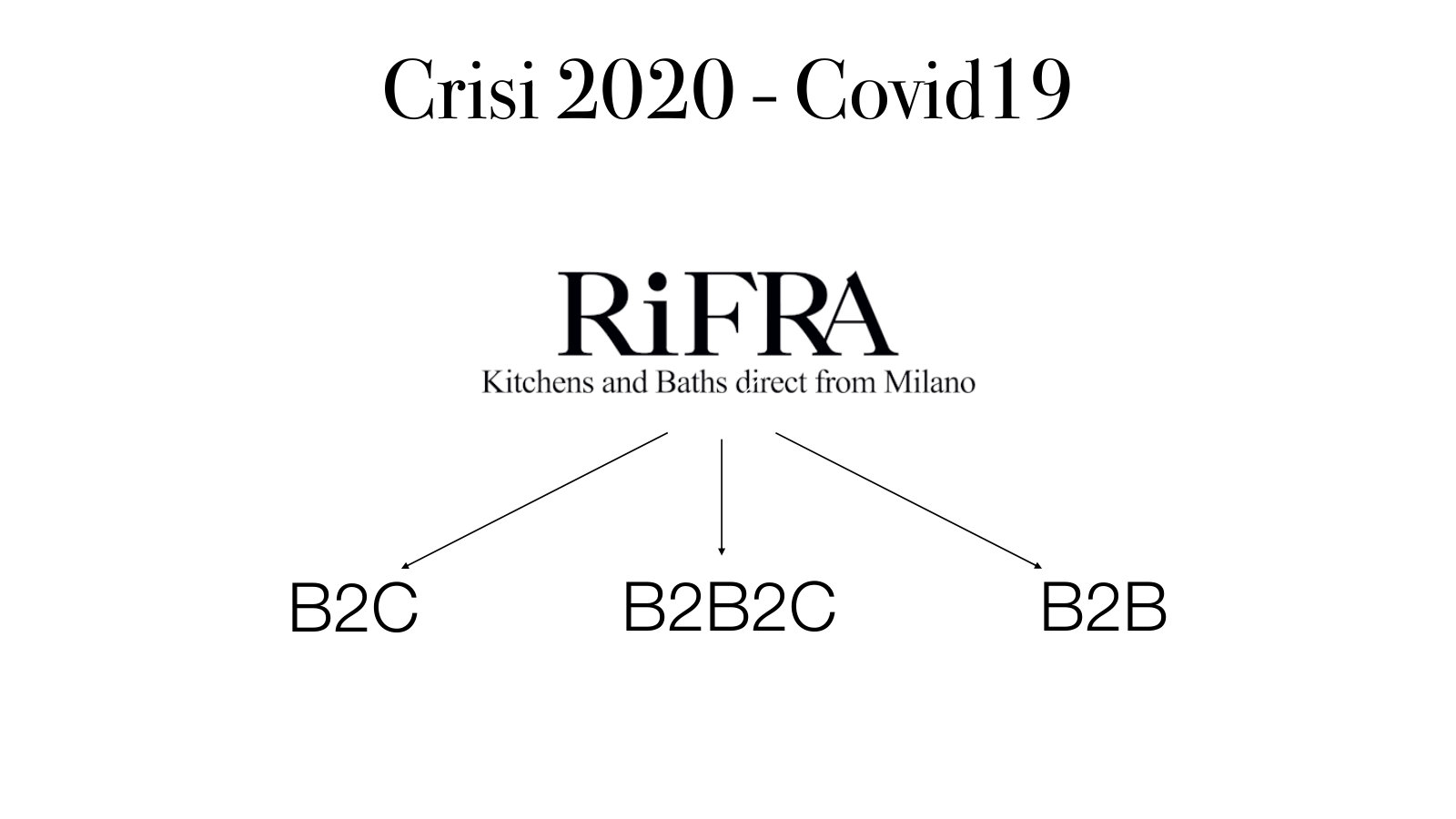
Let's put this in the context of SMEs. My company, RiFRA, makes kitchens and bathrooms in Brianza with around thirty employees and 2,500 square metres, and has been on the market for about 50 years. We started with contract manufacturing, became a manufacturer with our own brand and catalogue selling only to distributors, took on contract, meaning sales to property developers, pure business to business, and today also the consumer, with direct showrooms. I have experience in all three channels and today we run them side by side. The first step towards the consumer was the Milan showroom in 2017: for kitchens, a new product without a dealer chain as there was for bathrooms, we dared to sell direct, and the investment is paying off very well. Compared with intermediated distribution we get paid immediately and the margin is higher. With Covid we created fully online design and sales for a product as complex as a modular kitchen with 250 finishes, endless sizes and water and gas connections: a form, a first call with the designers, a second video call presenting the design. A system that evolves with feedback from the market.
Margin beats turnover
The paradigm in the Italian business owner's head absolutely has to change: margin beats turnover. What matters is increasing margins, even with turnover falling. Every order, every contract has to create margin once fixed and variable costs are paid, and has to bring value to the income statement. Margins must offset not only the fall in turnover but also the rising tax burden. And high margins can only be achieved by creating a high-end brand, linking it to marketing and quality products aimed at a target of high-spending people. You can't sell at a high price without a brand the market recognises as high end: the emotional element of the purchase is missing.
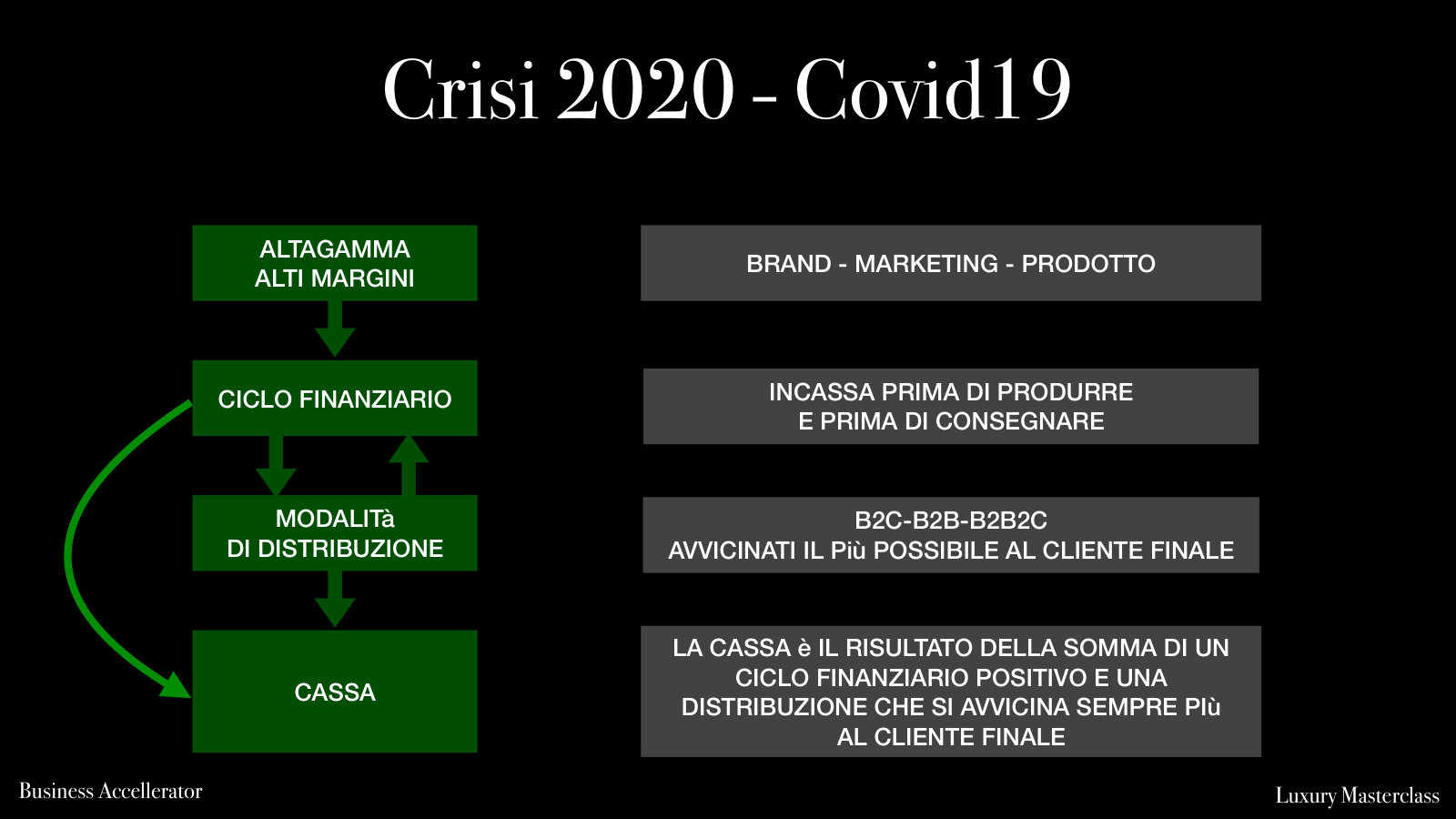
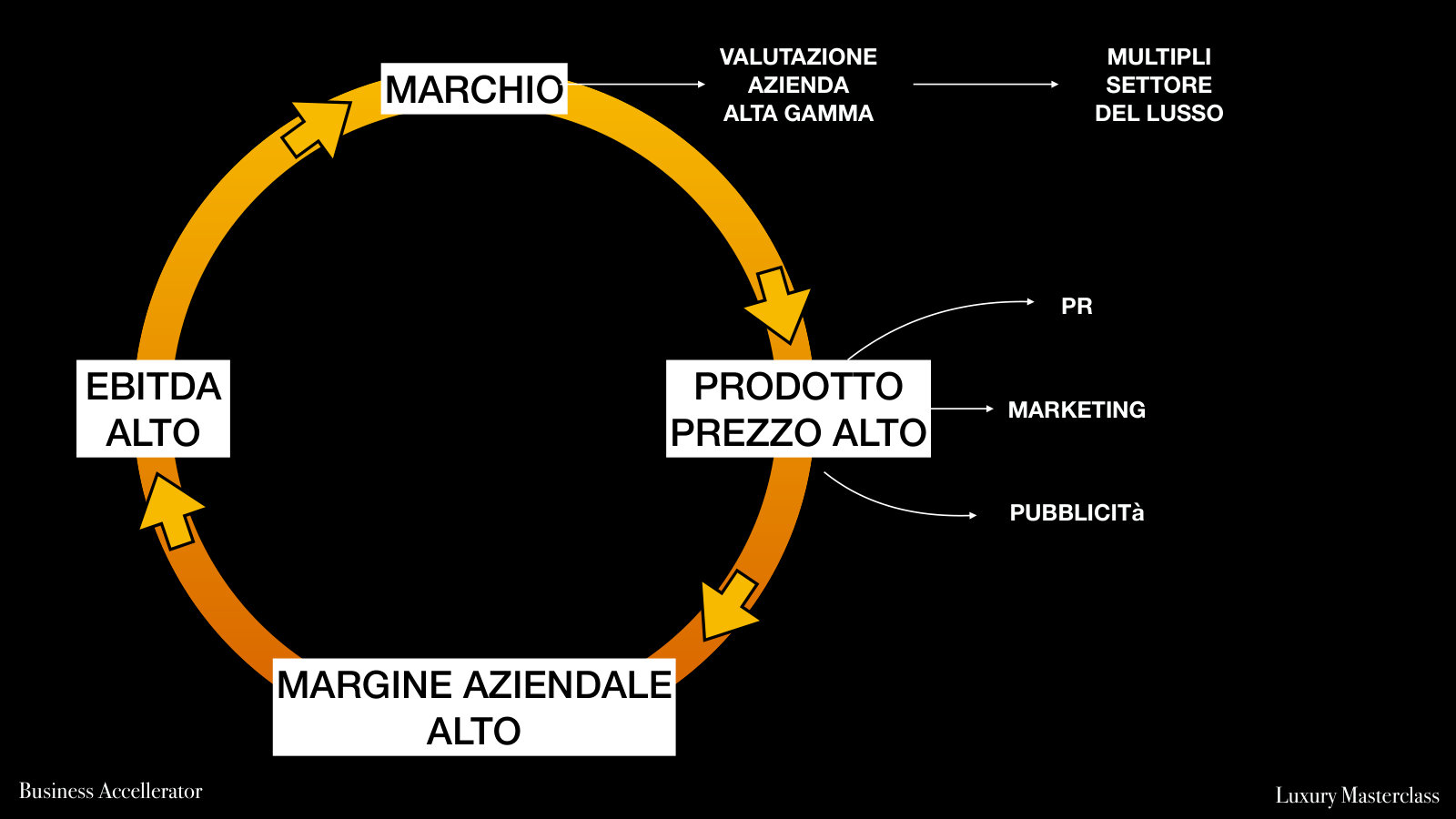
To simplify: the high-end market guarantees high margins; I have to create a brand, marketing and products; linked to this is a cash cycle, getting paid before producing and delivering, and therefore direct distribution wherever possible. Get ever closer to the end client: whoever is closest to the end client wins the game. This model generates cash, the sum of a positive cash cycle and distribution close to the client. The high end is the flywheel of margin: a brand that sells at a high price guarantees a high margin, a high EBITDA, meaning earnings before interest, taxes, depreciation and amortisation, and therefore a company valuation on the multiples of the luxury sector.
Sales and acquisitions: what a high-end brand is worth
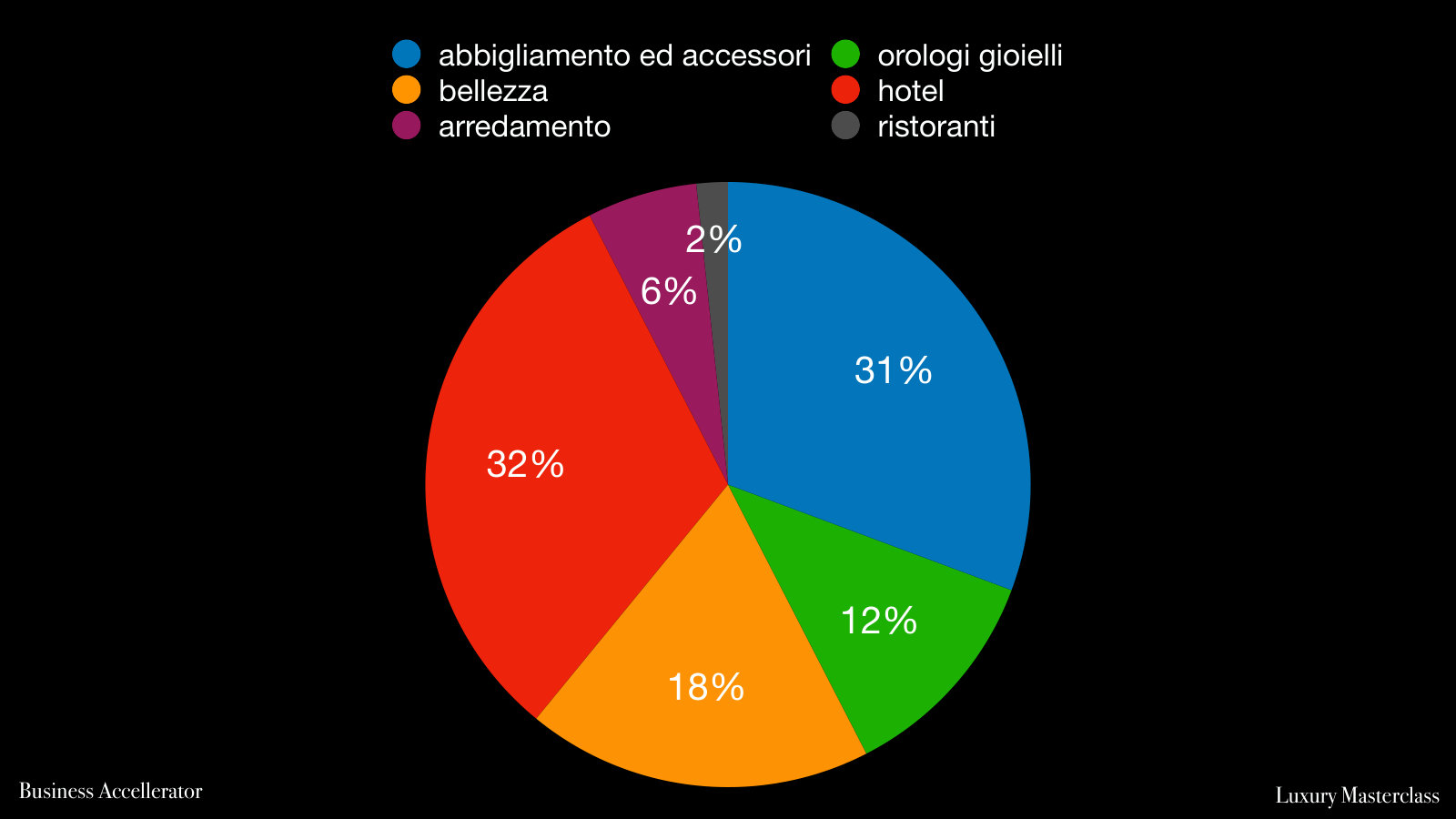
Creating a high-end brand gives the business owner a better chance of a favourable exit in the mergers and acquisitions market. That doesn't mean you are obliged to sell: the company can be listed, sold or inherited by your children. But investment funds and large international groups are increasingly looking for high-end companies to add to their portfolios, because the more luxury brands they have, the more advantages they gain in production, distribution and client acquisition. Most of these brands are in Italy, and their value is often higher than their annual turnover. According to Deloitte research, in 2018 there were 265 transactions in premium and luxury, private companies bought by groups and funds, in clothing and accessories, hotels, watches and jewellery, beauty and fragrances, furniture, restaurants, and then aviation, automotive and yachting. Restaurants that have become brands have received offers of up to five times their turnover.
The value formula
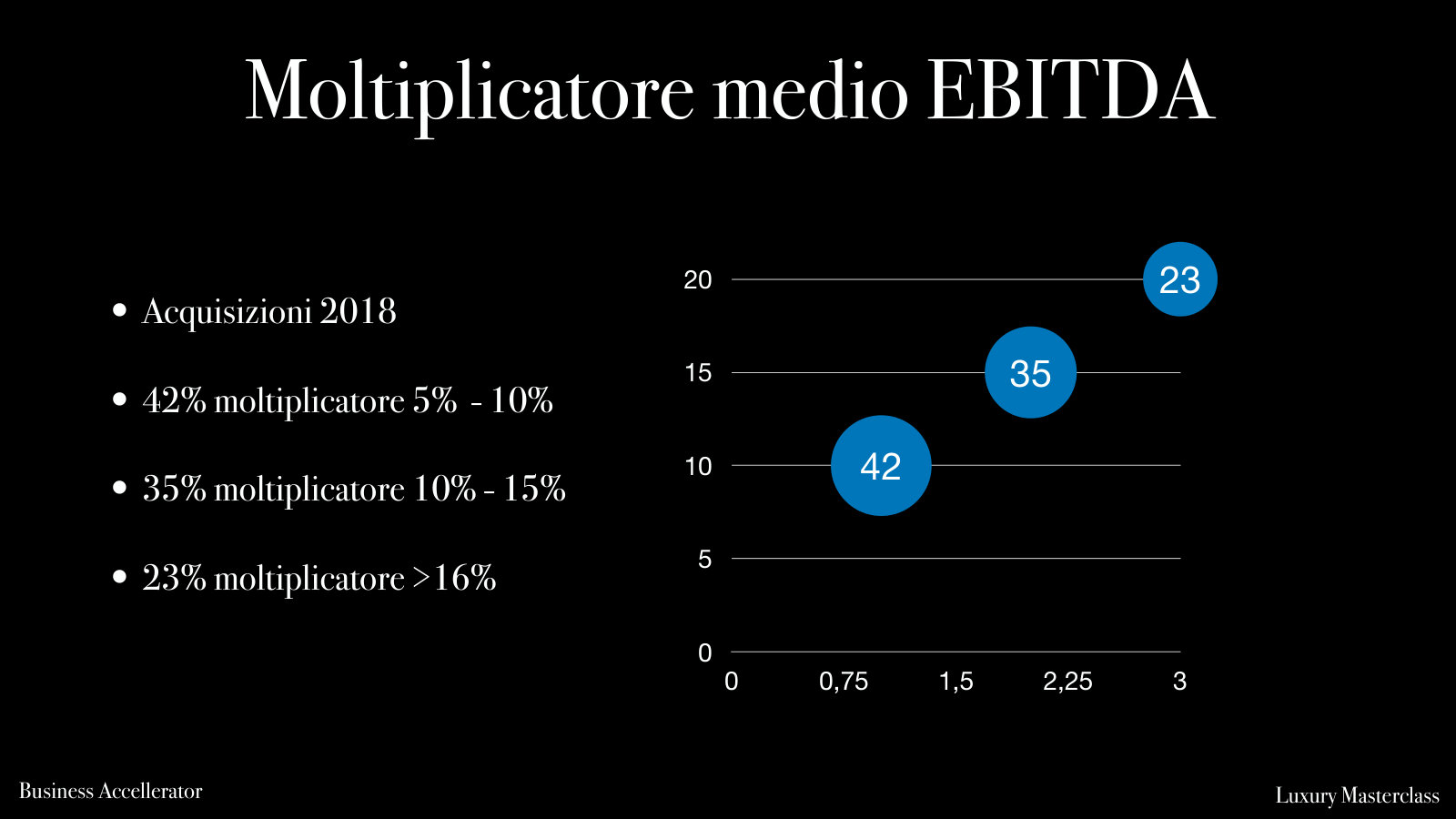
The value of the company is determined by the value of the brand, which depends on the market segment. The formula to write down: EBITDA multiplied by the sector multiple, minus the net financial position, in other words the debt. Statistics on 2018 acquisitions show that 42% had a multiple between 5 and 10, 35% between 10 and 15, 23% of 16 or more: 58% above 10. Let's do the exercise. An SME with a turnover of 10 million, a conservative EBITDA of 10%, so 1 million, a multiple of 10 and 3.5 million of debt: it is worth 6.5 million. If year after year, with the same turnover, I work on margin and on brand perception, EBITDA goes from 10% to 15%, 1.5 million, and the market gives me a multiple of 13: 1.5 times 13 minus 3.5 makes 16 million. From 6.5 to 16 million on a turnover of 10, just by increasing margin by 50% and the multiple by 30%. Exactly what Deloitte says: Italian luxury SMEs are bought for more than their turnover.
KPMG, in the first 9 months of 2019, counted 740 completed deals, 18% more than in 2018, worth around €32 billion, with SMEs dominating the scene. Max Fiani, who coordinated the report, spoke of a consolidation trend in many Made in Italy sectors: small deals, but ones that show an entrepreneurial attitude geared towards growth.
Cova and Sant Ambroeus
Two cases of Italian SMEs in food service, one of the six sectors that dominate the Italian scene together with clothing and accessories, beauty, furniture, watches and jewellery, and hotels. Cova, a historic Milanese pastry shop, became a brand: breakfast at Cova, the business lunch at Cova, Cova panettoni famous all over Europe. In 2013 the company and the brand were acquired by the LVMH group for €32.8 million: a pastry shop, in an excellent location, but sold for that sum because it created a brand. Sant Ambroeus, 300 metres from where I am recording, on Corso Matteotti, the elegant heart of the city where we high-end business owners have our showrooms and offices, twice turned down an acquisition offer: 15 million in 2014, then 20 million from Illy, with 2013 turnover of 3 million and a loss of about half a million. More than six times turnover, and loss-making. There is no logical basis for it, but that is how the high-end market thinks, and positioning yourself there means a small company can one day be valued at millions of euros.
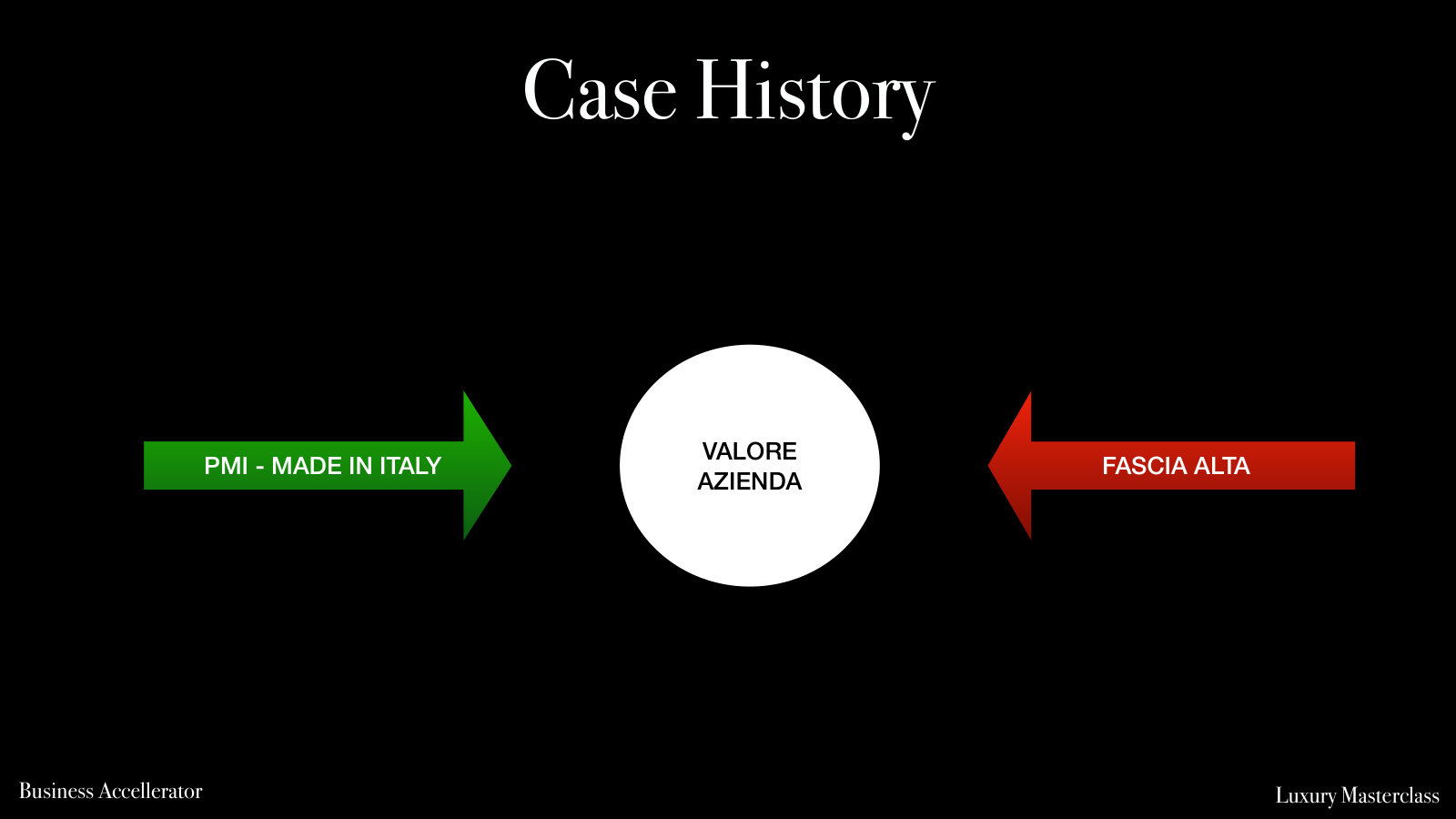
To sum up, with the colours of our flag: to create value in a company you need an SME firmly anchored to the values of Made in Italy and a focus on the high-end market. These two elements together make the company's value take off.
Frequently asked questions
Why should an SME sell at the high end instead of in the mid-market?
Because at the high end you sell with a high margin on every unit, which offsets falls in turnover and rising taxes, and because the high-end consumer, who also has income from assets, is the one who doesn't go into crisis. The mid-market is shrinking and the entry-price segment belongs to countries with low labour costs.
How do you calculate the value of a high-end company?
EBITDA multiplied by the sector multiple, minus the net financial position. In 2018, 58% of acquisitions in premium and luxury had a multiple above 10. An SME with 10 million in turnover, a 15% EBITDA, a multiple of 13 and 3.5 million in debt is worth 16 million.
What does the Tesla case teach about distribution?
That whoever controls distribution controls the business. Tesla sells online and has its own showrooms: it collects 100% of the price with no risk of non-payment, whereas a traditional car maker, through its dealers, receives about half. In March 2020, with dealerships closed, it had the best month in its history.
What does it mean that margin beats turnover?
That every order and every contract has to bring margin to the income statement once fixed and variable costs are paid. You no longer sell at a loss or at break-even to win a client, and the fall in turnover is offset by higher margins, which is only possible with a high-end brand.
One live webinar a month.
One topic, questions from the business owners who join, answers without sales slides. It's free and in Italian, and it's the simplest way to get to know us.
See the next webinar →