



The 7 mistakes that keep your company in the mid-market
In the tap and fittings district, two companies buy their brass from the same foundry. One sells a mixer tap at a price it has to justify every time; the other sells it at twice that and never justifies it. The product is the same. In this video I list the 7 mistakes that keep an entrepreneur stuck in the mid-market, the position nobody chooses, and for each one I explain what to do, starting with price and first-level margin.
We need your consent to play it: YouTube uses cookies that may profile what you watch.
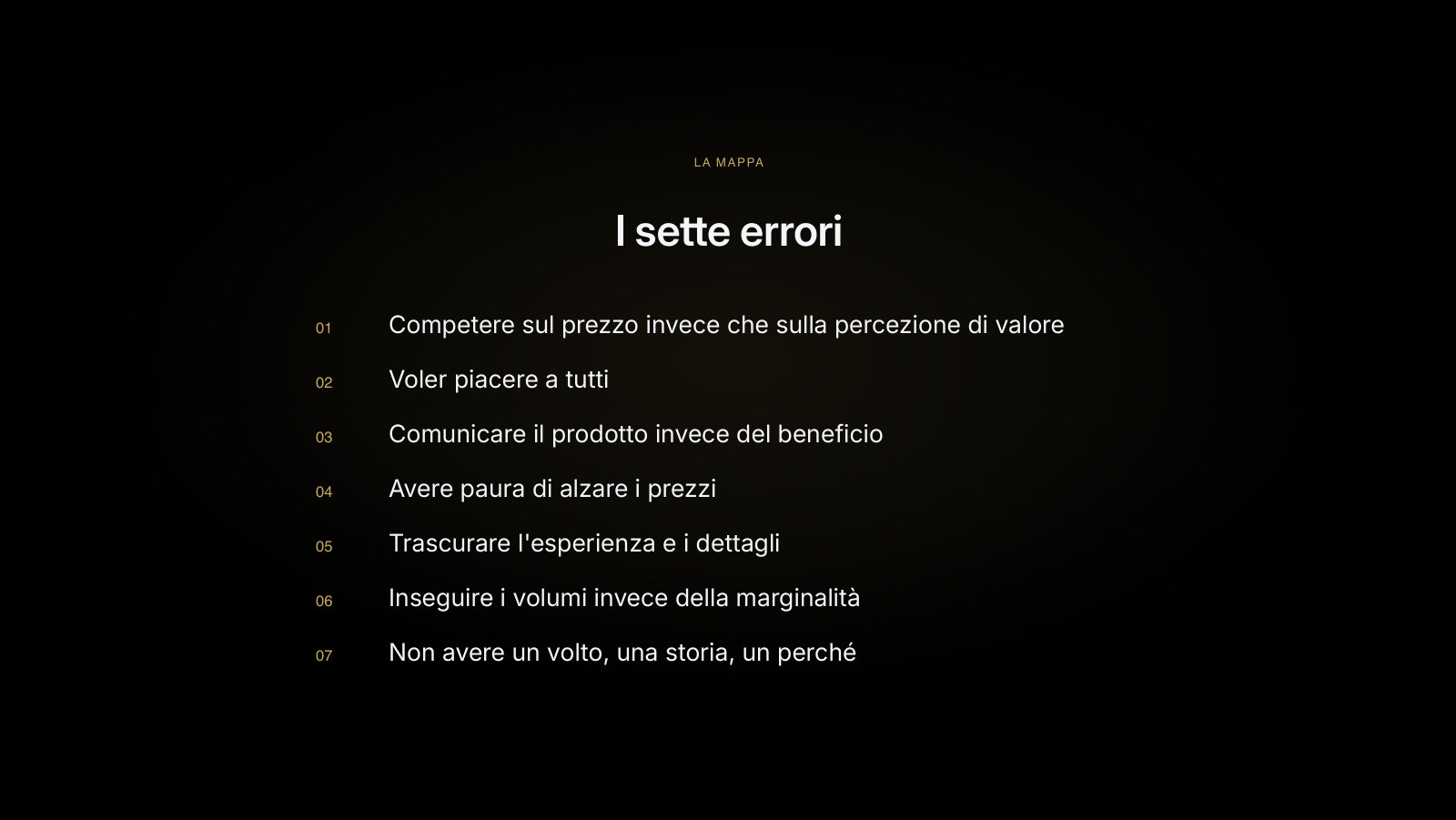
Cookie preferences- Competing on price instead of perceived value. This is the root mistake from which all the others grow.
- Trying to please everyone. Communication has to be built on the ideal customer profile.
- Communicating the product instead of the benefit. The customer buys the change the product brings to their life.
- Being afraid to raise prices. The price list should go up every year, by at least 5%, net of inflation.
- Neglecting experience and details. In luxury the product is only part of what you sell.
- Chasing volume instead of margin. Margin before turnover, on every customer and every job.
- Having no face, no story, no reason why. Without an identity, price is all you have left to sell on.
One district, two entrepreneurs
Italy is a country of industrial districts, each with its own speciality: furniture in Brianza, taps and fittings around Novara, ceramics in Sassuolo. I'll pick one at random, because the basic idea is what matters. In the tap and fittings district on Lake Orta, two entrepreneurs buy their brass from the same foundry. The first specialises in the high end of the market: he has customers who pay a premium price, a healthy income statement and an excellent margin at the end of the year. The second is stuck in the quicksand of the mid-market. He isn't in the low end, where volume is guaranteed, because in Italy today we can no longer make products at cost: production and running costs are too high to compete on price alone, and that segment has been taken by Chinese and Eastern European manufacturers.
The first entrepreneur works harder than anyone: he knows his product better than anybody, looks after every detail of production, always answers his customers. Yet at the end of the year his margins are always the same, and always thin. And there is a competitor with a similar product, sometimes even an inferior one, selling to the same audience at a higher price without justifying it to anyone. I say this from experience: at the start of my own career as an entrepreneur, when I had a physical product, bathroom furniture, I used to ask myself how my direct competitor could cost more, offer less quality and still sell more than me. After years of study and experience I understood why.
Same district, same suppliers, same raw material, same foundries. Yet one sells at twice the price of the other. Why does the second one manage it and the first one doesn't? The convenient answers we have been giving ourselves for 20 years are: he must have the right customers, he must be good at selling himself, it's all marketing anyway.
The mid-market: the position nobody chooses
If we draw a map of the market, at the bottom are those who win by charging a euro less; at the top, those who manage to impose their price on the market; in the middle, the most uncomfortable band, everybody else: too expensive to compete with the first group and not desirable enough to sit with the second. That no man's land has a name, the mid-market, and the first entrepreneur lives exactly there. You end up in the mid-market through inertia or necessity, and you stay there without noticing, through specific choices repeated every day. In my view there are seven mistakes that keep an entrepreneur stuck there.
Mistake 1: competing on price instead of perceived value
Lowering your price to close a sale is a surrender. Nobody says you can't negotiate or meet the customer halfway, but it has to be a deliberate strategy: promotions planned in advance, calculating exactly where you land and the margin the company keeps. A discount given to split the difference with the customer, without doing the sums first, costs you margin, and may even turn the job into a loss just to keep the company busy.
This is the root mistake from which all the others grow. When the only lever you know is price, you enter a war you cannot win, because there will always be someone, in Italy, in Europe or anywhere in the world, willing to charge a euro less than you. Competition has to move from price to building perceived value. Even if you are small, in fact especially if you are small, you need to build a narrative on two levels, emotional and rational, because this is how the potential customer's brain works: it makes the decision with the emotional side and then justifies the higher spend, compared with a mid-to-low-end product, with a rational argument. First the emotional narrative, then the rational one.
My first piece of advice is to look after your website as if it were the company's main asset. Try a test: open your site on your phone or computer, put yourself in a potential customer's shoes and ask yourself honestly whether you would buy from a site like that. Then communicate on social media in a way that is consistent with the site's art direction and the company's mood, and build a portfolio of long-form YouTube videos that give you credibility, visibility and authority.
Mistake 2: trying to please everyone
Saying that our customer is anyone is a death sentence. You need to work out the customer profile carefully, whether you sell to businesses or directly to private clients: identify who they are, understand their fears and their dreams, and in the rational part of your communication speak to them continuously over time. Thanks to technology we can be present in potential customers' lives with videos and content, and the more present we are, the more likely we are to be their first choice. But it takes communication targeted at the ideal customer profile.
Mistake 3: communicating the product instead of the benefit
This is perhaps the most common mistake, because talking about our product comes naturally to us. The right approach is always to think about the change your product or service brings to the customer's life: communicate benefits before features, and show them. Today technology and artificial intelligence give us photo and video tools that can show the promised transformation, something unthinkable until two years ago. This applies to services, from dentists to aesthetic medicine to property renovation, and to products, taps, cars, furniture: whatever the customer chooses for themselves, today we can show them the benefit they will have after the purchase. It is an opportunity we entrepreneurs have to seize.
Mistake 4: being afraid to raise prices
Many entrepreneurs know they should raise their prices but don't, for fear of losing customers. That fear is almost always misplaced. I advise the clients I work with on my courses and in consulting to raise their price list every year, by at least 5%: if a customer stops buying over a 5% increase, they are probably not the right customer. A price increase is the most powerful weapon an entrepreneur has to increase margins, because it doesn't touch the variable cost of goods and it is all margin.
A price that is too low signals little value. Whoever discounts out of fear teaches the market that their product is worth less than they think. The goal of our school is for clients to have a premium-brand image and price list that justify at least 30% more than the mass-market competitor. It is the first indicator, and it comes from the multiplier, that is, how much you multiply the product or service you buy or produce. It has a direct impact on first-level margin, which is what is left to pay fixed costs and from which EBITDA comes. With a low first-level margin there is little left to cover fixed costs, and EBITDA will inevitably be below the sector average.
Studying the accounts of our clients and their competitors, the winning companies are exactly these: a premium price 30% above the market, an excellent first-level margin, fixed costs kept as low as possible, and EBITDA that takes off. The challenge is to grow the brand steadily over the years to win high-spending customers without losing, or losing only a small part of, the existing customer base. And remember to raise your price list every year, net of inflation: in our management control model this is the decision with the biggest impact on profits in the short, medium and long term.
Mistake 5: neglecting experience and details
In luxury the product is only part of what you sell. You have to create the anticipation, the packaging, the way people are welcomed, the extra gesture nobody expected. Everything around the product and the service counts.
Mistake 6: chasing volume instead of margin
This is a tragic mistake. Margin is the only thing to consider, in particular first-level margin: sales revenue minus variable costs. It is the most important indicator you can have in a company, because it is what is left, after paying the variable costs of purchasing or production, to pay fixed costs. Margin before turnover: for every customer, every product, every service we need a job cost and to know how much margin is left for the organisation. You can have entry-level services with a deliberately low margin, and then develop the customer with high-value products, but it has to be planned carefully with the numbers in hand. We can no longer afford to improvise: the costs of running a business in Italy are so high that if we get it wrong two or three times we put the company's survival at risk.
Mistake 7: having no face, no story, no reason why
The last one is a marketing and positioning mistake. Companies that move up a segment have a story, a founder, a vision, a reason why that the customer identifies with. If nobody knows who you are and what you do, the only argument you have left to sell on is, once again, price, and those who sell only on price remain at risk of closing down. The brand needs a face, a story and a reason why, and it has to communicate constantly with its base of customers and potential customers.
Where the difference lies
The first and second entrepreneurs buy the same brass from the same foundries. The difference lay in these seven mistakes, which all come from a single way of thinking that has to change in order to adopt a new business model. Competing on price instead of value, trying to please everyone, communicating the product instead of the benefit, being afraid to raise prices, neglecting experience and details, chasing volume instead of margin, having no face, no story and no reason why.
It is a mindset that has to change. In Italian manufacturing and service companies the product is very often already there, otherwise we wouldn't be on the market. The extra step is to build a brand image, storytelling, a brand and therefore a perception that makes the customer say: this is a luxury brand, with the same product.
If you'd like to receive the slides or ask questions, you can fill in the contact form linked in the video's comments. Otherwise I'll see you at the free live webinars, with the dates on the website, or in the classroom in Milan for a two-day live course, with exercises alongside the tutors and a roadmap tailored to your company. The next classroom session is on 20–21 November 2026 in Milan.
Frequently asked questions
What is the mid-market?
The no man's land between those who win by charging a euro less and those who manage to impose their own price: companies too expensive to compete with the first group and not desirable enough to sit with the second. You end up there through inertia, and you stay there through mistakes repeated every day.
How much should prices go up each year?
At least 5%, net of inflation. If a customer stops buying over a 5% increase, they are probably not the right customer. The goal is a premium-brand price list, at least 30% above the mass-market competitor.
What is the most important indicator for an SME?
First-level margin: sales revenue minus variable costs. It is what is left to pay fixed costs, and EBITDA comes from it. You need to know it for every customer, product and job.
Where do you start to get out of the mid-market?
With the website, looked after as the company's main asset, consistent communication on social media and a portfolio of long-form YouTube videos that build credibility and authority. Then the ideal customer profile, benefits before features, and the price list.
One live webinar a month.
One topic, questions from the business owners who join, answers without sales slides. It's free and in Italian, and it's the simplest way to get to know us.
See the next webinar →