



The leadership code: empathy, humility, ambition, perseverance and hard work
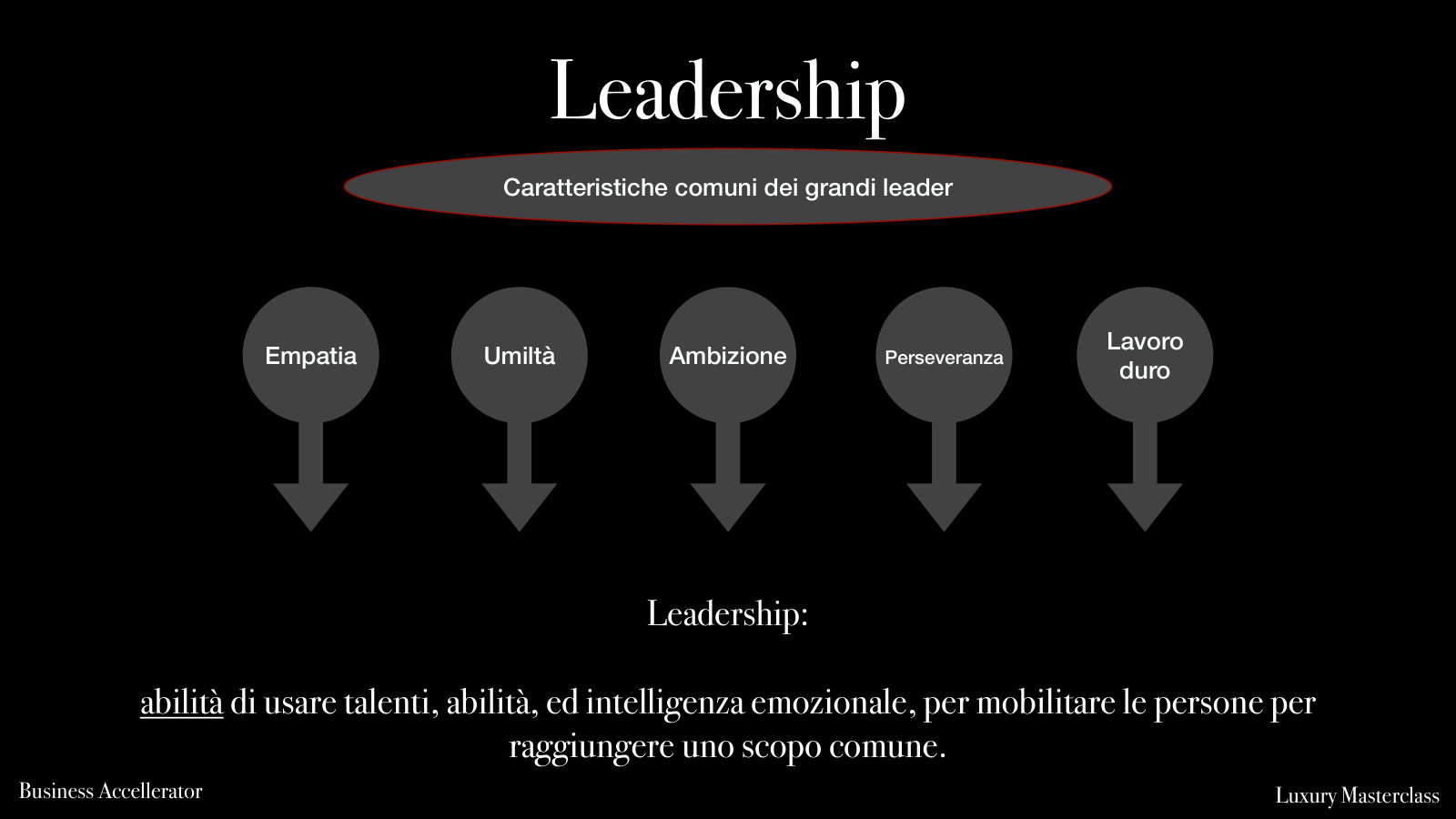
Leadership is the ability to use talent, skills and emotional intelligence to mobilise people towards a common goal. In this chapter of the 7 rules for winning in business I describe the five characteristics I have found in every leader I have studied, empathy, humility, ambition, perseverance and hard work, with Nadella's cultural change at Microsoft, the 1992 Clinton-Bush debate and practical tricks for training empathy in negotiations.
We need your consent to play it: YouTube uses cookies that may profile what you watch.
Cookie preferences- Leadership is the ability to use talent, skills and emotional intelligence to mobilise people towards a common goal. The leader plays to win the war in the long run.
- Five characteristics: empathy, humility, ambition, perseverance, hard work.
- Empathy inside and out: a team that rows in the same direction, and time spent with customers without a sales filter.
- Humble but ambitious. The arrogant ambitious person will never sell anything to anyone.
- Lead by example: no member of your team will ever work harder than you.
What leadership is
Leadership is the ability to use talent, your own skills and emotional intelligence to mobilise people towards a common goal. It is the definition I studied and the one I find purest and most beautiful, applied to business: the leader of a company, meaning the entrepreneur, must be able to win in the long run, improving the product, the marketing, the brand, customer service and the internal climate day by day. The leader always plays to win the war.
Another summary I have always liked comes from Simon Sinek: when everything goes well you give the credit to your team, when everything goes badly you take responsibility. But where does this ability come from? Every leader I have studied has five characteristics: empathy, humility, ambition, perseverance and hard work.
1. Empathy
Empathy is the ability to put yourself in another person's situation and immediately understand their psychological processes. The empathetic leader uses it in two directions: internally, in building the team, and externally, in negotiations with customers.
Inside: a team that rows in the same direction
Company objectives can only be achieved through people and their commitment, because a company is made of people. An empathetic leader takes the reins and shows the way, not just in theory but in practice, working as a team and doing away with favouritism: everyone rows with the same intensity, the leader included. If in a team of even three, four or seven people there is one negative person who stands in the way of the goal, the bad apple spoils the climate and the goal becomes almost impossible. You have to get rid of favouritism and of negative people.
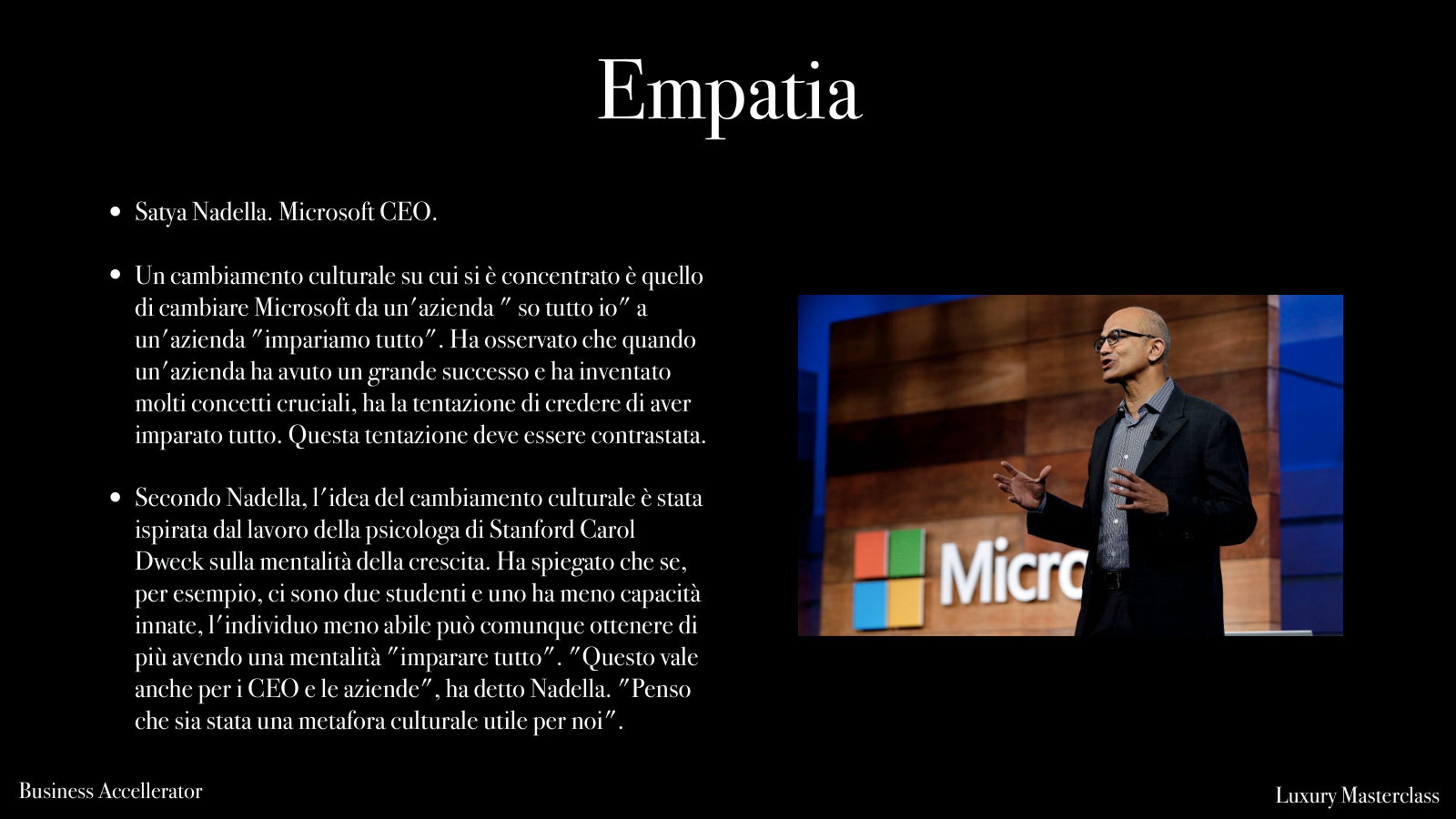
A leader who uses empathetic intelligence to run a company is Satya Nadella, who took a declining Microsoft to a value equal to Apple's. He drove a cultural change: from a "know-it-all" company to a "learn-it-all" company. He observed that when a company has been very successful and has invented many crucial concepts, it is tempted to believe it has learned everything, and that temptation has to be challenged. It showed with Microsoft's mp3 player, technically perhaps better than the iPod, which was sunk precisely by the "this is a better product" mentality. Nadella worked on a growth mindset: of two students, the one with less innate ability can achieve more with a learning-oriented mindset, and this holds for chief executives and for companies. The best-performing companies have humble bosses, always looking for new information, courses and seminars to put into practice. Declining companies have at the top an entrepreneur who has been successful and keeps saying "we do it this way because we've always done it this way", without understanding that the crisis is changing customers' buying behaviour. It is a mentality that leads to ruin.
Outside: time spent with customers
Time spent with customers is the best investment of time an entrepreneur can make. Try to talk to your customers as an entrepreneur, without a sales filter. With the online design service we launched, private customers contact the company and our sales staff call them directly, with one phone call and two video calls. I distribute the leads to the sales team, but I keep 20-30% of the leads to handle personally: every day two or three hours on the phone with new customers, not the long-standing customers we have been invoicing for years, introducing myself as sales director and discussing their projects. It also serves to test sales methods, and to avoid being arrogant with your own salespeople: ask yourself when you last went out in the field to sell. Today company heads also need to work alongside the sales team, because that way you can give a practical demonstration of the process, not just say "you got it wrong, you should have done this", but "doing it this way I sell more than you". Focus your energy on a relationship built on the customer's interests, concerns, problems and opportunities: the customer will never be on the defensive and will strengthen their trust in you and your brand.
A few tricks to train empathy
Train your smile, constructed but genuine. Train your handshake, firm, especially at the first meeting in person. Learn the names of the people at the meeting and repeat the customer's name often: it is a tragic mistake to walk into a meeting without remembering the names of the customers or employees at the table, while they know yours. Before the meeting go over everything, look them up on LinkedIn and Facebook and connect each person to their name in your mind. Listen carefully, focus on the customer and keep your phone in your pocket: ten years ago in Seattle I watched one of my agents play with his phone while I was talking to the customer, instead of keeping up the conversation with the other person at the table. It was a mistake that weighed on the relationship, and indeed he is no longer our agent. And in the showroom I received two salespeople, one of whom was playing with his phone while the other gave his pitch. If you are a salesperson or an entrepreneur, the phone for leisure gets an hour, an hour and a half in the evening; in front of the customer it stays in your pocket, at most to use the calculator to close the contract. Use non-verbal communication, the gestures we Italians are famous for, and look the customer in the eye both when they are speaking and when you are: they must feel you will take care of them.
Bill Clinton, the master of empathetic communication
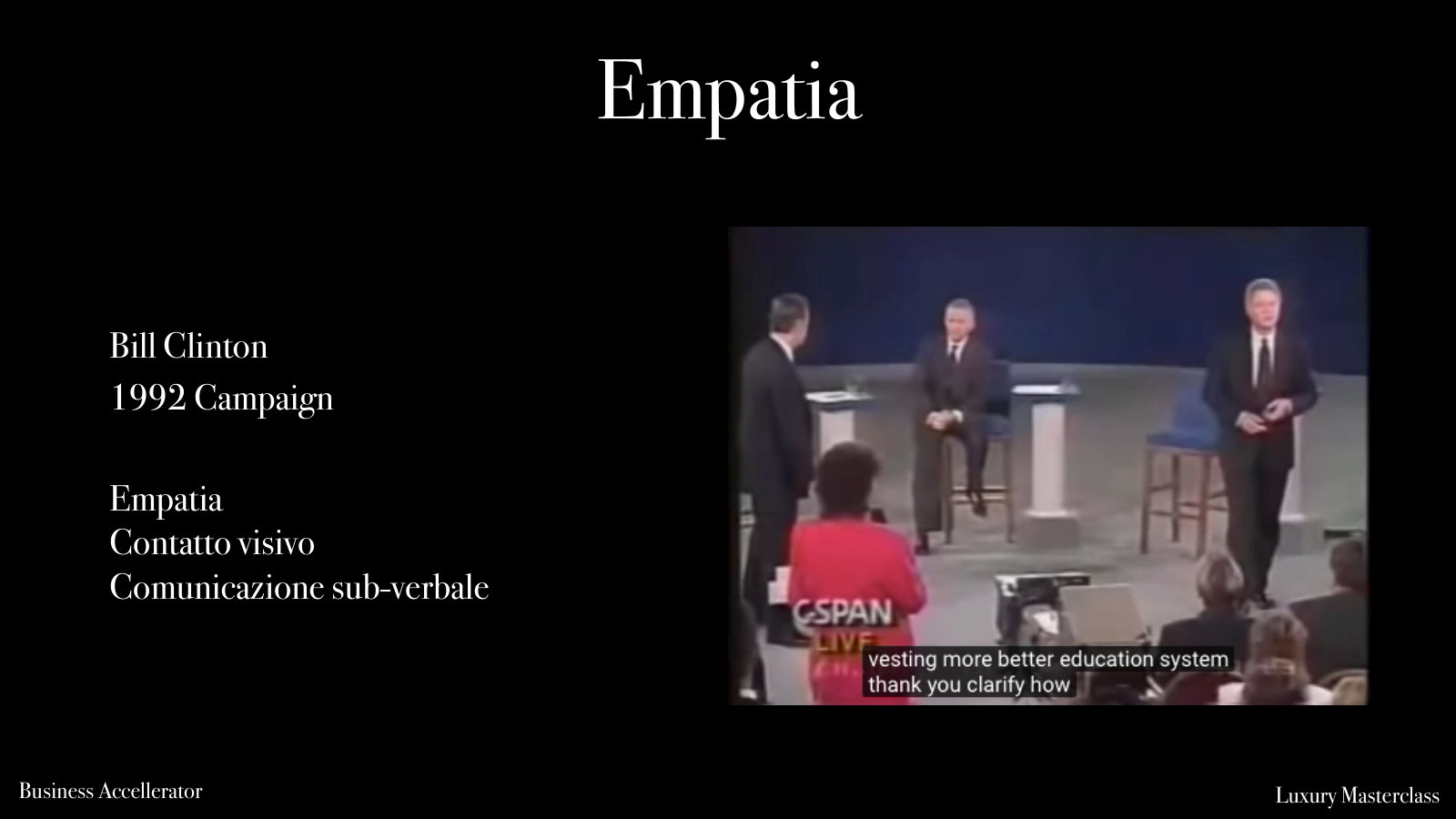
The world's number one political leader for empathy is Bill Clinton, with an innate gift for instantly connecting with anyone from any social class. In the 1992 presidential debate a woman in the audience asked how the national debt had affected the candidates personally. President Bush answered in an irritated tone, understanding neither the question nor how to answer it. Clinton, the challenger who went on to win, connected with the question without making the woman feel stupid: he answered with specific questions, bringing the conversation onto his own ground; he put himself in the ordinary person's shoes, as the governor of a small state who knows by name the people losing their jobs and the factories closing; he used non-verbal communication, moving closer; and he looked the woman in the eye. Four elements that explain why he is the master of empathetic communication and how he won the election.
2 and 3. Humble but ambitious
Humility must always go with ambition: the mark of a leader is being humble but ambitious. The opposite is ambitious and arrogant, and the arrogant ambitious person will never get ahead because people dislike them, and will never sell anything to anyone because the customer will dislike them. You must be seen as humble but ambitious: it is the key to closing even million-euro contracts, because the customer finds in front of them a person with a clean face, as they say in the United States, who wants to look after their interests, but who is ambitious. A humble but ambitious leader uses knowledge, skills and experience to connect with others in the best way, builds trust, sees failures as challenges to overcome and develops a team spirit that leads to happier employees and higher profits.
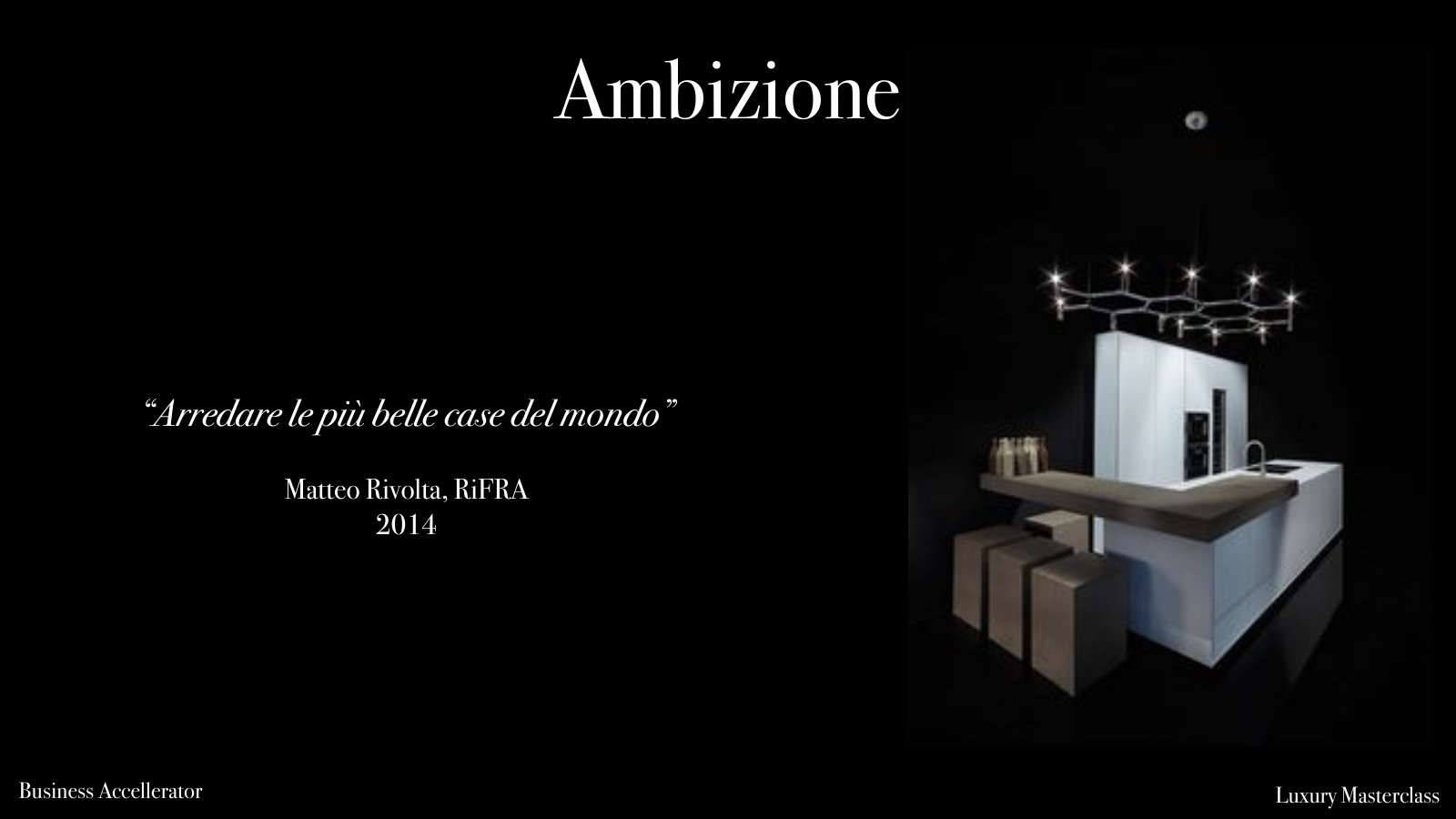
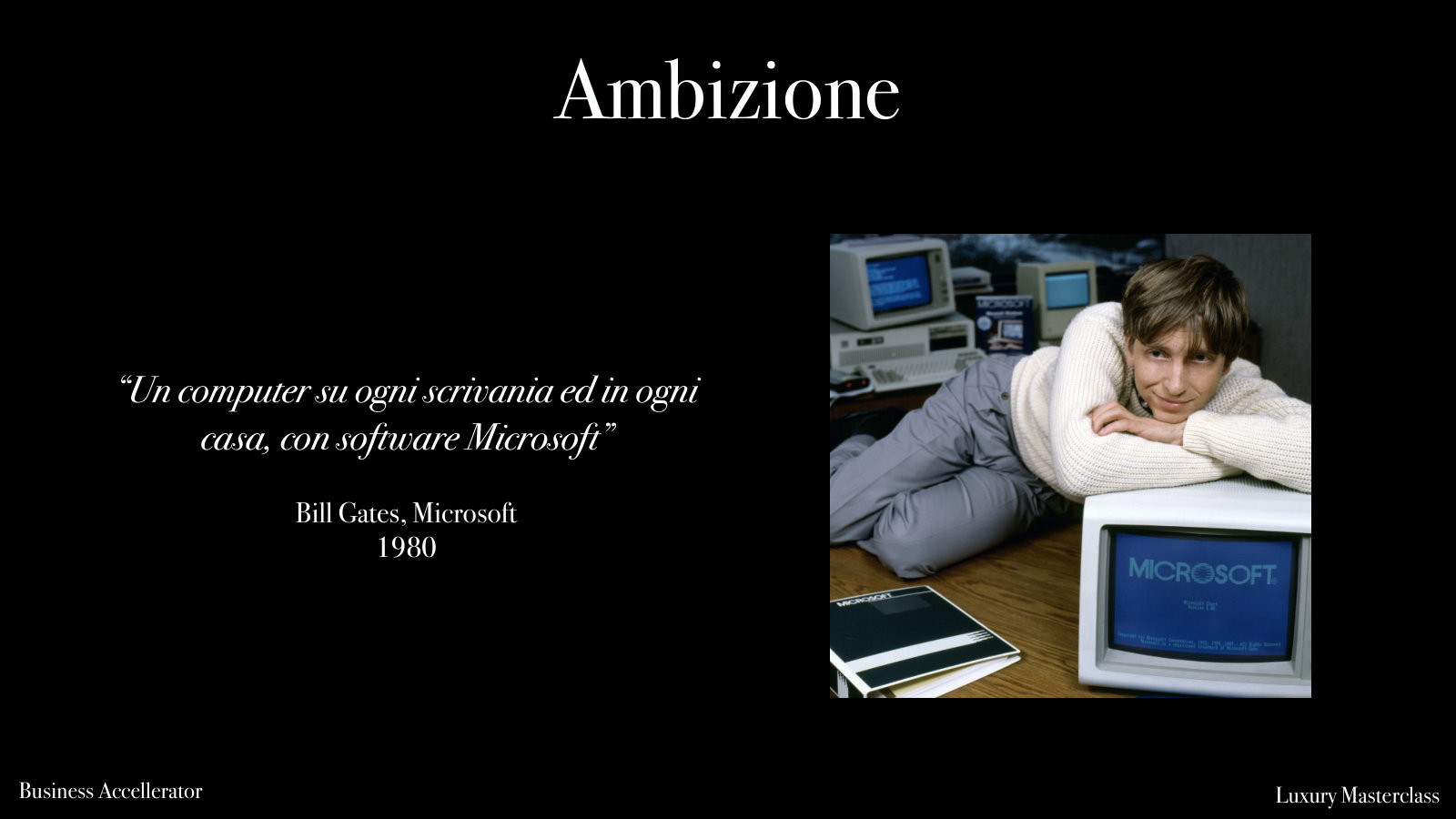
Ambition should be seen in terms of a project: the ambitious leader knows exactly where they want to go and turns the vision into a plan. Without a planned vision you don't trigger the mix of energy, determination and initiative that everyone needs today to make their company safe. Once you could say: I'm starting this business, I know the trade, I work well and the orders will come. It really worked like that, I'm not joking: you did good work, word of mouth spread and orders arrived by fax, then by email. That is no longer the case. You need to be ambitious but humble, like Bill Gates in the 1980s, the classic ambitious and humble leader: a computer on every desk and in every home, running Microsoft software. Put in the context of an SME like ours, our ambition is very simple: to furnish the most beautiful homes in the world, and it seems we are managing it, from Los Angeles to New York, from Milan to Rome to Brussels.
4. Perseverance
Perseverance is what our grandparents called patience: the ability to endure, to carry the load on your shoulders, to stay faithful even when the weight of the undertaking seems too great and we would be tempted to give it all up. It isn't me saying this but Pope Francis: perseverance is the virtue that commits us to fight for the good without giving in to obstacles and without being overcome by tiredness and discouragement. A lack of perseverance is one of the main causes of failure. The greater your perseverance in reaching your goals, the greater your self-discipline, and the greater your self-esteem.
5. Hard work
Steering a company to success is the most complex job there is: you have to be an expert in corporate finance, the market, the product, marketing, and you have to build a brand to sell in the high end. You have to be intelligent, understand many things and above all work every day, because every day you are judged by the market, which, by buying your products or not, passes judgement on your company. The only judgement that counts is the customers', and they express it by opening their wallets. You can't run a company remotely, working five hours a week, delegating without method and being absent from the workplace. Remote working is fine, but people need to be brought together around a workplace. Otherwise there is no explaining why the most innovative companies in the world, Apple, Facebook, Instagram, Google, Twitter, Microsoft, have beautiful, enormous offices, campuses where employees work in person: because that is where a team and a company culture are built, and team leaders take the company to success. If remote working were the solution, the most innovative companies would have been the first to abandon their offices.
Lead by example. Like it or not, you are the point of reference for your employees and collaborators, and the team calibrates itself to your standards. If you are absent and doing the bare minimum, the whole company will reflect that attitude and the market will see it as weak. If you are on top of things, physically present, the first to work harder than everyone, the bar rises and your people will follow you. But remember that no employee or collaborator will ever work and commit more than you. That's normal: the company is yours. Work harder than the others, and they will follow you in your mission.
Frequently asked questions
What are the characteristics of a leader?
Five, present in every leader I have studied: empathy, humility, ambition, perseverance and hard work. Humility must always go with ambition: the arrogant ambitious person sells nothing to anyone.
Why should an entrepreneur personally look after some customers?
Because time with customers, without a sales filter, is the best investment of time: it helps you understand the market, test sales methods and give salespeople a practical demonstration instead of a telling-off. I personally handle 20-30% of new leads.
What does the 1992 Clinton-Bush debate teach?
That empathy shows in four gestures: answering a confused question with specific questions, putting yourself in the other person's shoes, using non-verbal communication by moving closer, and looking the speaker in the eye.
Is remote working compatible with leadership?
Remote working is fine, but people need a shared workplace where company culture is born: the most innovative companies in the world have campuses and offices where employees work in person. And the leader must be present and work harder than everyone, because the team calibrates itself to their standards.
One live webinar a month.
One topic, questions from the business owners who join, answers without sales slides. It's free and in Italian, and it's the simplest way to get to know us.
See the next webinar →