



Enrico Mattei: the Italian who took on the Seven Sisters and changed the rules of oil
Italy, 1945. Oil is controlled by seven companies that decide prices, routes and destinies. A partisan with no degree is given the job of winding up AGIP and instead transforms it: in 16 years he builds the world's sixth-largest energy group, invents Italy's first industrial brand and overturns the rules of oil with the 75-25 formula. Then he becomes too dangerous. In this story I retrace Mattei's method and draw 6 lessons from it for anyone building a company today.
We need your consent to play it: YouTube uses cookies that may profile what you watch.
Cookie preferences- Disobey when you're right. Mattei was supposed to wind up AGIP: he brought the data before announcing his disobedience.
- Work on the terms. He won by redrawing the rules of the game without lowering the price.
- Build alliances before you need them. A network of relationships is the moat no competitor can copy.
- Brand is strategic power. Without a brand, all you have is a price.
- Speed beats capital. He decided, acted, then informed.
- When you become too dangerous, you need to know it. Protection is built while you grow.
Italy, 1945
The country is in ruins. Oil is controlled by others: seven companies that decide prices, routes and destinies. A provincial partisan is given an impossible job, winding up AGIP, and instead he transforms it. In 20 years he builds the world's sixth-largest energy group, changes the rules of global oil and becomes too dangerous to stay alive.
This is an Italian story that no business school tells in full. A man without an engineering degree who took on the Seven Sisters of world oil, a partisan who built an energy group from scratch, and an entrepreneur who changed the rules of the game and paid for it with his life. As in every episode of Stories that teach, the aim is to study the business model and the entrepreneurial lessons so we can apply them to our own companies.
The setting is Italy in the immediate post-war years. The war has destroyed the industrial fabric, the north is devastated, infrastructure is collapsing, the lira is worth almost nothing and dependence on foreign energy is total: no oil or gas field has yet been discovered. The strategic resource of the century is oil, and whoever controls it controls the world. It is controlled by the Seven Sisters, an invisible cartel that sets the price instead of the market: Standard Oil, Shell, BP, Gulf, Texaco, Mobil, Socal. Everyone believes Italian subsoil is poor. The big companies don't invest in Italy. AGIP has existed since 1926, but it is moribund, so much so that the government considers it a waste of public money and wants to wind it up.
Who Enrico Mattei was
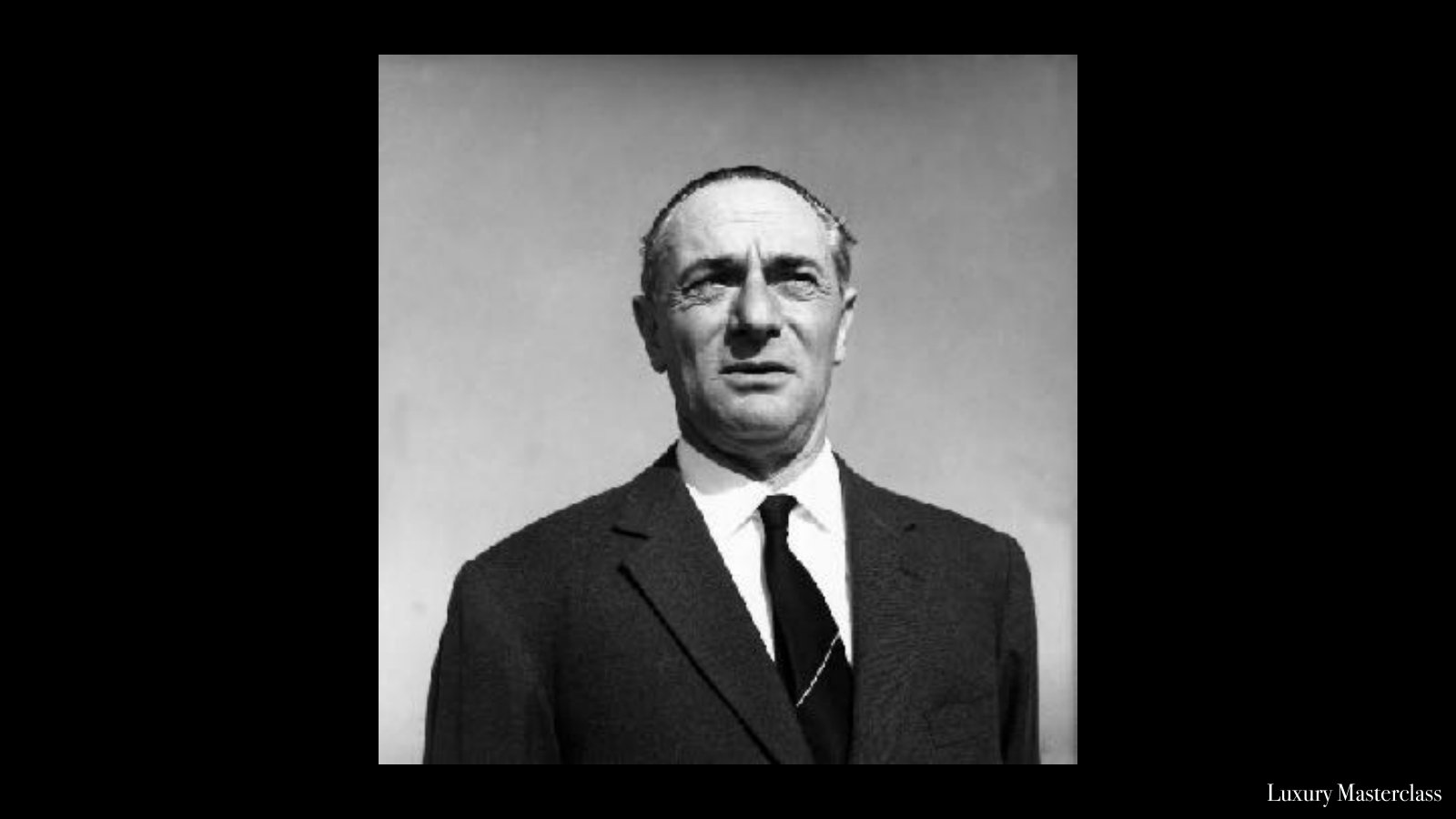
Enter a man nobody expected. Enrico Mattei was born in 1906 in Acqualagna, in the province of Pesaro, the son of a stationmaster. He left school as a boy and went straight to work: errand boy, factory worker, salesman, and at 21 he was already sales director of a tannery in Milan. A pure self-made man, like all the greats who shaped Italian business after the war: the common thread is having learnt the trade on the street. In the 1930s he was a fully fledged entrepreneur, with a chemicals company in Milan.
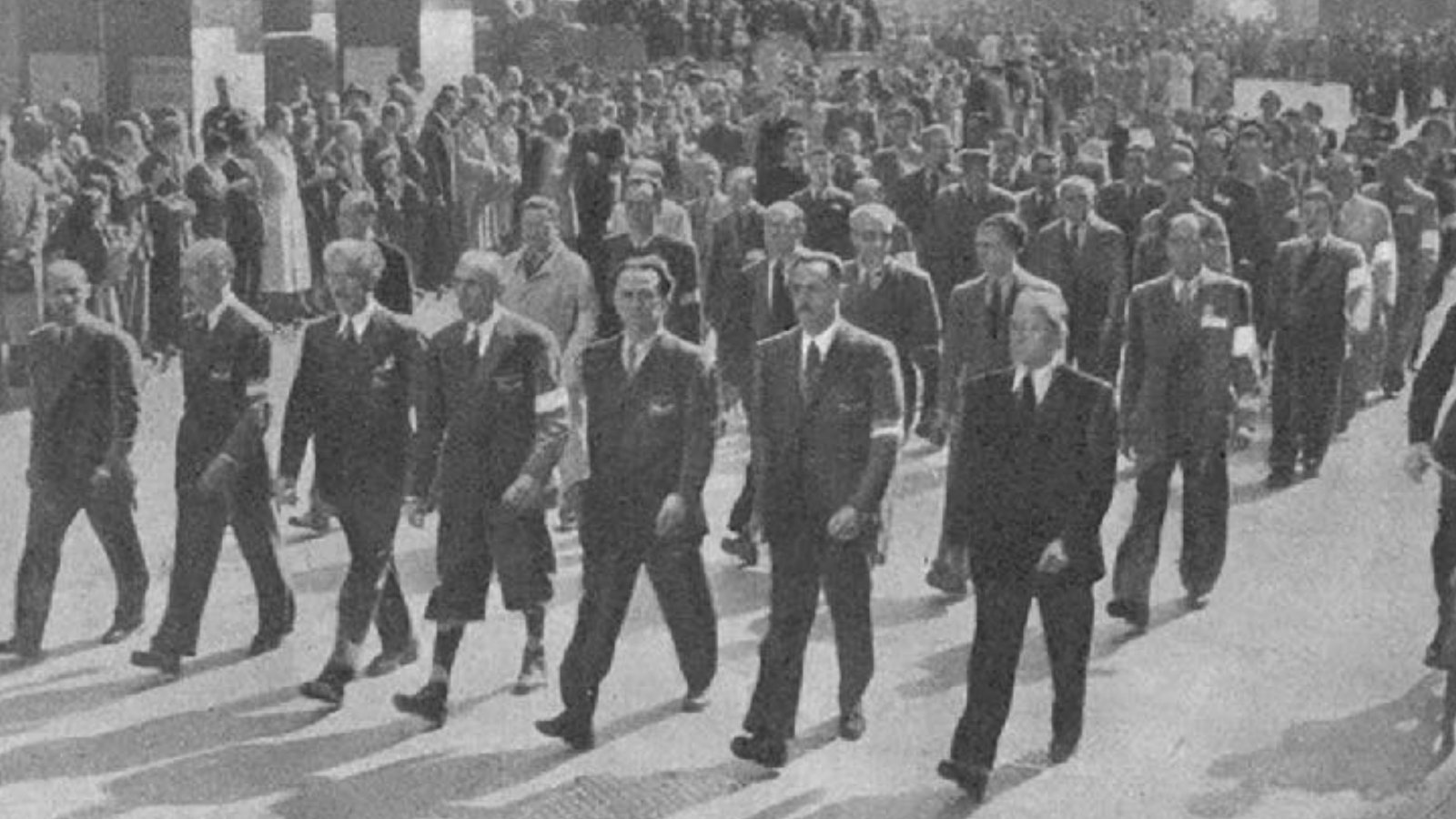
Then came the war. He became a partisan in the Fiamme Verdi brigades, a commander in Lombardy, and organised the resistance like an entrepreneur, with method, discipline and real leadership. He was close to the Christian Democrats, who would lead the Republic from the post-war period to the 1990s, and respected by their key politicians. The charisma built during the war would carry him to dominate the world oil scene.
AGIP commissioner: the disobedience that founded ENI
With this background, in 1945 the government appointed him commissioner of AGIP. The mandate was clear: shut everything down and sell the assets. Mattei had a different idea and decided not to obey. So began the most important act of disobedience in Italian industrial history. Instead of winding up, without consulting the government, he started drilling under the Po Valley and in 1946 found methane fields there. They were huge and unexpected. He said nothing until he had certain, irrefutable data, and when he presented it, it was impossible for the government to close down what he had just found.
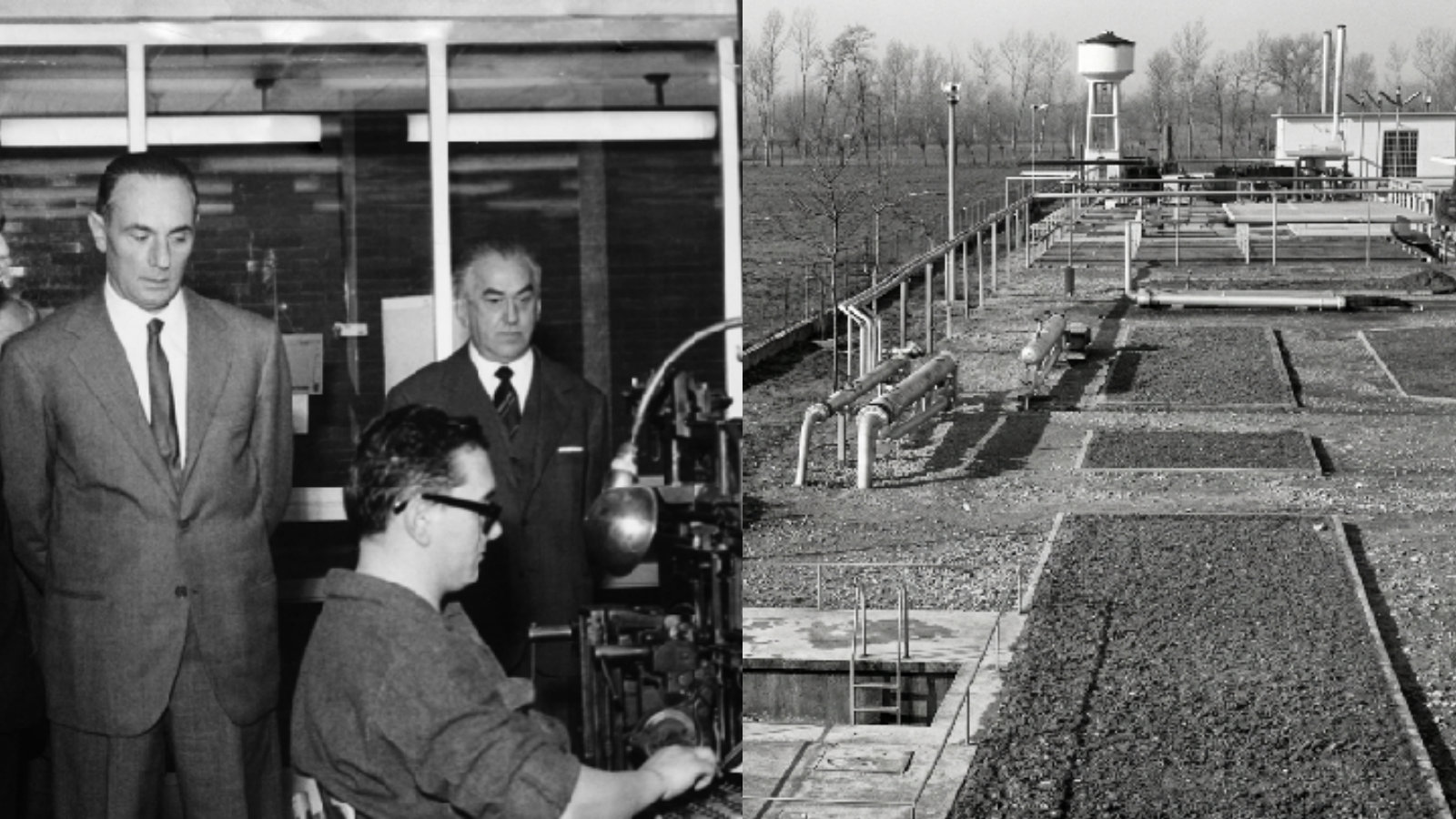
AGIP was not wound up. In 1953 Mattei persuaded Parliament to create the Ente Nazionale Idrocarburi, the state's energy arm. He was its first president and its only real operational commander, with carte blanche. He knew it, and used it systematically: in less than 10 years he turned a new company into the world's sixth-largest energy group.
An integrated supply chain: from extraction to the consumer
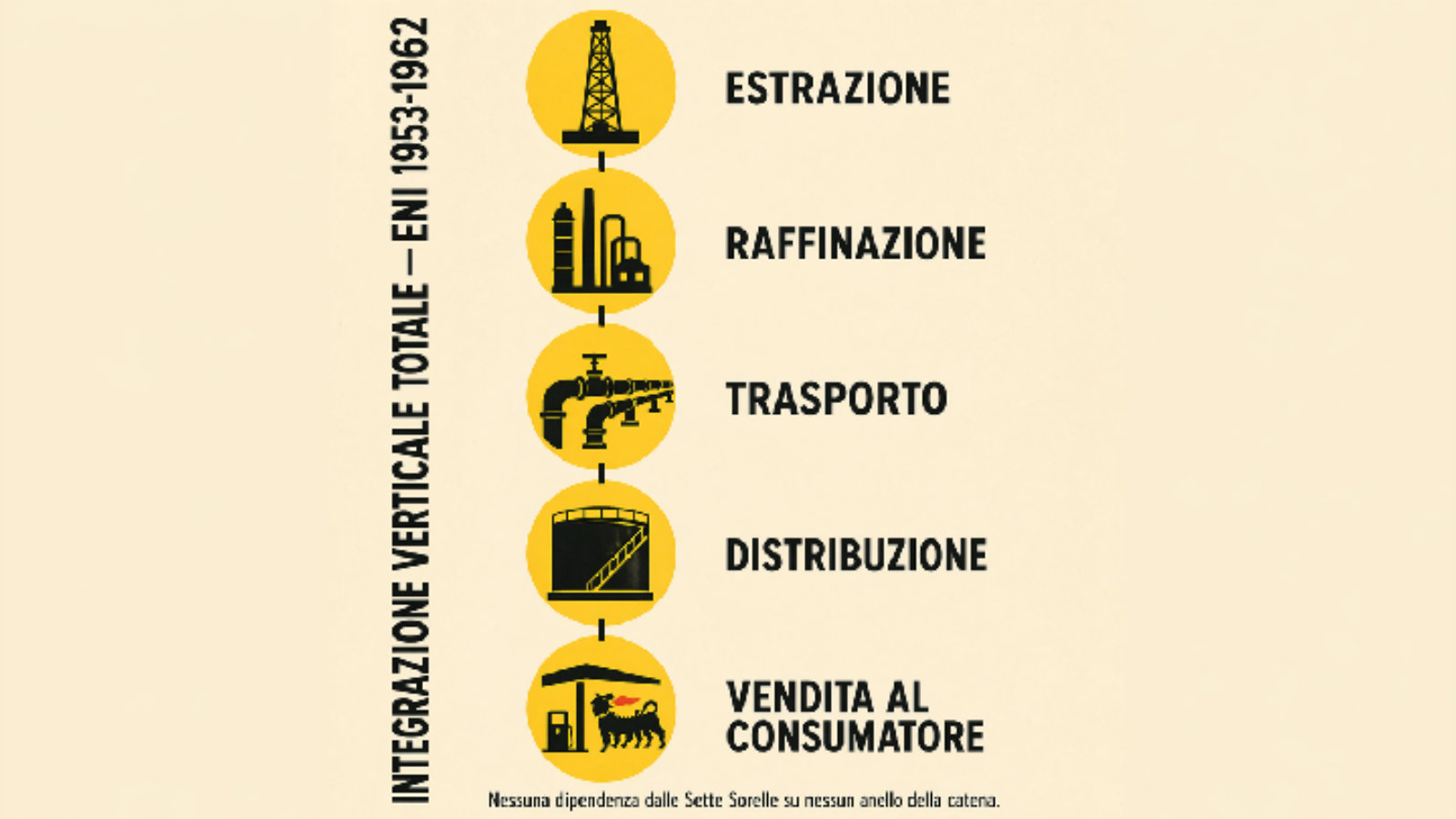
The most important strategic choice was total vertical integration. Mattei integrated the entire supply chain: extraction, refining, distribution and sale to the consumer. It is probably the first case in history of a move from a business-to-business sector to business-to-consumer. He built refineries, oil pipelines, gas pipelines and AGIP-branded service stations. In 10 years ENI was a complete, self-sufficient industrial system, from the source to the pump.
The brand: an idea of modern Italy
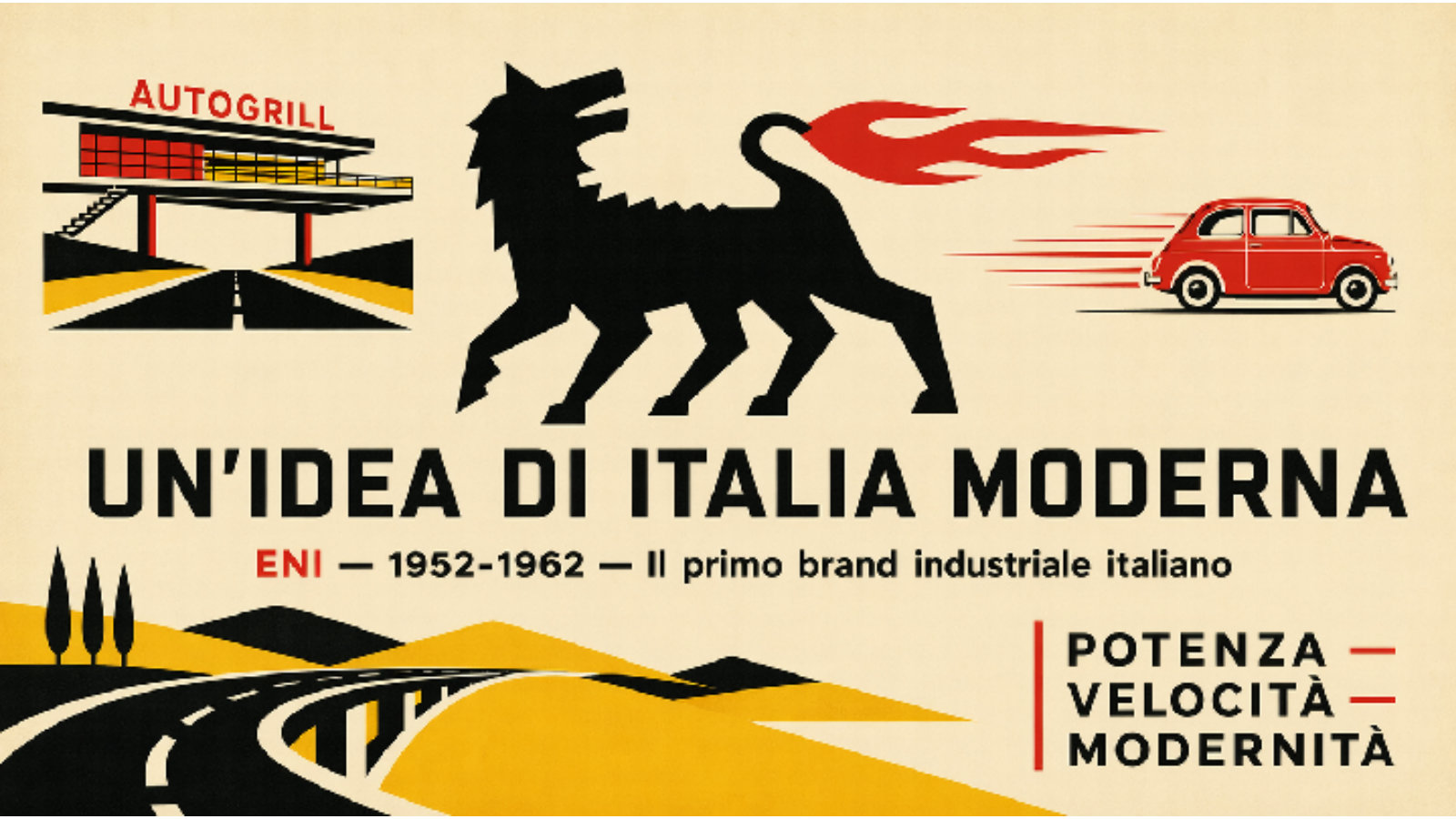
Mattei understood the value of a brand in a mainly industrial sector that was selling to the public for the first time. He created Italy's first global brand, the six-legged dog, a symbol of power and speed. He launched Autogrill on the Autostrada del Sole, which became an experience and not just a filling station. Italian industrial design entered the world of energy for the first time. As well as selling fuel, Mattei created a brand identified with the idea of a modern, competitive Italy rising from the ashes of the war.
How the six-legged dog was born
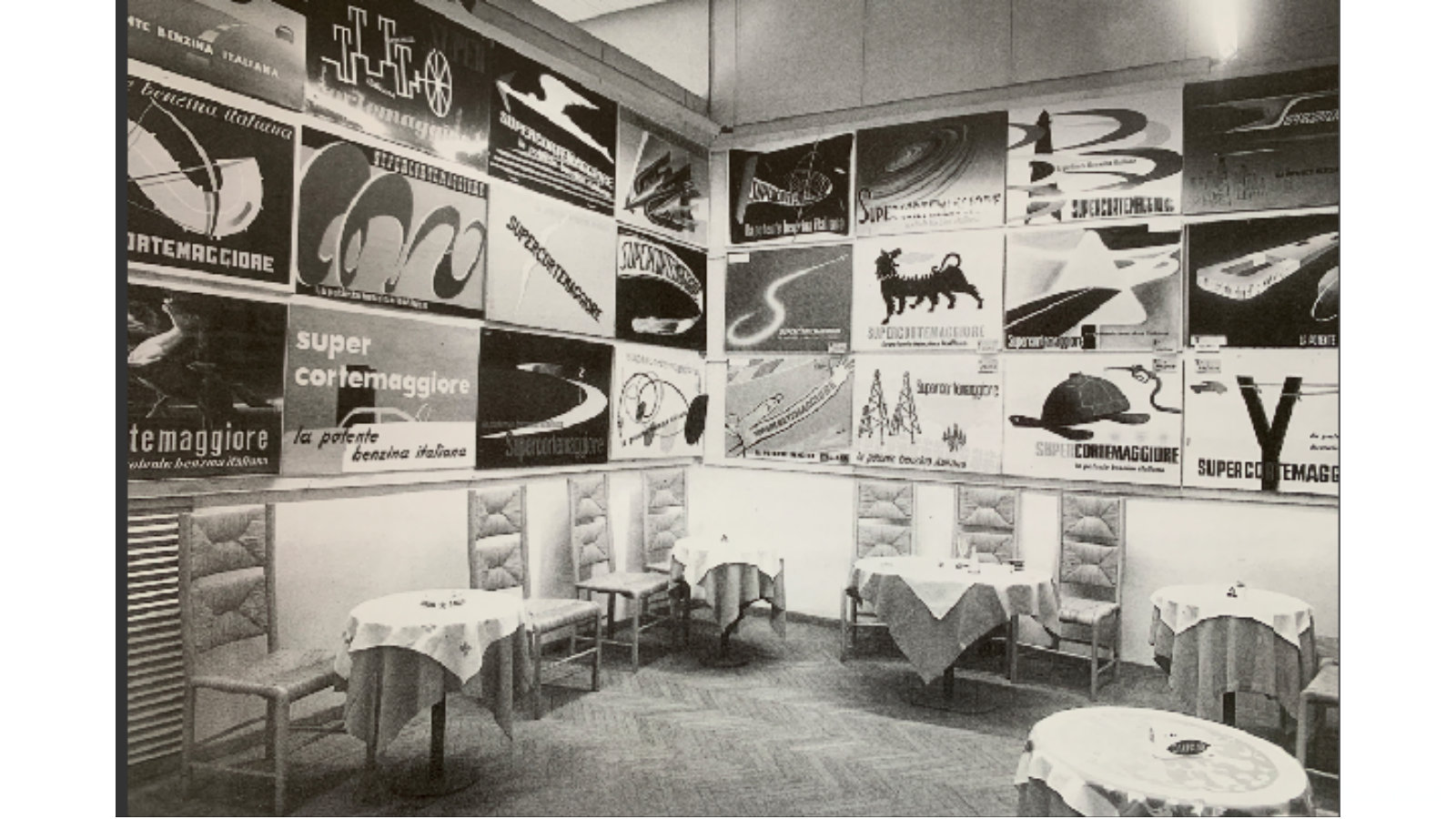
It was 1952, the year of the rebirth of Italian design and architecture, with Domus edited by Gio Ponti. Mattei launched a competition not for ENI's logo but for the brand of Supercortemaggiore petrol and Agipgas, two flagship consumer products, with their advertising posters. 4,000 sketches came in, spurred also by prize money of 10 million lire, a huge sum at the time, judged by a jury of the highest calibre: Gio Ponti, Mario Sironi, Mino Maccari, Antonio Baldini, president of the Rome Quadriennale, and the journalists Dante Ferrario and Silvio Negro.
The six-legged dog won, and it has two fathers. The first is Giuseppe Guzzi, a Milanese graphic designer, who took the prize money, moved to Argentina and vanished without trace. In 1983, 30 years later, the son of the sculptor Luigi Broggini revealed the true authorship of the logo, with the 1952 letter announcing the win. Historians will decide who is right. That logo is still one of the most powerful in the world.
Supercortemaggiore, the powerful Italian petrol, became AGIP's flagship product with the six-legged dog as its logo, and then came sponsorships across the board, all the way to Mansell and Prost's 1990 Formula 1 Ferrari. Fortunately nobody at ENI has ever thought of changing this historic logo, and I hope it stays that way for decades to come.
Il Giorno: the press as a positioning weapon
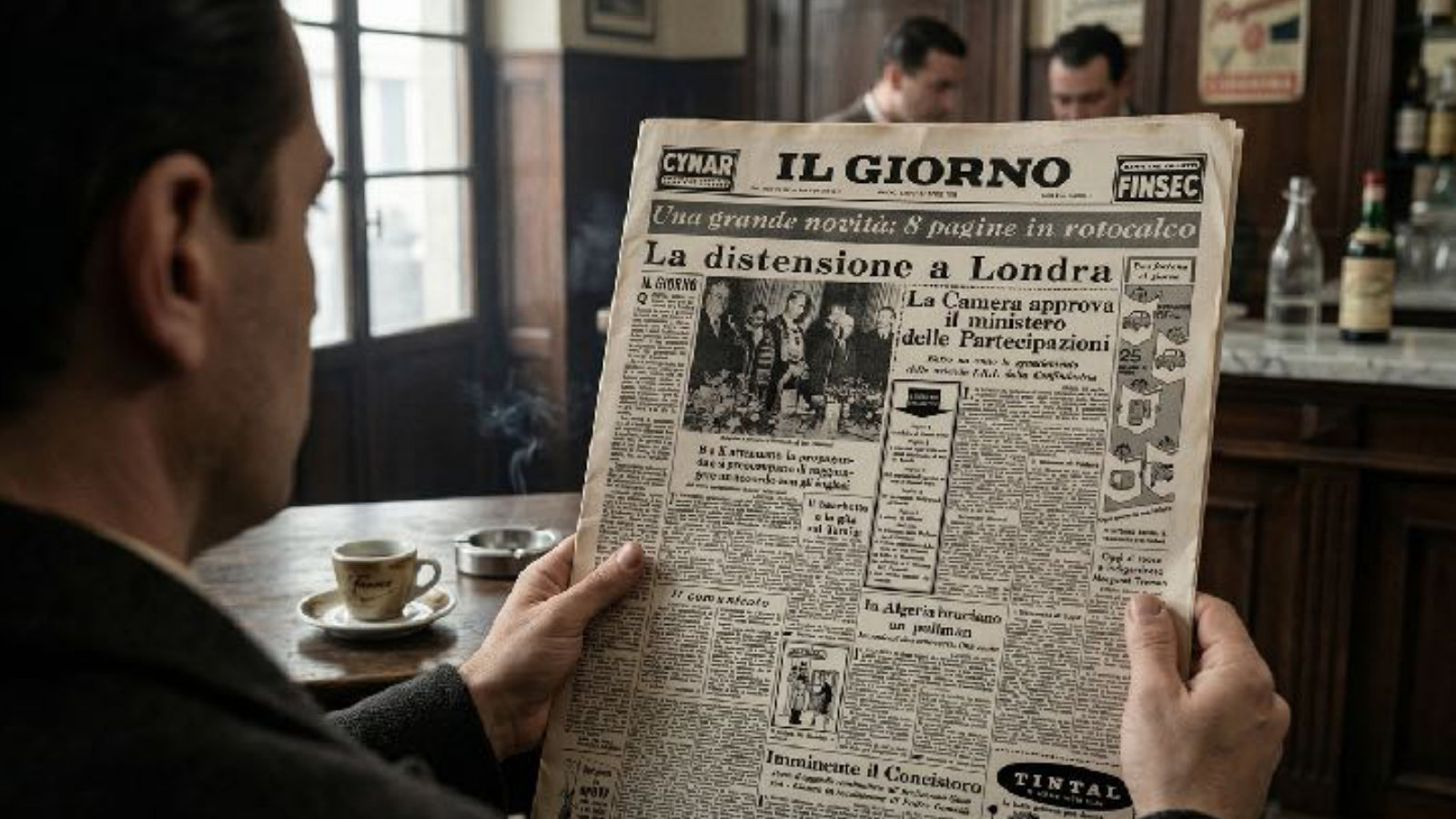
Mattei was not content with founding what would become the world's sixth-largest oil company. He understood that the world of communication was changing and that industrial power needed a public voice. In the 1950s the main source of information and influence was the printed newspaper, and in 1956 he founded Il Giorno, a Milan daily set up against a Corriere della Sera seen as too conservative, in its design and its positioning alike. A modern newspaper, with a new look and direct language, to build public consensus around his vision.
The idea is that whoever controls information controls the narrative, and the narrative is a decisive advantage in business. It's advice I give the entrepreneurs we work with too: never give up control of the narrative, inside and outside the company. Today you can do it with owned tools, such as a blog, a YouTube channel and social networks, and with non-owned ones, such as public relations. Mattei understood it before anyone else.
The model was London's Daily Express. The designer Giuseppe Trevisani created a layout that was an innovation for Italy: eight columns, a front page like a shop window, big lively headlines, a main photograph on the front page, short articles continuing inside, on the model of the British and American press. The first editor, Gaetano Baldacci, liked to tell his journalists that if they had produced a front page similar to the Corriere's, they should ask themselves where they had gone wrong.
Taking on the Seven Sisters and the 75-25 formula
From this ecosystem Mattei launched his challenge to the oil cartel that controlled the world: Standard Oil, Shell, Anglo-Persian, Chevron, Gulf, Texaco and Mobil, which held 90% of known reserves. An oligopoly that left no room for free-market prices, and that no government or private company had ever openly challenged.
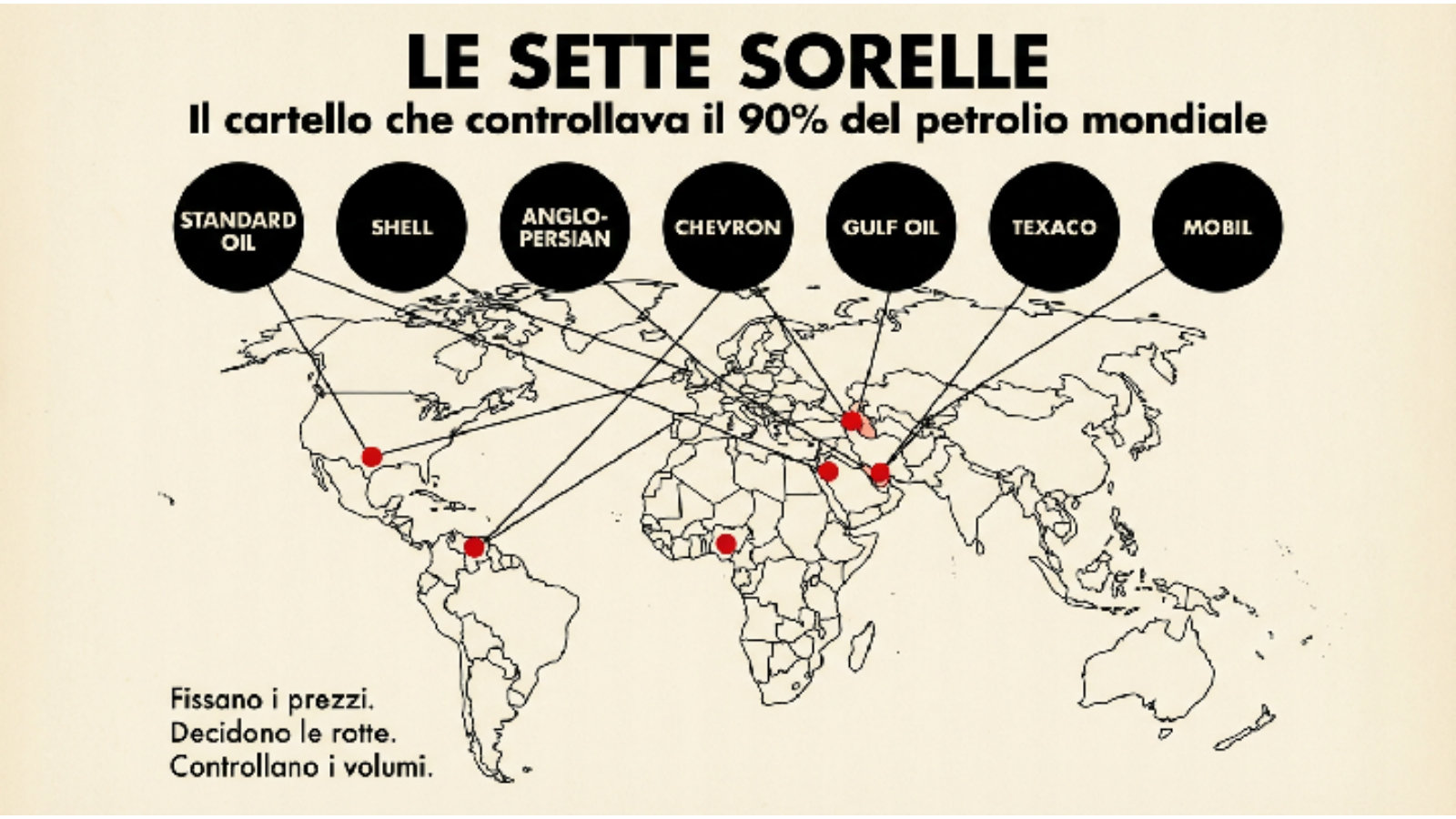
The Seven Sisters' business model was simple: they paid producing countries 50% of the profits, but they decided prices, volumes and routes. Iraq, Iran and Saudi Arabia were mere providers of territory and had to accept terms they could not refuse. It was economic colonialism disguised as a commercial contract. Those who didn't accept had no access to the international market.
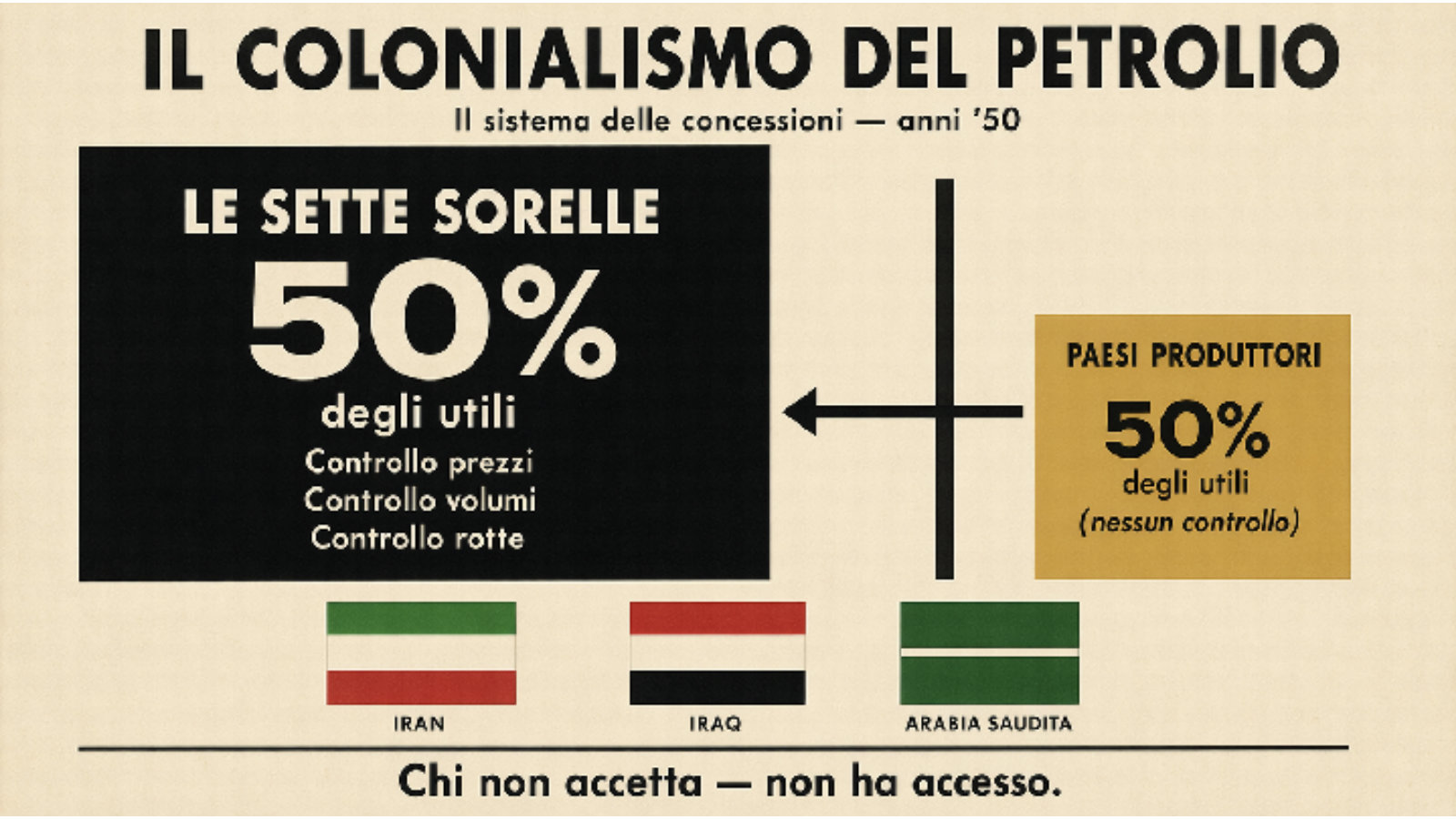
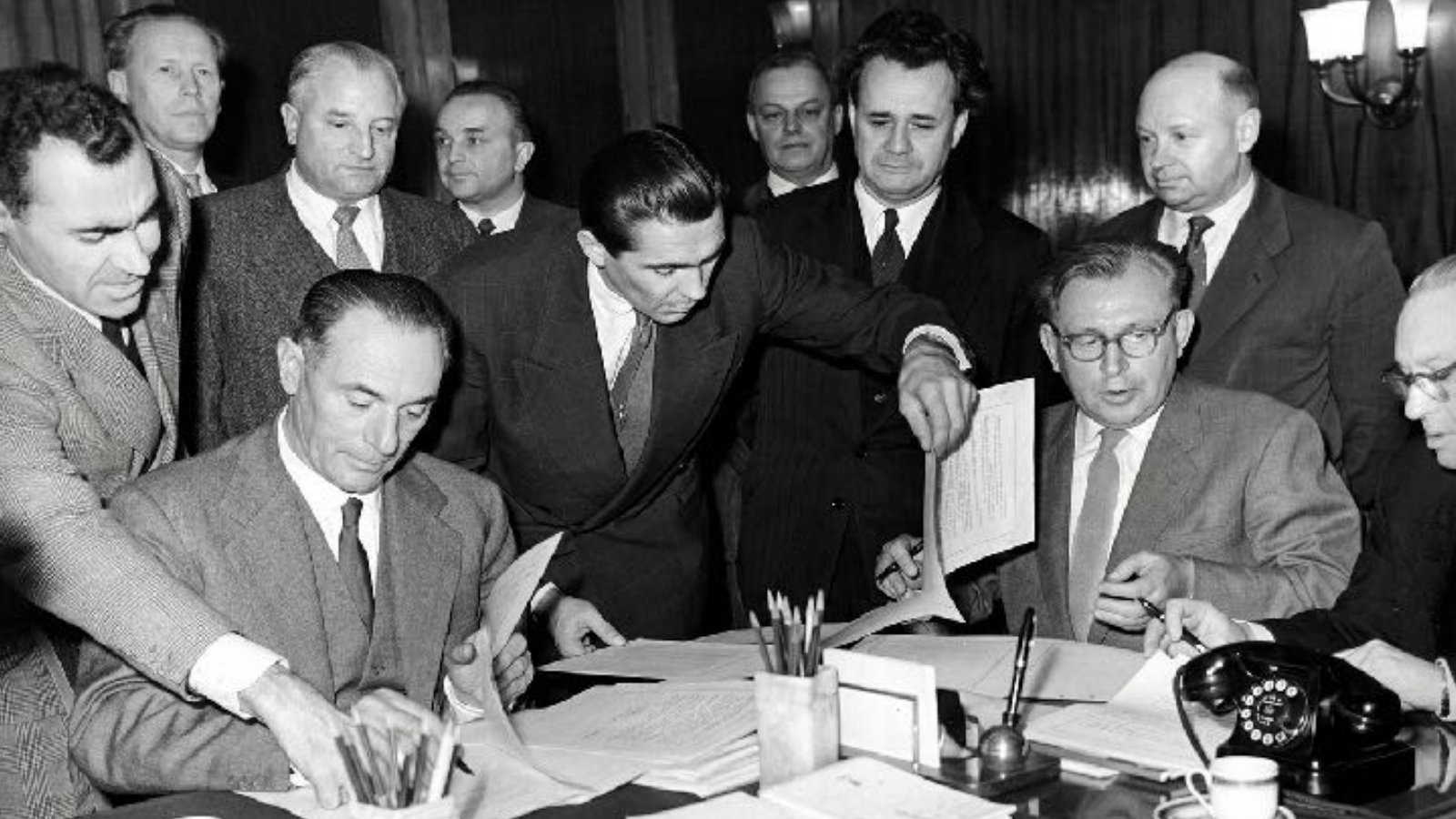
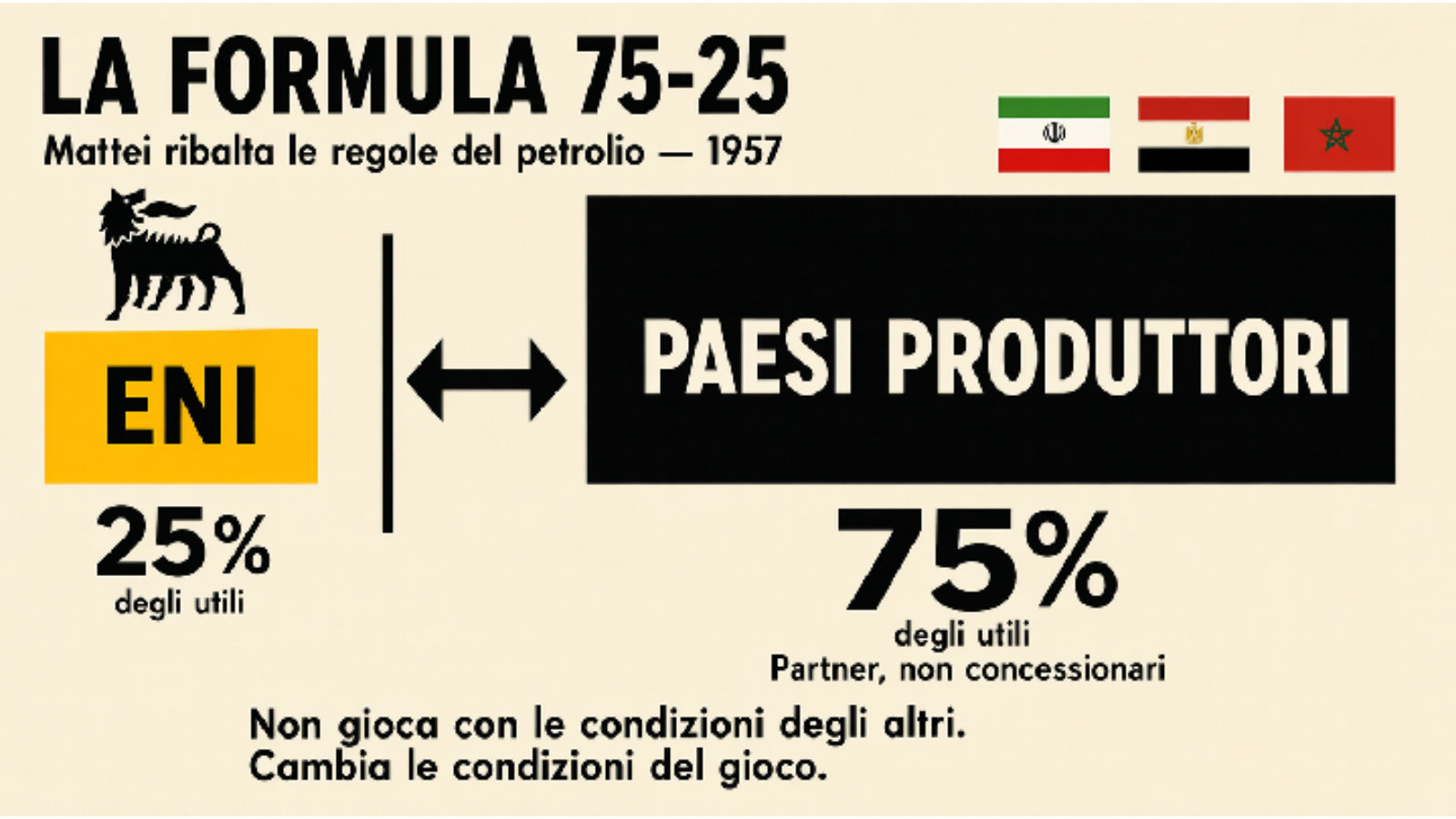
Mattei broke the rules of the game. He entered an oligopoly market and offered partners better terms: to Iran he offered 75% of the profits, with 25% left to ENI. Nobody had ever done it. The experts of the day considered it commercial suicide, but Mattei bought loyalty and access with structural generosity, and the 75-25 deal became the international standard within a decade. Even today Italy's diplomatic channels with Iran and with Libya, the most important file in our foreign policy, rest on the foundations Mattei laid.
To simplify the message for the general public he coined the term Seven Sisters, disparagingly. The slogan went viral before the concept of virality existed. The companies hated it but could do nothing about it: something opaque and unknown became a recognisable public target. Naming the enemy is the first step to beating it.
In 1951 Mossadegh's Iran nationalised its oil and was boycotted by the Seven Sisters: nobody would buy its oil. Mattei broke the boycott and bought it on his own. The Seven Sisters reacted by cutting off his shipping routes, and his answer was to build his own tanker fleet, so as to be completely independent in transport too.
1960: the deal with the USSR
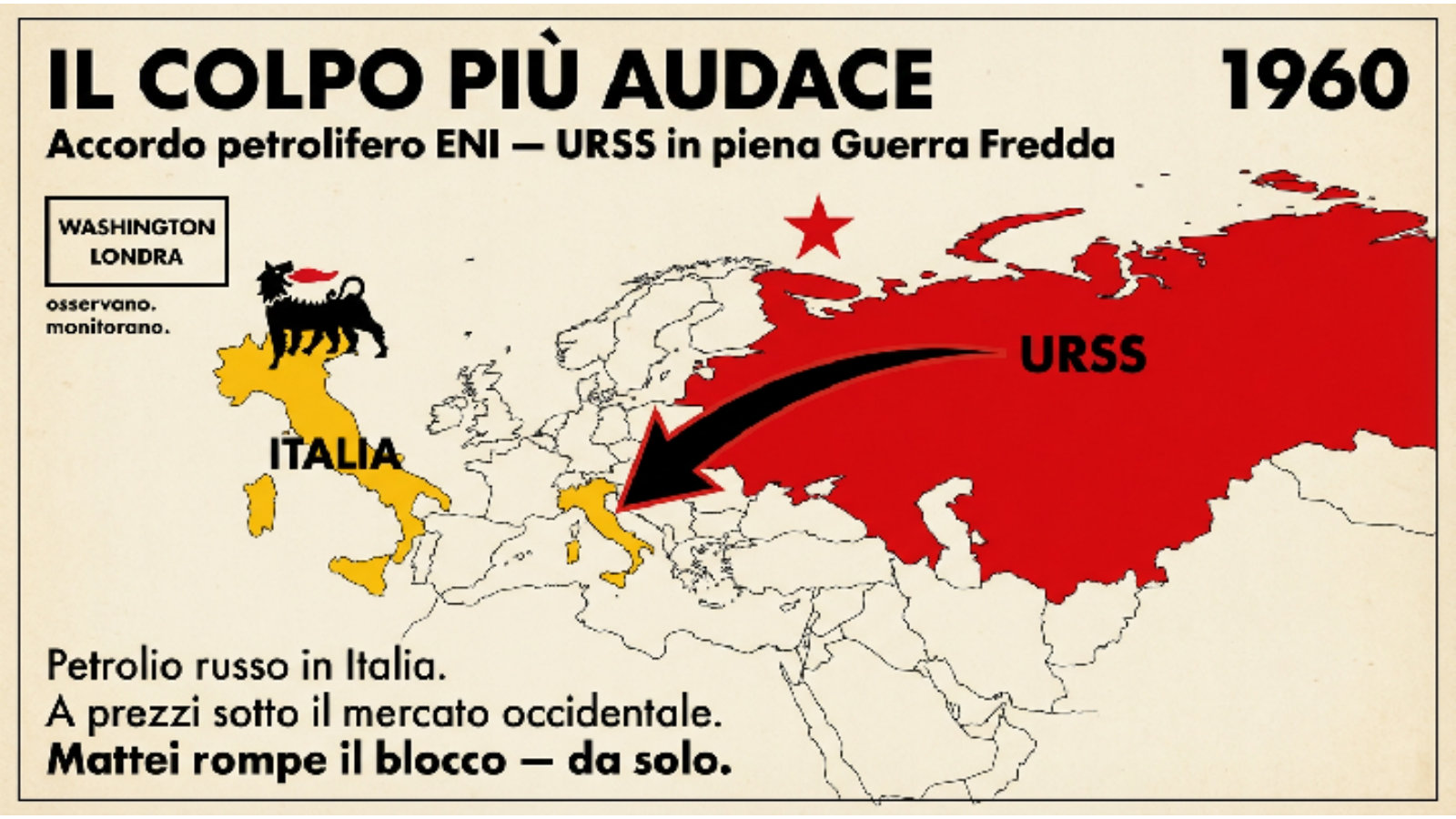
His boldest move was to go beyond the Iron Curtain. In 1960, at the height of the Cold War, Mattei signed a supply agreement with the Soviet Union and brought Russian oil and gas to Italy at prices below the Western market. Washington and London were furious and began monitoring him systematically. But his guiding light was the interest of ENI and of Italy, and he broke the Western energy bloc with absolute pragmatism.
The ENI model became a global contagion: India, Indonesia and Mexico studied it and wanted to replicate it, and Third World countries saw it as a way out. The Seven Sisters realised that Mattei had become an ideological reference point as well as a competitor. If the model were replicated on a global scale, their monopoly could collapse within a decade.
The Mattei method: speed, pragmatism, relationships
In a rare interview from the time, Mattei said that in its early years ENI had been “the kitten” up against a frightening mass of interests, which tried to smother it or keep it weak; little by little, working with tenacity, the group had become a great enterprise able to stand up to the coalition of oil giants.
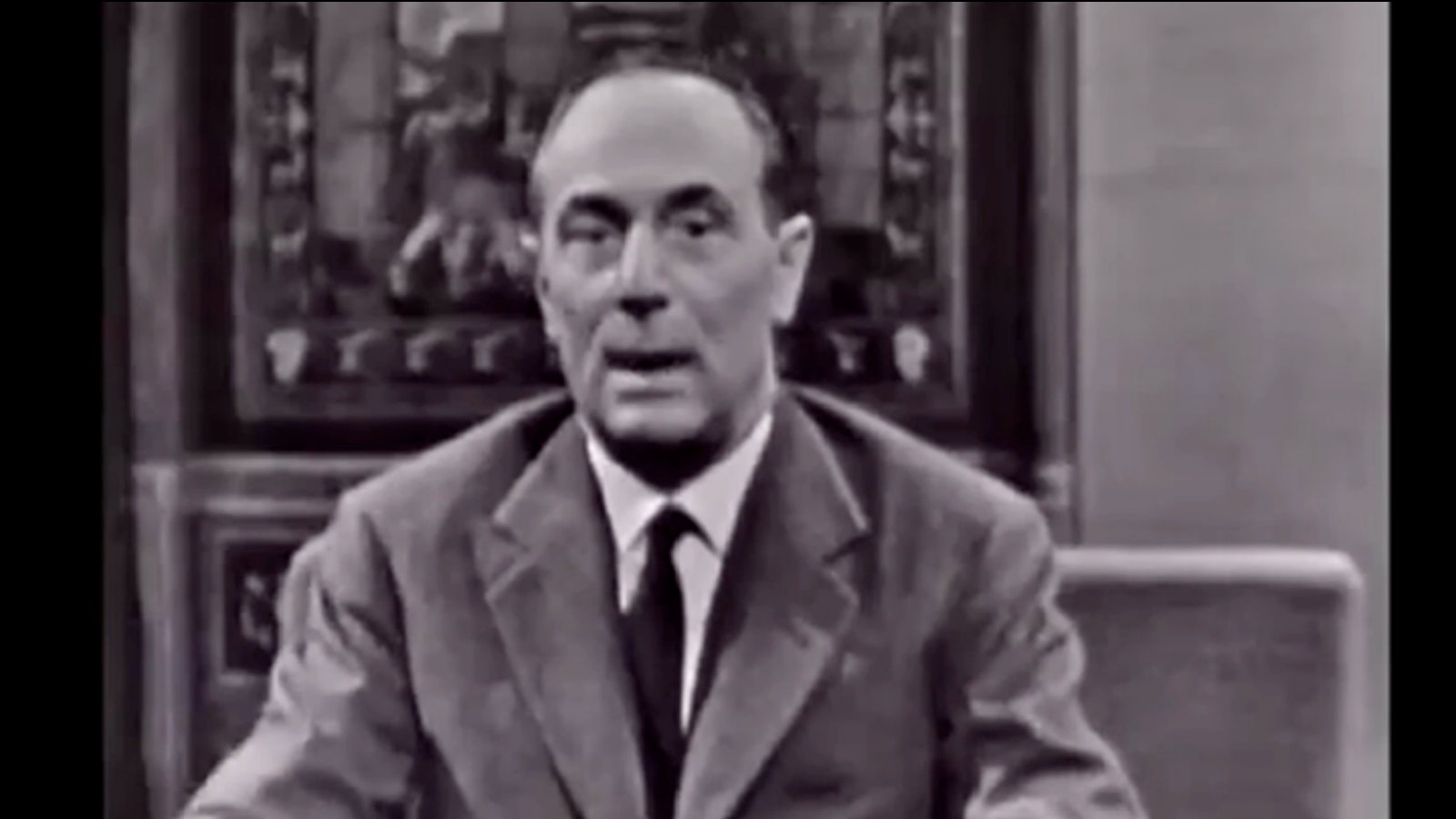
His method was speed and absolute pragmatism. He didn't wait for the committee: he decided and then informed, always in that order. He was constantly travelling, visiting 20 countries in a year to build direct relationships with heads of state, bypassing traditional diplomacy. He trusted his instinct more than consultants, and speed of decision was his main competitive advantage. He was an exceptional negotiator, always better prepared than the other side. He used generosity as a strategic weapon. He knew when to get up from the table, and when he did, it was no bluff. The 75-25 was long-term competitive calculation.
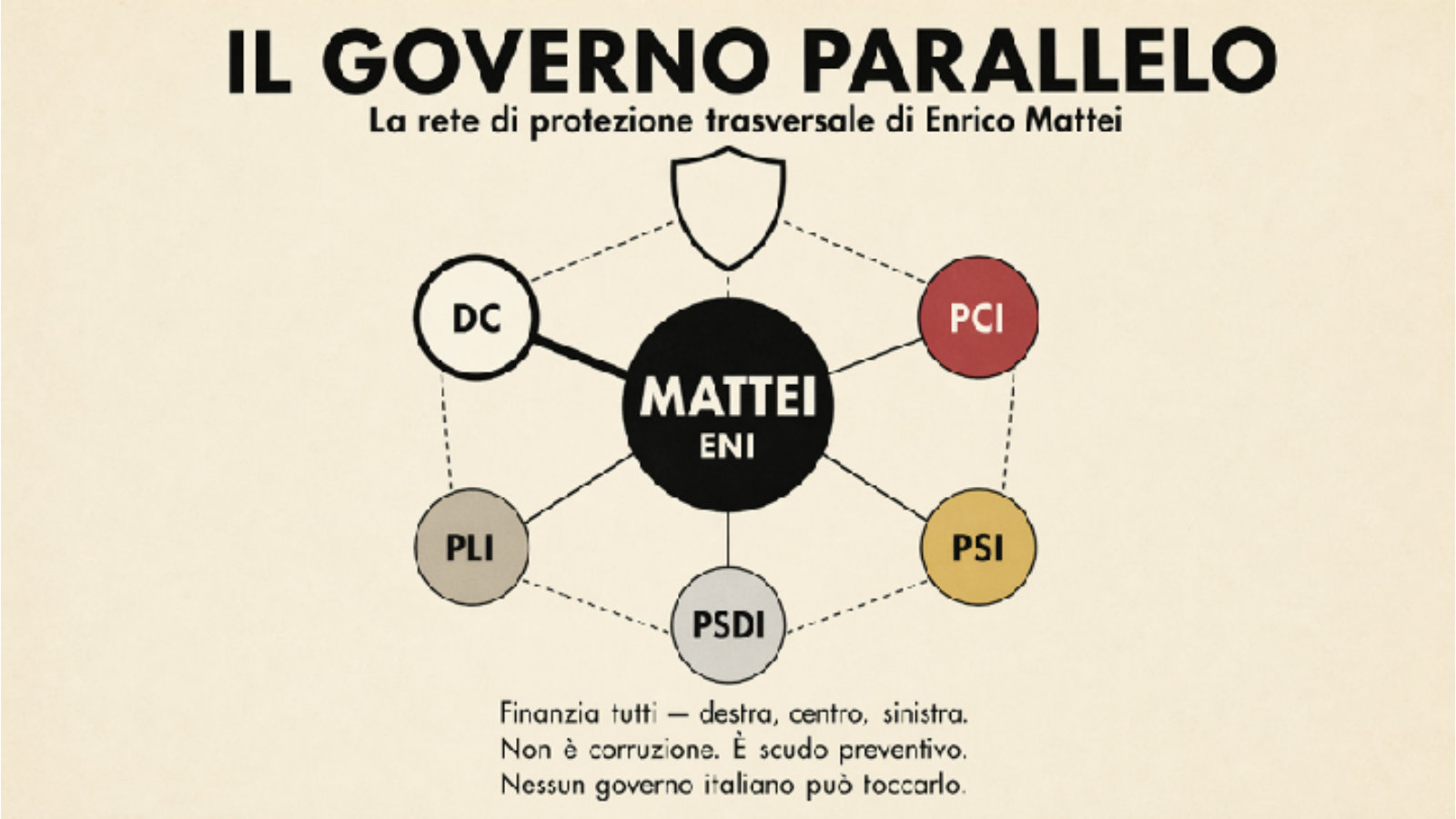
He was close to the Christian Democrats but depended on no party: he was cross-party by strategy. He funded politicians of every stripe, communists included. It was the construction of a pre-emptive protective shield. They called him the parallel government, and he never denied it. No Italian government had any interest in touching him, because the network he had built was invulnerable.
He flew the planes himself, with a civil licence, to get wherever he had interests. Speed of movement was an integral part of the strategy, and the plane, customised with the six-legged dog, was the symbol of his independence from everything and everyone.
For the workers he created a welfare system tied to ENI: houses, schools, hospitals for employees and their families. He paid wages above the industry average, dealt with the unions respectfully, and employees felt part of a national mission. Welfare was an investment in loyalty and productivity.
The enemies
He had plenty of enemies. The Seven Sisters, first of all: his deals cost them billions of dollars every year, and producing countries began renegotiating with them too. Mattei was a dangerous alternative model. Eliminating him became an economic necessity for the system. Then the Sicilian Mafia: ENI wanted the subsoil of Sicily, where there was oil, and judicial investigations would bring to light local, political, Mafia and American interests intertwined in murky ways. Not everyone in the DC loved him: he was too independent to be controlled, ENI's power exceeded that of many ministries, and he had too many fronts open at once. He was perhaps the most powerful man in Italy. And after the agreements with the Soviet Union, unacceptable to the CIA at the height of the Cold War, Washington saw him as a destabilising element in the Western order: relations between Italy and the United States cooled and American intelligence opened files on him, declassified decades later.
1962: the peak and the end
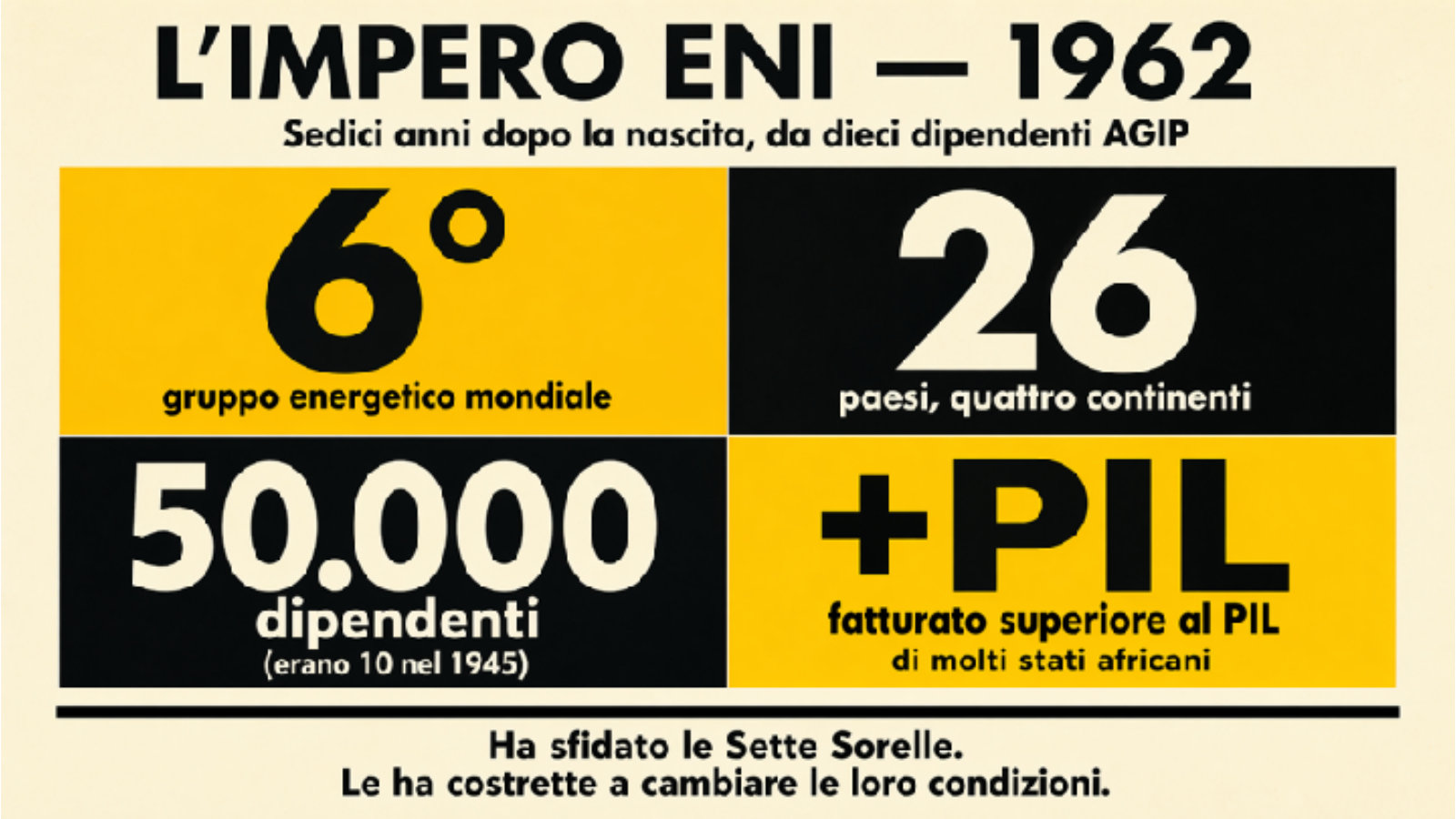
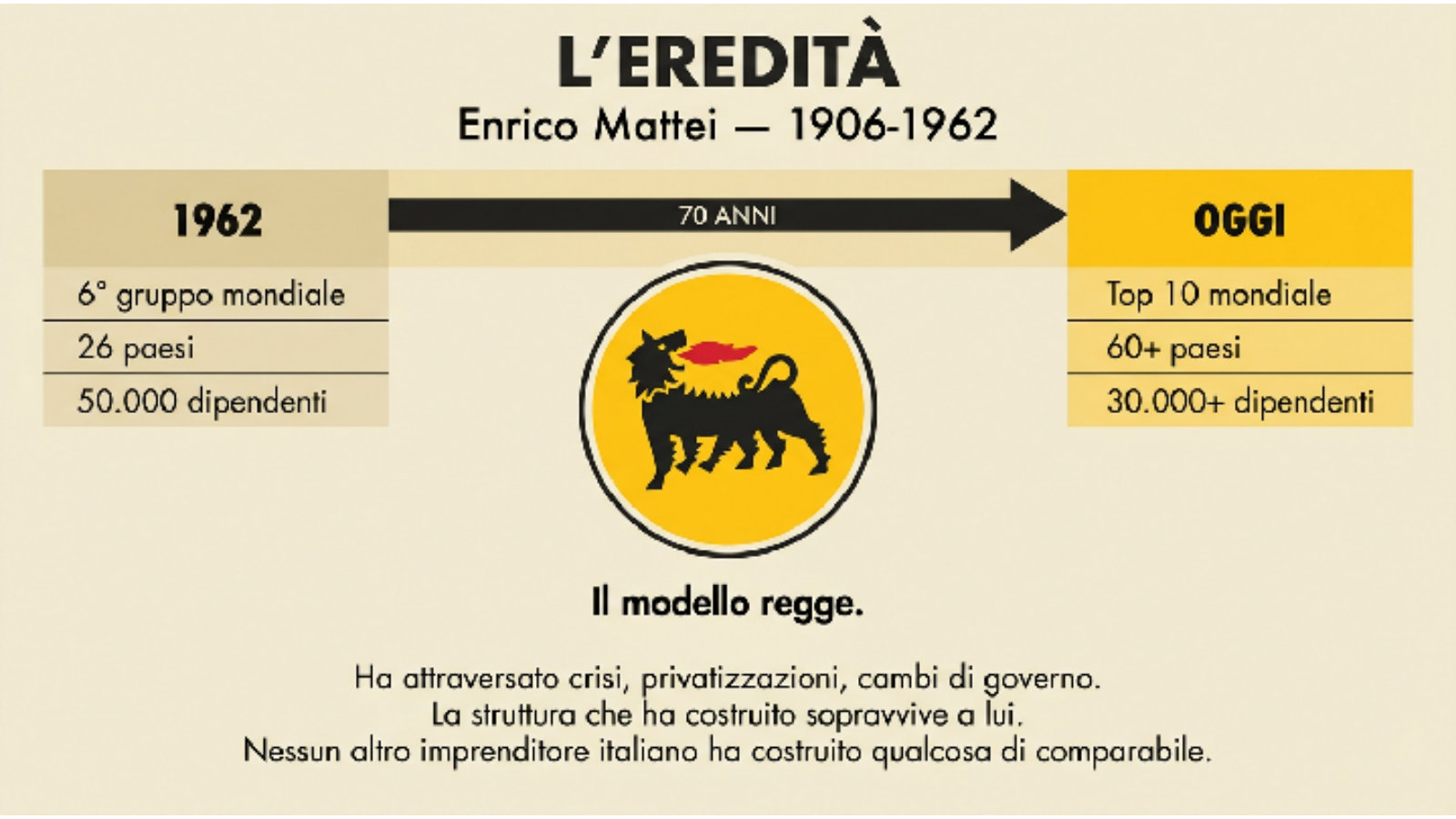
1962 was the year of the peak and the year of the end. ENI was the world's sixth-largest energy group, started from nothing 16 years earlier, operating in 26 countries on four continents, with 50,000 employees against AGIP's 10 in 1945, and a turnover greater than the GDP of many of the African countries it had signed agreements with. All this built by taking on the Seven Sisters and revolutionising the sector's commercial agreements.
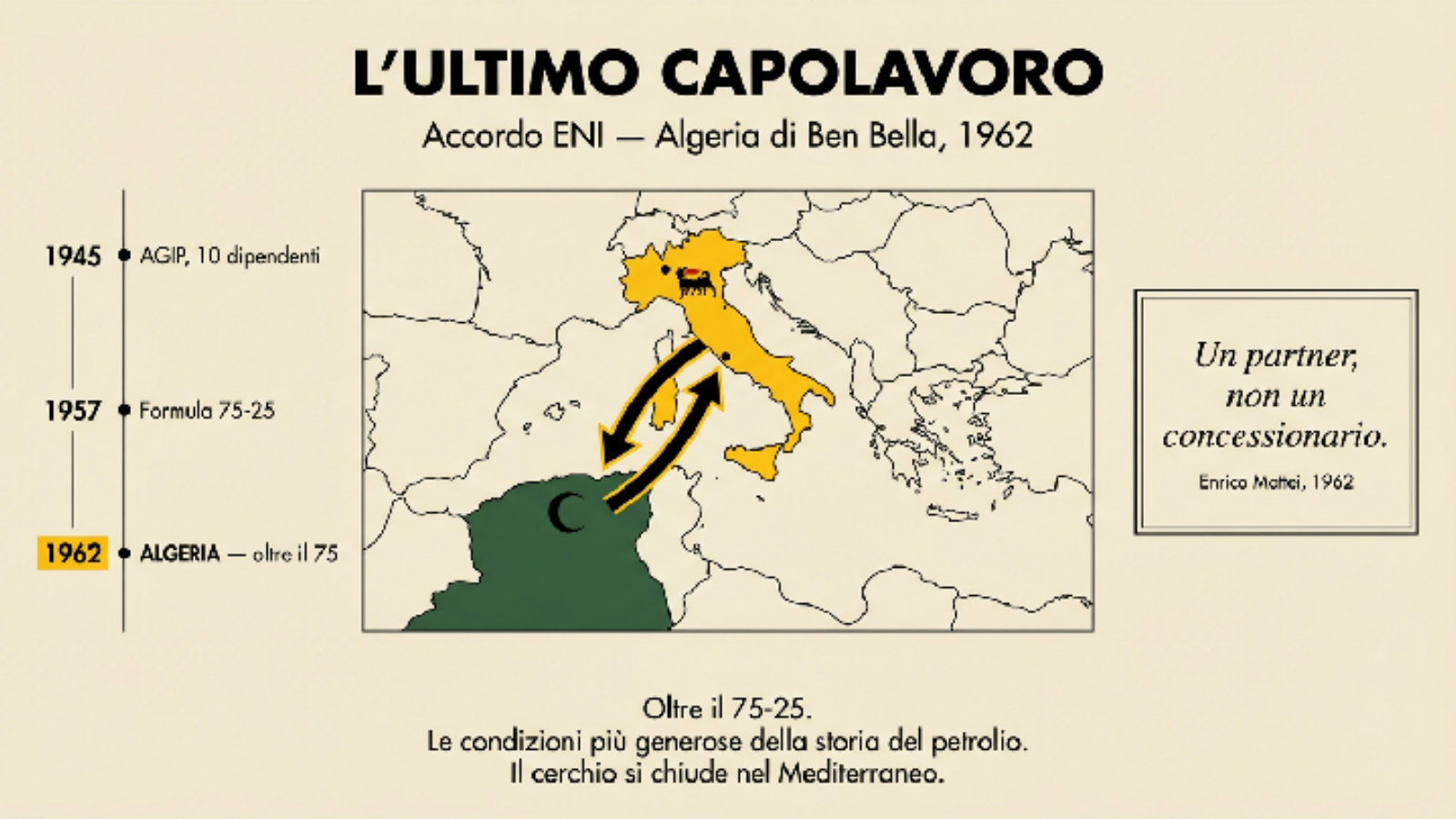
His last masterpiece was the agreement with Algeria, newly independent from France after years of war. Ben Bella was looking for non-colonialist allies and Mattei was the natural candidate: he offered terms even more generous than 75-25, playing in France's near abroad. The agreement projected ENI into the southern Mediterranean and crowned his African strategy.
In the months before his death the pressure mounted. In the summer of 1962 he received increasingly explicit anonymous threats. His entourage asked him to fly less and he refused: he would not change his habits out of fear, and he was personally negotiating new agreements with Algeria, the Soviet Union, Tunisia and Nigeria. He had too many powerful enemies at the same time. Perhaps he knew it, but he didn't stop.
Bascapé, 27 October 1962
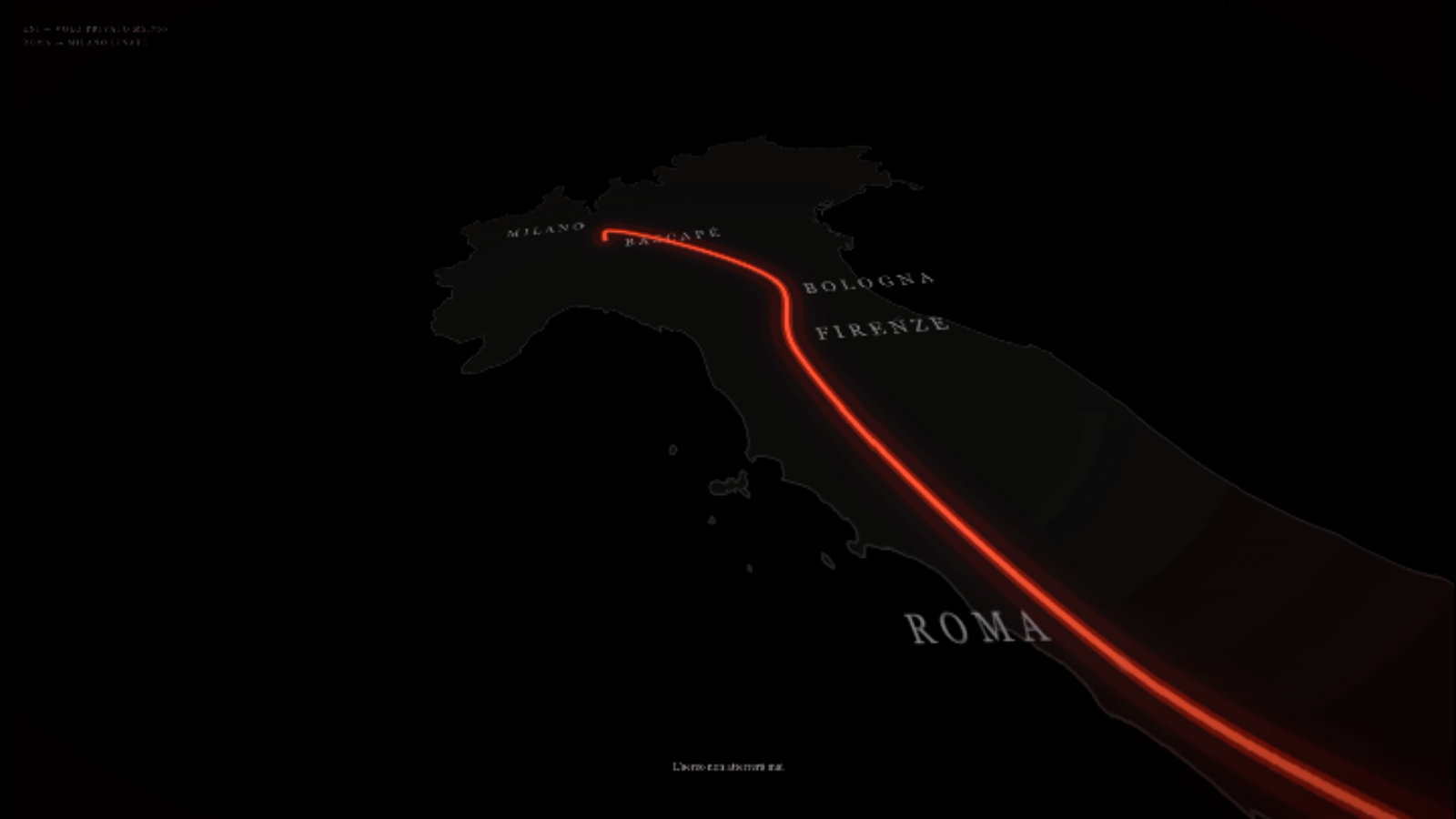
On 27 October 1962 Mattei was in Sicily visiting ENI's wells. In the afternoon he met the local authorities and in the evening, in a sudden, unplanned change, he decided to fly back to Milan that night. At 18:57 he took off from Catania. The plane never arrived: it disappeared from radar at 19:05 near Linate, and the wreckage was found at Bascapé, 20 km from the airport. The impact was vertical; the plane had nosedived, not glided. Mattei, the pilot Bertuzzi and the American journalist McHale were killed. The authorities spoke of a technical fault, but nobody really believed it.
Three investigations followed. The first, in 1962, closed the case as an accident caused by an unspecified technical fault. In 1994 the remains were exhumed and experts found traces of PETN, a military explosive, in the fuselage, and the case was reopened as murder. In 2003 the Pavia prosecutor's office closed it without convicting anyone: perpetrators unknown. 60 years on, nobody has answered for his death. The scenarios, explored in films and books, are three: Cosa Nostra, which had direct interests in the oil at Gela; Washington and the American intelligence services, because of the deals with the USSR; the Seven Sisters, to remove the problem at its source. The answer is probably a mix of all three. The Mattei case is the greatest industrial mystery in Italian history, and it is still open.
There is also an awkward witness. In 1970 the journalist Mauro De Mauro was investigating Mattei's last day in Sicily for Francesco Rosi's film and discovered something he was not supposed to find. In September 1970 he was kidnapped outside his home in Palermo and never found. Another victim of the same story.
The legacy
ENI is still among the world's top 10 energy companies, operates in more than 60 countries and is Italy's most important company, with more than 30,000 employees, listed and partly privatised. It has come through crises, privatisations and changes of government, and the model holds. No other Italian entrepreneur has built anything comparable starting out self-taught, as a salesman, from an AGIP with 10 employees that the government wanted to close. And no successor has ever touched the six-legged dog.
The 75-25 principle became the international standard for the industry. Partly thanks to Mattei's push, OPEC was born in 1960, and today producing countries control their own resources: the rules of the game he changed have never gone back, and his model inspired the economic decolonisation of a generation of countries. Mattei's public memory rests on Francesco Rosi's film, The Mattei Affair, winner of the Palme d'Or at Cannes in 1972, with Gian Maria Volonté in a legendary performance. The film reopened the debate about his death when politics preferred silence.
Lessons for today's entrepreneurs
1. When you feel you're right, disobey
Mattei had an explicit mandate to close AGIP and he disobeyed methodically: he brought the data before announcing his disobedience. Strategic disobedience requires vision and the courage to act. If you wait for permission to do great things, you'll never do them. The difference between those who build and those who execute is exactly this choice.
2. Work on the terms
Mattei won by offering producers structurally different terms, without betting on cheaper oil. He changed the paradigm so as not to play by other people's rules. Lowering the price would have been a strategic defeat; he redrew the commercial terms.
3. Build alliances before you need them
In our small companies too we have to build alliances with strategic partners, suppliers, customers and lenders, creating an ecosystem of relationships to use in the good times but above all in the hard ones. A network of relationships is the invisible moat no competitor can copy.
4. Brand is strategic power
The six-legged dog, Il Giorno, Autogrill, AGIP stations: Mattei created an ecosystem of brands and symbols. A brand creates identity, a place in people's minds, a barrier to entry. Along with fuel he sold an idea of a modern, sovereign Italy. Positioning comes before marketing and is a long-term competitive strategy. Without a brand, all you have is a price. Those who build a brand at the high end go and win the best customers and generate margins above the industry average.
5. Speed is a real competitive advantage
Mattei moved faster than any state or corporate bureaucracy: he decided, acted, then informed. The Seven Sisters had more resources and more capital; he had speed on his side. In many markets speed of execution beats available capital. Those who wait for everyone's agreement always arrive late.
6. When you become too dangerous, you need to know it
This lesson cost him his life. He did not weigh the risks clearly enough: too many open enemies at once. Growing defensibly is more sustainable than growing exposed. Protection is built while you grow, before you reach the peak.
What kind of Mattei are you?
You probably also operate in markets where the big players seem unbeatable. Mattei's answer was to change the rules of the game. So the question to ask yourself is how you can change the rules of the game.
The other pillar is premium positioning as an act of courage: choosing not to be the cheapest option. Premium comes from a deep knowledge of your real value. Those who position well compete on category.
The ultimate goal is to build something that lasts. ENI still exists after 70 years, the six-legged dog is still there, untouchable, the rules Mattei changed are still in force. Something that outlives you: a company that can stand even without you, beyond next month's or next quarter's turnover. At the start you have to work inside it and be its protagonist; then you have to start looking at it from above as it grows, and make it last beyond your own generation, whether you then decide to sell it, list it, leave it to your children or hand it to managers.
Frequently asked questions
What is Mattei's 75-25 formula?
It is the deal ENI offered Iran in 1957: 75% of the profits to the producing country and 25% to ENI, against the 50-50 imposed by the Seven Sisters, who on top of that decided prices, volumes and routes. Within a decade it became the international standard for the industry.
Who were the Seven Sisters?
The cartel of seven oil companies that controlled 90% of known reserves: Standard Oil, Shell, Anglo-Persian, Chevron, Gulf, Texaco and Mobil. Mattei coined the name, disparagingly, to give a recognisable target to an opaque power.
How did Enrico Mattei die?
On 27 October 1962 his plane, which had taken off from Catania, crashed at Bascapé, near Linate. The first investigation blamed a technical fault. In 1994 traces of PETN, a military explosive, were found and the case was reopened as murder. In 2003 the Pavia prosecutor's office closed it with the perpetrators unknown.
What can an SME learn from Mattei?
To compete on terms and on category rather than on price, to build a brand as a barrier to entry, to form alliances before you need them, to decide faster than richer competitors, and to build protection while you grow.
One live webinar a month.
One topic, questions from the business owners who join, answers without sales slides. It's free and in Italian, and it's the simplest way to get to know us.
See the next webinar →